

The Turret Journal — Essay III
The complete history of the Adams Pragge House at what is now 1028 Tyler Street had been forgotten – within its walls, in the papers passed down with it, and in the records of the city that once knew it.
It seemed everyone we met had a story:
“I rode a claw foot tub in through a second-floor window” (our former coffee roaster)
“I loved playing around the little koi pond that used to be there” (a woman who attended an Adams Pragge House event)
“My buddies and I would run through this yard to hide from the cops” (the man we bought a marina staircase from)
Aside from general information about the previous two owners and the photos and papers they left, dating back to the early 1960s, we also had
awareness that military couples were housed there during World War II and that the San Juan Baptist Church was founded in the parlor;
murmurings that when many of the grand Victorians fell into disrepair in the post-war recession years, the city considered burning the house as practice for fire fighters;
a 1942 Christmas card found deep in a pocket door;
an empty pack of Marlboro cigarettes and bag of Cheetos, 1970s-era, found on the attic floor up in the Witch’s Hat; and
published recountings of ghost stories our own experience cannot confirm.
But these were the familiar fragments of more recent history. And like the ghost stories, the record did not hold, and it did not resolve into a coherent history.
Joseph and I moved into the house in late May 2022. For nearly two full years after that, Joseph worked almost obsessively to research and reconstruct the full ownership history of the property and flesh out the lives of its inhabitants.
City property records provided a partial sequence of names. Newspaper notices in the Leader archives and the earlier Argus archives filled in occasional details. The Jefferson County Historical Society, whose collections represent a remarkable act of sustained local stewardship, held biography files, and helpful staff showed us big, leather-bound account logs from the local pharmacy detailing what one had bought over time and other carefully preserved objects. Among them another inhabitant’s beaded 1920s-era tea gown.
But the information on the house itself in the Historical Society records was thin, and biographies didn’t fully attach to it. Some of what we found was inaccurate or misleading but, nevertheless, retained as part of the history of the house.
Even the name it had colloquially gone by for some sixty years, under which it was established in the digital age — the Captain John Quincy Adams House — was factually incorrect and took us a year to unravel.
Joseph pored through every photograph in the Historical Society and University of Washington online archives connected to Port Townsend and its inhabitants — whether they seemed relevant or not — hoping to catch even just a glimpse of the turret in the background of a wider shot or a face that could help place one more piece in the puzzle. He scoured — and we sometimes purchased — city directories found in antiques stores or auctions near and far.
Individual names slowly settled into their place within the house and the life of the town, but gaping holes remained in its earliest history.
I found this difficult to reconcile with the house’s prominence and the role it had been intended to play within Port Townsend’s grand project of civic ambition — entire neighborhoods of gracious houses laid out and marketed to attract the wealthy class that would make this corner of the Olympic Peninsula what its promoters believed it was destined to become: Key City, the City of Dreams.
The largest of those holes, as it turned out, was also the beginning:
The original owners.
The family Albert Adams dreamed would arrive to make him a wealthy man when he built the house on spec in 1889.
They were the last piece to fall into place. And when they did for us, finally, in the winter of 2024, the shape of the history resolved differently. And with it, our perception of our own role as its stewards changed.
The family came to our awareness — as one always does — through his name: Charles Intermela.
But it was the revelation of her that changed everything.
She carried several names across her life, as women of her time and circumstance often did.
In the territorial census of 1871, two letters would be placed by her name.
I will come back to those letters.
The name I will start with — distinct from the names of the men who made, raised, or sheltered her — is Julia.
Julia was born in Seattle on June 12, 1855 — before Seattle had become a city, at the precise moment it was being invented.
Her father was Henry Leiter Yesler, the entrepreneur from Ohio who arrived in the region in 1852 and established the first steam-powered sawmill on Elliott Bay. Almost immediately, Yesler’s mill became the economic spine of the settlement, its long chute of greased logs running down Mill Street to the lumbermill at the waterfront and giving the street a colloquial name so precise for its moment and flexible to its future — Skid Road, Skid Row — that it remains an established part of the American lexicon and even has been the subject of Broadway musical songs. When Washington Territory separated from Oregon in 1853, he was appointed county auditor. He would later serve three terms as King County commissioner and twice as Seattle mayor. He was Seattle’s wealthiest resident in his lifetime. He built the city’s first water system. He helped build Seattle itself and then dug in again to help rebuild it after the Great Seattle Fire of 1889. Skid Row is now Yesler’s Way. His name attached to the city’s founding mythology so completely that it functions now more as landscape than biography. Ambitious and ruthless, complicated and unconventional, a capitalist who was nonetheless responsible for the city’s first library before it even had a university, free thinking and expansive yet maddeningly constrained to his time — Yesler was the Father of Seattle.
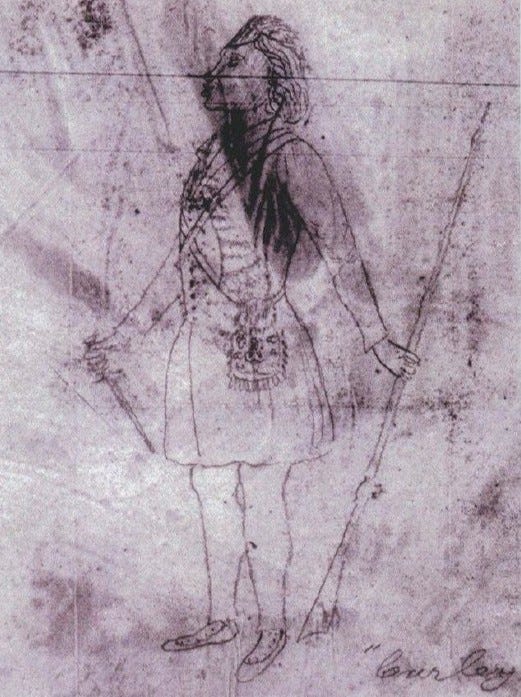
Julia’s mother was Susan Curley. Susan was the daughter of Suquardl, the Duwamish hereditary leader known to settlers as Chief Curley. Suquardl worked closely with Yesler, serving as foreman at the mill — a position that required him to move constantly between the world of the new settlement and the surrounding Duwamish communities, translating not just language but intention, absorbing friction before it could become violence. Susan worked at the mill with him.
This was not incidental. The Duwamish leadership understood, from early in the settlement’s life, that proximity to the men building this place was its own form of negotiation — that kinship with power was how a people without military advantage shaped what was coming. Suquardl’s role at the mill was part of that understanding. So was Susan’s presence within Yesler’s household. She was fifteen years old when Julia was conceived.
During the tensions that culminated in the Battle of Seattle in January 1856 — when Julia was seven months old, when the USS Decatur sat in the harbor with its guns trained on the town — Suquardl carried warnings between communities, working to contain what could not fully be contained.
Yesler himself recounted, for The Puget Sound Gazetteer (”The Daughter of Old Chief Seattle,” September 1888), how Suquardl was fishing in his canoe when he encountered an old woman on her way to Old Man House, on Chief Seattle’s reservation. She told him that the Duwamish Indians under Chief Claycum had gone with Chief Leschi and the Puyallup Indians to fight the people of Seattle, to wipe them out of existence. Suquardl brought this information to Yesler. Yesler took the report to Captain Guert Gansevoort aboard the Decatur.
A contemporary of Yesler’s from Indiana, Nicholas Sheffer, confirmed the story of Suquardl’s warning for The Lynden Tribune in 1909, and then, unprompted, gave us something more:
The Indians were pressing us pretty close and it was considered the part of wisdom to put the women and children aboard the war ship. I was in Seattle that day [January 26, 1856]. Mr. Yesler’s woman did not take kindly to the idea of going on the ship to live, but was at last prevailed upon to do it on account of the baby girl of which the father was very fond. Yesler was a good man, never making himself conspicuous, never crowding himself forward, but his opinion or advice when given was generally about right. He was not married to the Indian woman but when his wife came he did not do like many others, drive the girl back to her tribe. He provided for the Indian woman and looked out for her welfare and for that of his daughter by her. He gave the daughter as good an education as circumstances would permit. I had the pleasure of meeting the daughter about two years ago. She is married to a very nice gentleman who is one of the foremost citizens in the city and county where they live. She is a perfect lady and is respected by all who know her.
Susan was among those taken aboard.
The record leaves the moment there: Susan’s reluctance; Henry’s decision. On surface, a decision to protect. But the conditions surrounding it complicate that decision and illuminate the reluctance. The warnings Suquardl carried did not come from a distance. They moved through the same network of relations to which Susan belonged. To board the ship was not only to seek protection. It was to cross a line that had only just been drawn, and not by her. That she crossed it anyway — prevailed upon by Henry, on account of the child — tells you something about what the line cost.
Had the revelations about Julia’s lineage ended here, that alone would have been significant. But there was more:
Suquardl’s brother was Si’athl.
Chief Seattle.
Julia was the living fact of what those worlds had already made of each other — deliberately, strategically, at great cost. Her father, her grandfather, her great-uncle each shaped what Seattle would become. And the child — and the city — born at that intersection were what the shaping produced.
In the 1871 territorial census, the enumerator recorded her name and placed beside it two letters:
HB.
Half-breed.
Which is to say: the census knew what to do with Henry Yesler. It knew what to do with Suquardl. It knew what to do with Si’athl. And what it did with the child born at the union of those lineages was reduce her to a fraction.
When Yesler journeyed west to the shores of Elliott Bay in 1852, he had left a wife, Sarah, and their five-year-old son in Ohio. Sheffer recalled, “Most of the white men on Puget Sound then, whose wives were not with them, had Indian women for housekeepers, clam diggers, etc.” Some white settlers viewed the associations of white men and Native women with disapproval tinged with racism.
Three years after Julia’s birth, and after six years of separation, Sarah finally moved to the Washington Territory, arriving in July. Too sickly to travel, the boy stayed behind with relatives. He would die a year later, never having reunited with his parents.
Sheffer recalled: “Mrs. Yesler, when she came and found Mr. Yesler the father of the little daughter, took the little one to her home and treated her as her own child.” Nevertheless, in that same year, with Sarah’s arrival and Henry’s ascent to office as County Commissioner, the household arrangement changed. Henry sent Susan Curley to live with Jeremiah S. Benson, a cook at his mill originally from Michigan. He sent young Julia with her. Susan later married Benson and had another daughter with him. Julia spent most of her childhood within the Benson household. In the territorial records, she became Julia Benson.
Yesler’s Cook House, which had just been erected in winter 1852–53 to serve his mill employees, had by the mid-1850s become the settlement’s most important multi-purpose building — at times military headquarters, storehouse, hotel, church, entertainment hall, district court, town hall, jail, and county auditor’s office. By placing Julia with the cook, Henry Yesler kept her close to his world.
Susan died when Julia was seventeen.
The date of her death was not recorded, and the timeline is not precise. The 1870 census places Julia with Benson, but the 1871 census shows her again in Yesler’s home. Whatever the precise sequence, she did not remain with Benson after her mother’s death. Yesler arranged for Julia to live with Charles B. Pierce — a trusted business associate — and Pierce’s wife Jennie, who soon relocated to Oakland, California. Julia was seventeen when she arrived in the Pierce household.
She was thirty-five when she left it.
Eighteen years.
The full span of what her era would have considered a young woman’s most marriageable years — the years normally organized around courtship, around the expectation of establishing a household of one’s own — Julia spent within someone else’s family. Neither daughter nor wife, neither fully independent nor entirely dependent. What the arrangement meant to her, whether she experienced it as refuge or constraint or the particular weight of a long situation one cannot name, the record does not say. What it meant to Yesler is harder still to read. He was by then a public figure of considerable standing — county commissioner, city aspirant, a man whose position required the careful management of appearances. A daughter marked HB in the census, however educated and well-placed and however fond he may have been of her, would have faced a narrowed field of acceptable marriage in the social world he inhabited, particularly in the California to which the Pierces moved, where the racial hierarchies of the post-Gold Rush West were enforced with the particular rigidity of a society still working out what it had become. Perhaps the Pierce household was protective. Perhaps it was expedient. Perhaps — and this is the reading that sits most uneasily with me — it was both simultaneously, and Yesler found in the arrangement a way to provide for Julia without having to solve, openly, the problem of who she was.
And yet he did provide for her. He educated her. He kept her within what would have been considered a respectable household for nearly two decades. And at some point — perhaps through directed provision or through the quiet workings of a wealthy man’s intentions toward a beloved daughter, but not through open inheritance — he gave her something the law could recognize even when it preferred not to recognize her.
The means to property.
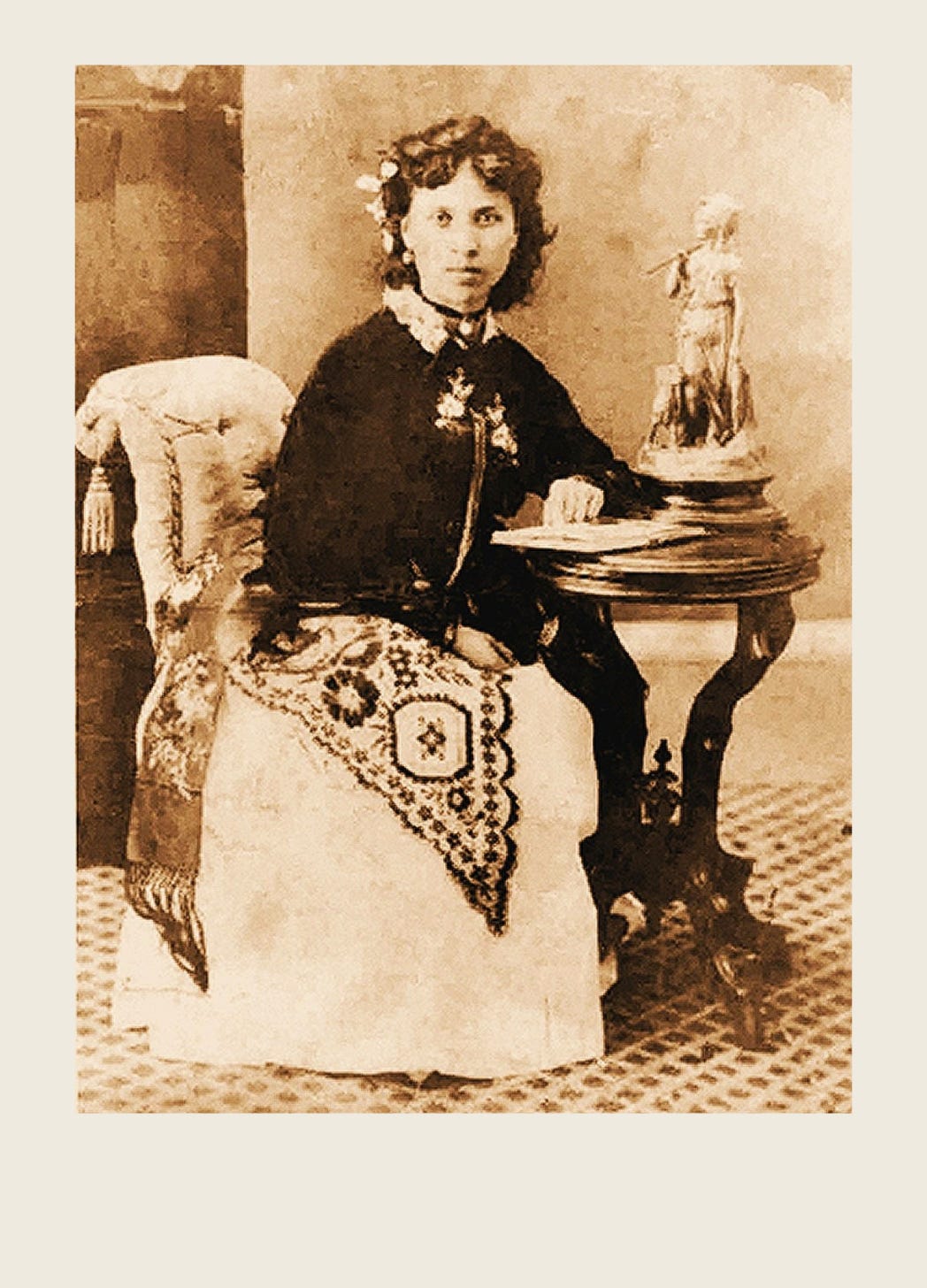
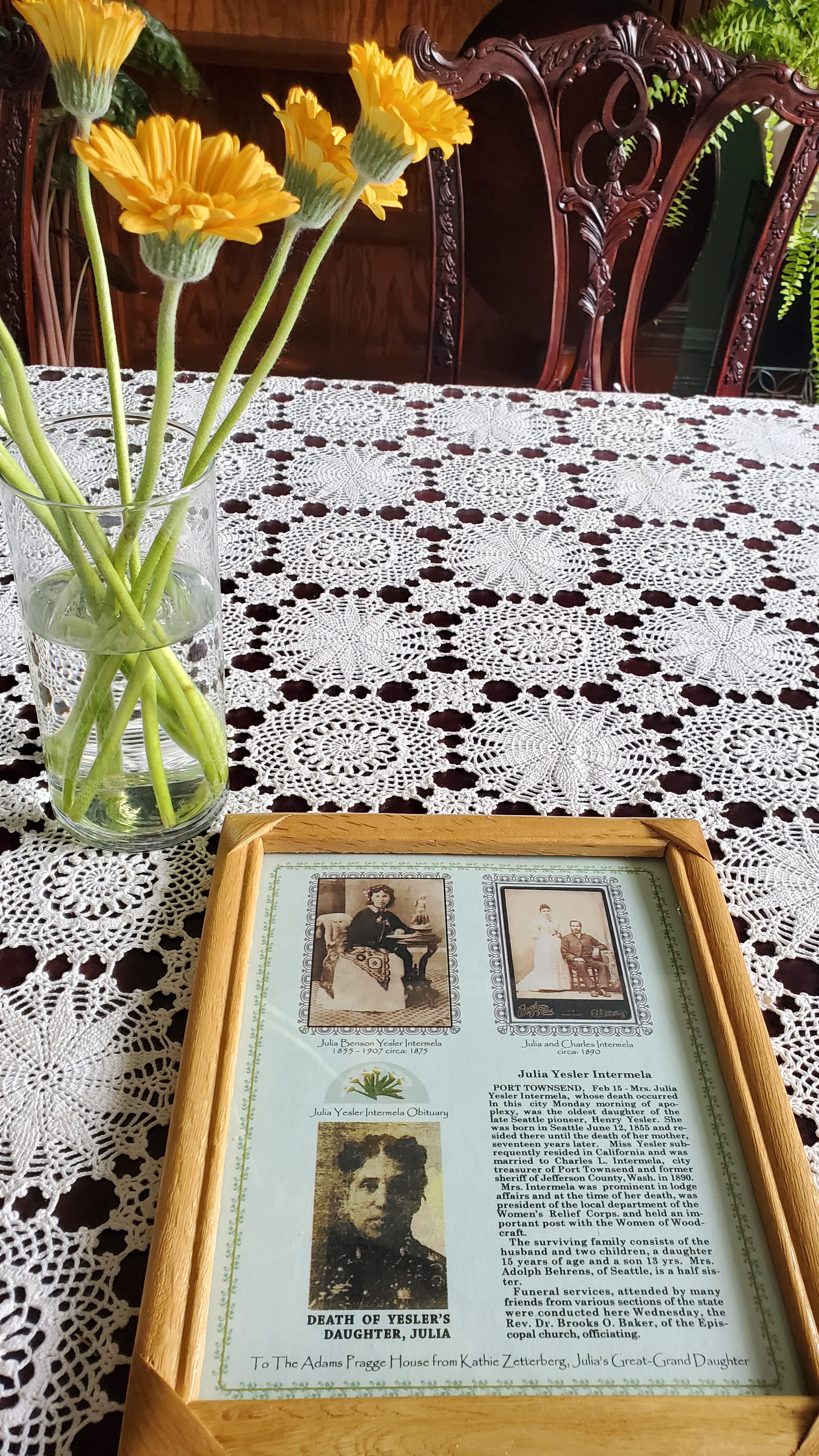
What is certain is that she was not diminished by whatever men arranged around her. The photograph of Julia as a teenager — and it is a remarkable photograph — shows her seated at a studio table, composed and self-possessed, needlework in her lap, a book open beside her. She is dressed in the fashion of a young woman of standing. She looks directly into the camera without apology. Whatever may have been taken from her, she does not look like a woman who understood herself as a fraction.
Around 1878, Julia returned to the Puget Sound region with the Pierces, who had established a homestead in Quilcene, on the eastern shore of the Olympic Peninsula. Another recent arrival in that small community was Charles Leander Intermela. They met and were married in 1890. Julia was thirty-five.
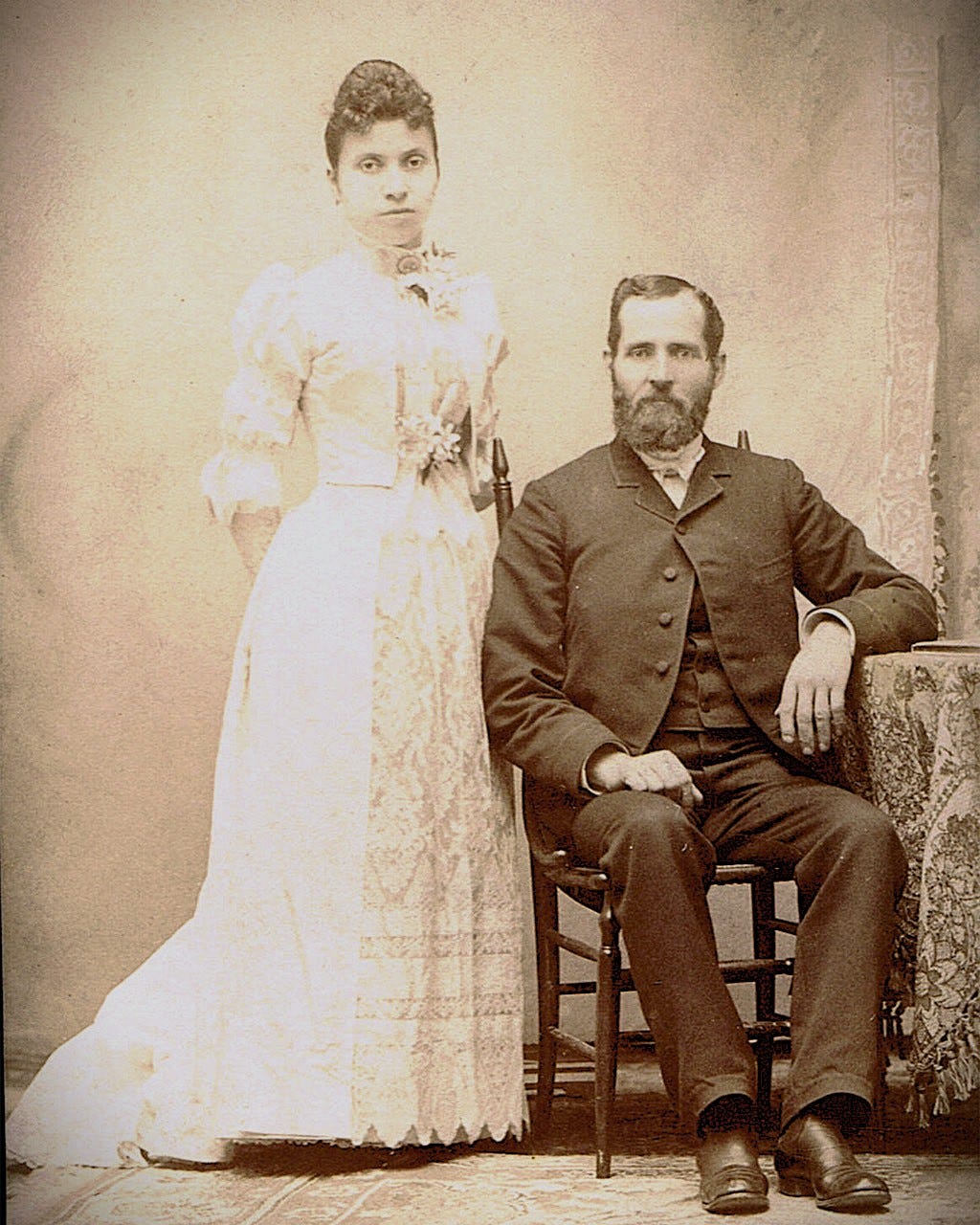
Within a decade of her return to the Puget Sound, she had a husband, two children, and — though this would only become fully legible to us more than a century later — a house.
Charles ran for Jefferson County Sheriff as a Republican and won. The office brought them to Port Townsend — the Olympic Peninsula’s principal port, a city that had briefly touched greatness and was now learning to live within more ordinary proportions.
The house Bert Adams had built on spec for $5,000 during the boom of 1889 had stood without a buyer for thirteen years. He had lost it to the First National Bank in 1893, when the railroad failed to arrive and the boom collapsed.
It was a house constructed for a future that never came.
Until they did.
They purchased it for $1,000 on December 31, 1902, and moved into the house at 426 Maple Avenue — what is now 1028 Tyler Street.
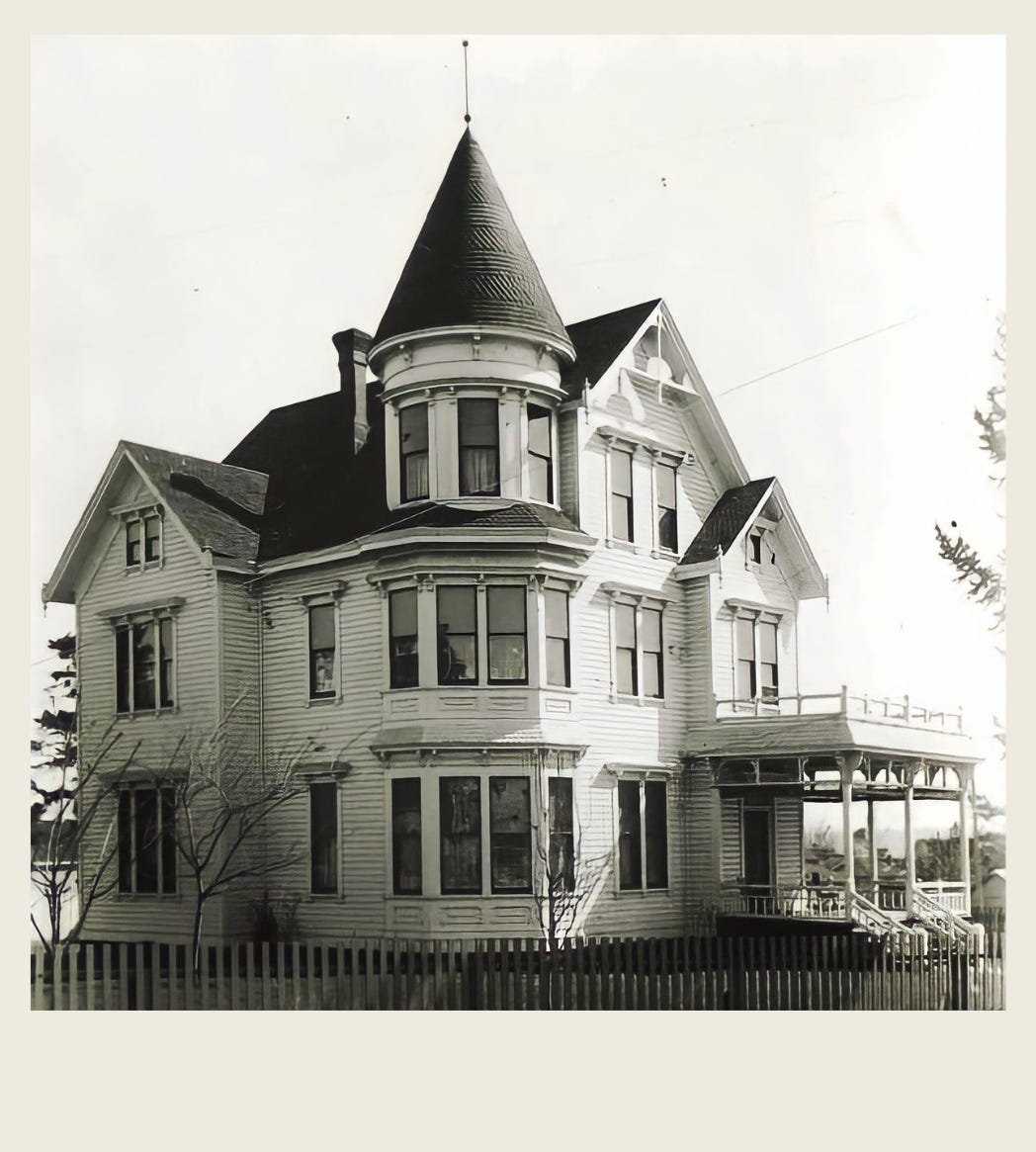
The Intermelas came to this house with two children — Elsia “Elsie,” then ten, and Charles Jr., nine — whose youthful exuberance and imagination would sweep in from its gracious porch, up the turn of the staircase, through its hallways and many rooms, to its turret, like something out of a fairy tale.
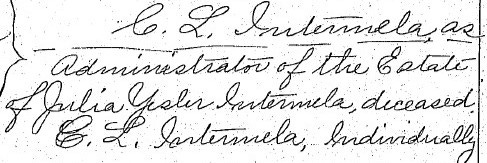
Charles was the Sheriff, the public figure, the Republican with civic ambitions — who would rise to City Treasurer while the family lived in the house — whose name appeared frequently in the newspaper in connection with county business. But we learn through its eventual sale that the house was actually Julia’s. In an era when married women’s property rights remained severely constrained — when a wife’s possessions typically passed under her husband’s legal control at marriage — the house on Maple Avenue stood in her name. A contemporary newspaper account would later report that it was sold as part of her estate, not his, and the handwritten transfer of title to the next inhabitants shows unequivocally that the house belonged to the Estate of Julia Yesler Intermela. Charles Intermela was merely the administrator of her estate. How this arrangement came to be is not entirely certain, and the existing record of the house’s sale to the Intermelas shows only that Charles closed on the sale – ownership in his name implied by the absence of a declarative statement to include hers. But the most plausible answer is also the most resonant: that the fortune Henry Yesler accumulated over a lifetime of mill-owning and land speculation had, in some portion, made its way to his daughter. The man who had moved Julia between households, who had kept her at a careful distance from his public life across eighteen years, had also — perhaps as restitution, perhaps as love, perhaps as both at once — ensured that she could own something outright. That she could have, in the eyes of the law that had once written HB beside her name, a house.
During her years in this house Julia participated actively in the civic life of Port Townsend. She was a member of the Women’s Relief Corps, in which she served as Junior Vice President beginning in January 1906. She was a member of the Women of Woodcraft and its local chapter the Heather Circle, in which she served as Attendant. The newspaper notices that record these affiliations are brief, as such notices always were — names in a list, offices noted, the ordinary texture of a woman’s civic life rendered in a few column inches and then filed away. But taken together they describe someone woven into the social fabric of the town, present and participating, known. In these, she is Mrs. C.L. Intermela.
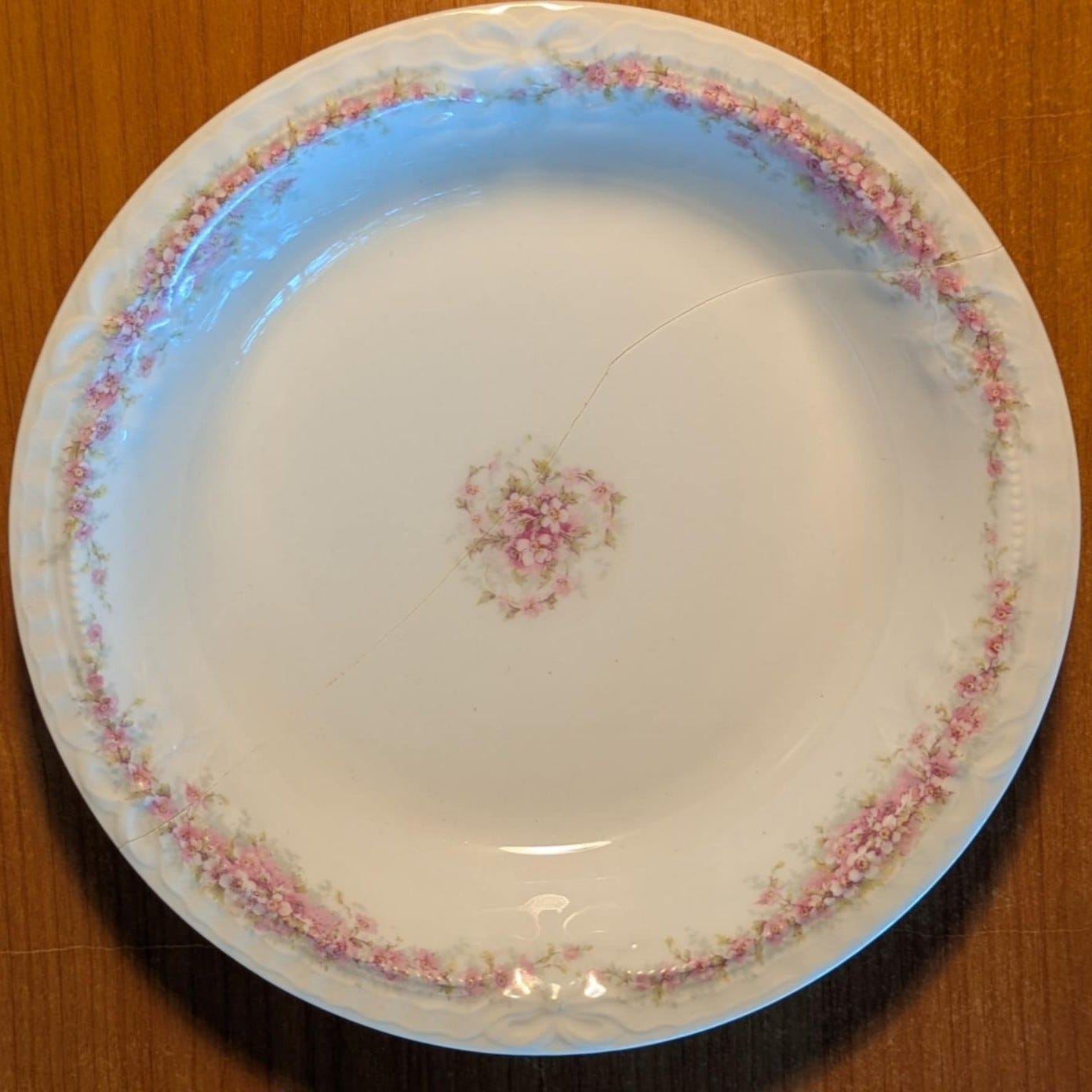
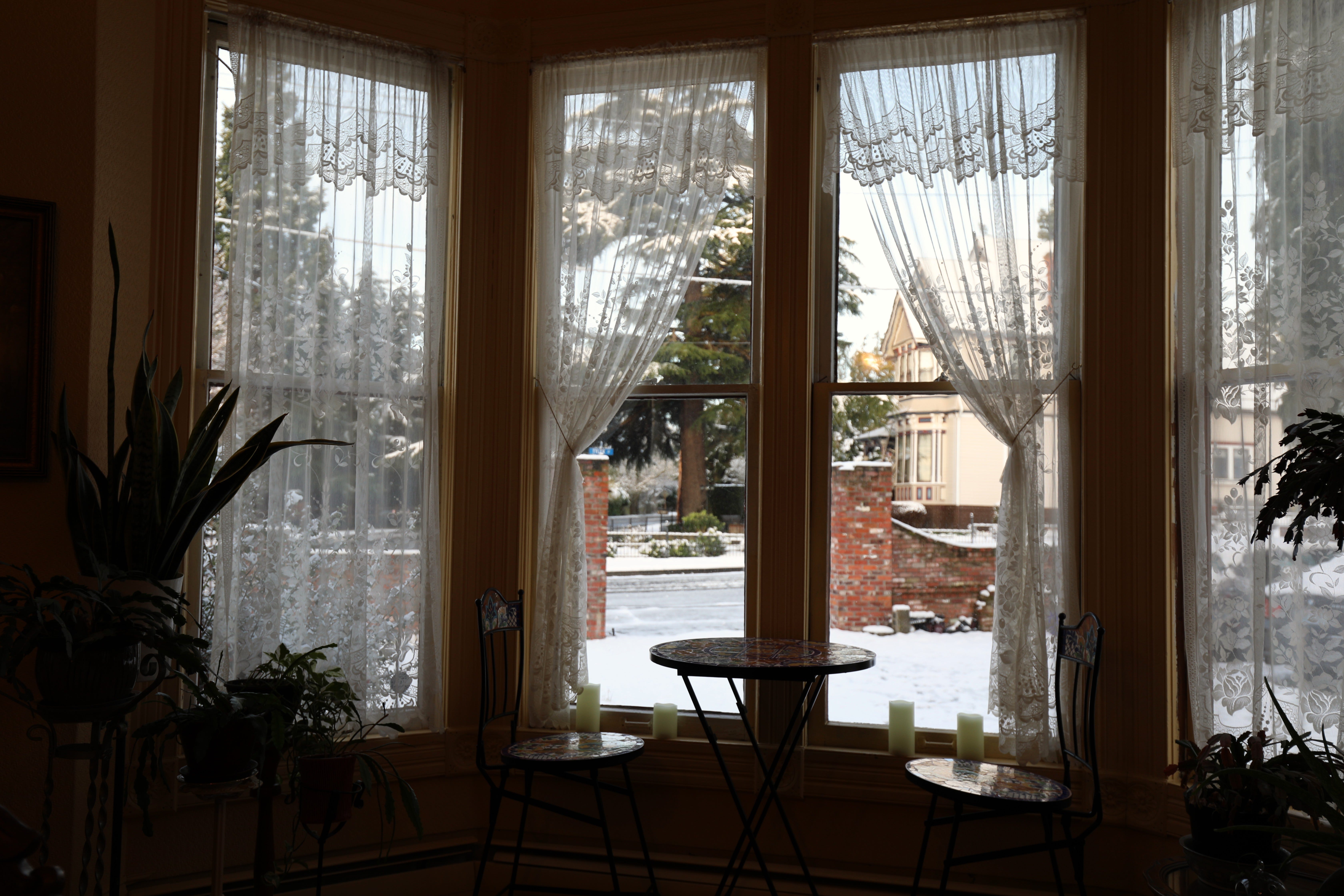
I find myself returning, though, to the smaller and more private picture. To family recollections that describe her entertaining with a delicate Haviland china dinner service, pieces of which have remained within the family for generations. To Julia in the parlor — the polygonal room on the ground floor, seven double-hung seven-foot windows set into its walls: four forming the angled bank of the turret facing west, one facing northwest, two southwest on the front of the house. In the afternoon, this room held more light than most Victorian interiors were designed to contain. Through those west-facing windows, across the way, the Stockand house — another monument of Port Townsend’s most ambitious year. The ordinary view of a street and a town she’d had the means and the standing to choose.
Newspaper records tell us that in October 1903, a group of boys and girls surprised Elsie at her home, where they played games and enjoyed supper. I find myself imagining Julia at the door, welcoming them in — whether she had helped plan it and was watching Elsie’s delight with quiet satisfaction, or whether she was as surprised as her daughter and was hastily assembling supper for a houseful of young people, a mother catching the joyful experience life had thrown her way. I imagine her, too, in the parlor in the fading light as the afternoons shortened toward winter — playing her piano, perhaps. Did she also sing? Or simply sitting in the way that becomes possible when the day has finished and the house has settled into itself, when the children have gone upstairs and the Sheriff has retired and the evening belongs to the woman whose name provides the estate. On the northeast wall, a single door opens to the foyer and grand double pocket doors open to the dining room. The house connected to itself, room to room, in the way that a house occupied by a family connects — never entirely closed off, always permeable to the sounds and movements of the people within it.
The parlor was Julia’s room in the fullest sense. It is where her funeral would later be held, where her body would lie. But in the years before that, in the ordinary afternoons of a life she had chosen, in a house she owned, it was simply where she came to entertain, and to rest.
Through extended family connections Julia also maintained ties to Seattle’s early Native leadership. Among these was a relationship with Angeline — Kikisoblu — the eldest daughter of Chief Seattle, whose long life had extended well into the era of the city’s growth. Angeline had known Henry Yesler for decades. She had known Susan Curley. She attended Yesler’s funeral in 1892, and when they let her into his mansion afterward, she went to a corner and wept. Between Julia and Angeline there was a kinship that ran deeper than social connection — both were women the growing city knew how to invoke as symbols of its own founding story while remaining uncertain what to do with them as people, as women with full lives and hereditary standing in a world being reorganized around them. Seattle did not, in the end, take particular care of these women who carried its lineage — not Susan Curley, whose death can only be calculated backward from her daughter’s obituary, nor Angeline, whose grave in Seattle required later research to confirm, nor Julia, whose grave at Laurel Grove in Port Townsend remains unmarked and unknown.
Julia died suddenly on February 11, 1907, at age fifty-one — one moment healthy and the next dead of apoplexy following a fit of coughing. Her death certificate leaves blank the space for her father’s name, though it notes his birthplace as Ohio — it was actually Maryland — a small erasure that speaks to how carefully the fact of Henry Yesler had been managed around his daughter even in the official record of her death. The Seattle Post-Intelligencer and the Seattle Times ran stories headlined “Daughter of Seattle Pioneer Passes Away” and “Eldest Daughter of Henry Yesler Is Dead.” In these, she is called Julia Yesler Intermela — no HB, her Duwamish ancestry now conspicuously absent. The fraction that had followed her from birth was quietly set aside in death, replaced by the father’s name alone. Which half the obituary writers chose to honor, and which they chose to omit, tells its own story.
I wonder: in what room of her home did she draw her last breath?
As I look now at my own piano — a 1911 A.B. Chase Grand I brought with me to Washington during my own emigration from Ohio more than twenty-five years ago — I wonder if someone played hymns on Julia’s piano at her funeral. Had the community gathered to mourn her also filled the house with song for her?
I know that her funeral was held in the parlor on Tuesday, February 19, at 1:30 in the afternoon — and in February, the low winter sun moving through the western sky would have reached those seven tall windows at exactly that hour, falling in long pale light across the floor, across whatever was at the center of the room. The pocket doors would have been opened to the dining room. The foyer door open as well, the whole ground floor made to flow together to hold the many people who came. According to Port Townsend’s Weekly Leader of February 20, 1907, “The services attracted a large attendance. Sorrowing friends and relatives from Seattle and other cities mingled in the grief of the bereaved family and sorrowing friends of Port Townsend, who knew and esteemed the dead woman highly.” Among them, Charles Pragge stood as one of her pallbearers and helped carry her out through the front door of the house that had been hers. Within a few years he and his wife Helen would move into the house, and Helen would wear the tea gown in the 1920s that is carefully packed in archival material at the Historical Society, preserved by someone who understood that an object can carry a life inside it — its fabric now fragile, but representing a long thread: Julia to the parlor to the pallbearer to the tea gown. It is the kind of thread this house keeps generating, as if it already knows the continuity that the people who move through it do not.
Julia was carried from the parlor to Laurel Grove. Within a year, the house — her house, the house the newspaper would record as part of her estate — was sold. The instrument of that sale was also, more than a century later, the document that finally made her visible to us.
The household dispersed. Charles Intermela remarried. Elsie made the local paper again when she eloped with a young man named Roy Price, the two of them crossing by steamship to Victoria with two other young people to marry in a double elopement that the Leader reported with evident satisfaction. Charles Jr. left home not long after — angry, family stories would later say, at his father’s second wife and at what felt like a deliberate effort to close the door on his mother’s ancestry, as if it could simply be put away and had not, in any way that mattered, been. He went north, far north, eventually settling in the mining country of British Columbia, and upon becoming a father himself named his first daughter Julia.
Over the following century the memory of the house’s first family faded entirely. Julia’s name did not appear in local histories. It was never attached to the house. The oral tradition of the house did not include her. Even among her descendants, the details of her Indigenous lineage survived mostly as fragments: a story half-remembered, something someone thought they’d once heard, a line of ancestry that someone had decided, at some point, was better left unpursued.
The two letters had done their work.
The final piece arrived for us on December 27, 2023. An employee of the Washington State Archives sent Joseph the documents that completed the house’s ownership chain — the handwritten estate sale record, the piece missing across nearly two years of searching, the name that connected the house to its first family and that told us, in the same moment, two things we had not expected: who she was, and that the house had been hers.
That she was a woman was surprising in the precise legal sense — not that a woman had been erased from history, which is an old and unsurprising story, but that a woman had owned this house outright in 1902, that it had passed through her estate, in her name. Uncommon for that era, and yet there it was in the contemporary record: her house, her estate.
What the document revealed, in full, took time to absorb. The woman we had been unable to locate — the gap at the very beginning of the house’s history — was the daughter of Seattle’s founder. The granddaughter of the brother of Chief Seattle. A woman beside whose name the territorial census had placed HB — a child reduced to a fraction — who had spent her entire young adulthood in someone else’s household across eighteen carefully managed years, who had come home at thirty-five and made a life on her own terms, who had joined the Women’s Relief Corps and the Women of Woodcraft and the Heather Circle, who had entertained with her delicate Haviland china, who had sat in her parlor in the long afternoon light and looked out through seven tall windows at the street and the neighbor’s house and the ordinary world she had chosen. And who had been so thoroughly forgotten that the address her great-granddaughter Kathie Zetterberg had been given when she first tried to find the house years earlier was a street name that no longer existed, and so led her to a modern apartment building: a dead end.
The house had outlasted her name.
On February 5, 2024, five weeks after our discovery, Joseph sent a message through Facebook: “Are you the Kathie Zetterberg who is descended from Julia Yesler? If so, my wife and I now live in her former home in Port Townsend. We are enthralled by the history of the house, especially Julia’s part in it, and we would love to connect with you.” And on Saturday, February 24, she came. She stood in the parlor — the polygonal room, the room where her great-grandmother had played piano, an heirloom from Julia that had survived the generations and now sits in Kathie’s own living room — the room where her great-grandmother had sat in the afternoon light and where her great-grandmother’s body had later lain. She passed through the pocket doors to the dining room, with its large windows. She climbed to the upper floors and looked out across the evergreen tops of trees at the view and the western sky. She brought stories and pictures. We took a picture together. It felt momentous.
What I kept returning to, standing there with her, was the distance between those two letters and the estate record.
HB beside the name of a child — placed there to locate her, to say what she was and was not, to reduce to a category what could not be reduced.
And then, in death, a newspaper accounting of her estate, her house, in her name — now as Julia Yesler Intermela, the father acknowledged at last, the Duwamish ancestry absent — passing into other hands. The same society that had written those two letters had also, through the mechanisms of property law, recorded her ownership of this place.
Both things were true simultaneously, applied by the same world to the same woman. The notation and her estate. The fraction and the house.
But Julia was not a fraction. She never was.
The parlor holds the afternoon light in the same absorbing way it always has, streaming through those seven tall windows from the west and the northwest and the southwest, casting long shadows across the floor of the room that was hers — the room where she entertained, where she rested, where she was laid out, and where one February afternoon more than a century later her great-granddaughter stood quietly and studied the architecture that once held the everyday details of a life she had spent years trying to find.
Those four west-facing windows, occupying the first-floor turret, look out in the direction of Laurel Grove Cemetery, where Julia was carried on a February afternoon in 1907. The cemetery is not visible from the house. It never was. Julia would have had no way of knowing, sitting in her parlor in the long light of an ordinary afternoon, that the windows she looked through faced the ground where she would lie.
She just sat in the light. In her room. In her house.
Sources for this essay include Washington territorial census records; Jefferson County property records; the Port Townsend Leader and Argus archives at the University of Washington Digital Collections; records of the Washington State Archives; the Seattle Post-Intelligencer and Seattle Times obituary notices of February 1907; Henry Yesler’s account in The Puget Sound Gazetteer (September 1888); T.S. Phelps’ 1908 Reminiscences of Seattle: Washington Territory and the U.S. Sloop-of-War “Decatur” During the Indian War of 1855-1856; Nicholas Sheffer’s 1909 account in The Lynden Tribune; building records from the Pacific Coast Architecture Database; and genealogical research by Kathie Zetterberg, including her essay “Yesler’s Daughter,” published on HistoryLink.org.
Zhenya Lavy writes The Turret Journal from within the Adams Pragge House, an 1889 Victorian in Port Townsend, Washington, where she and her husband serve as its stewards.
The Adams Pragge House is a three-suite bed and breakfast in Port Townsend, Washington. Learn more at adamspraggehouse.com.
→ https://adamspraggehouse.com
Related essays from The Turret Journal:
The Measure of a Man: Charles E. Coon and the Problem of Community Memory
Beneath Notice: Charles E. Coon and the Life the Record Could Not Hold
The way you honored her life and wove it into the story of the home was so powerful and beautifully done <3
Brilliantly written homage to Julia Yesler Intermela and her grand House of Many Stories - do tell us more.