

The Turret Journal — Essay II
In late winter the Adams Pragge House reveals the logic it was built upon — the movement of light across rooms, the structure of garden and tree, and the quiet work of a west-facing turret in Port Townsend, Washington.
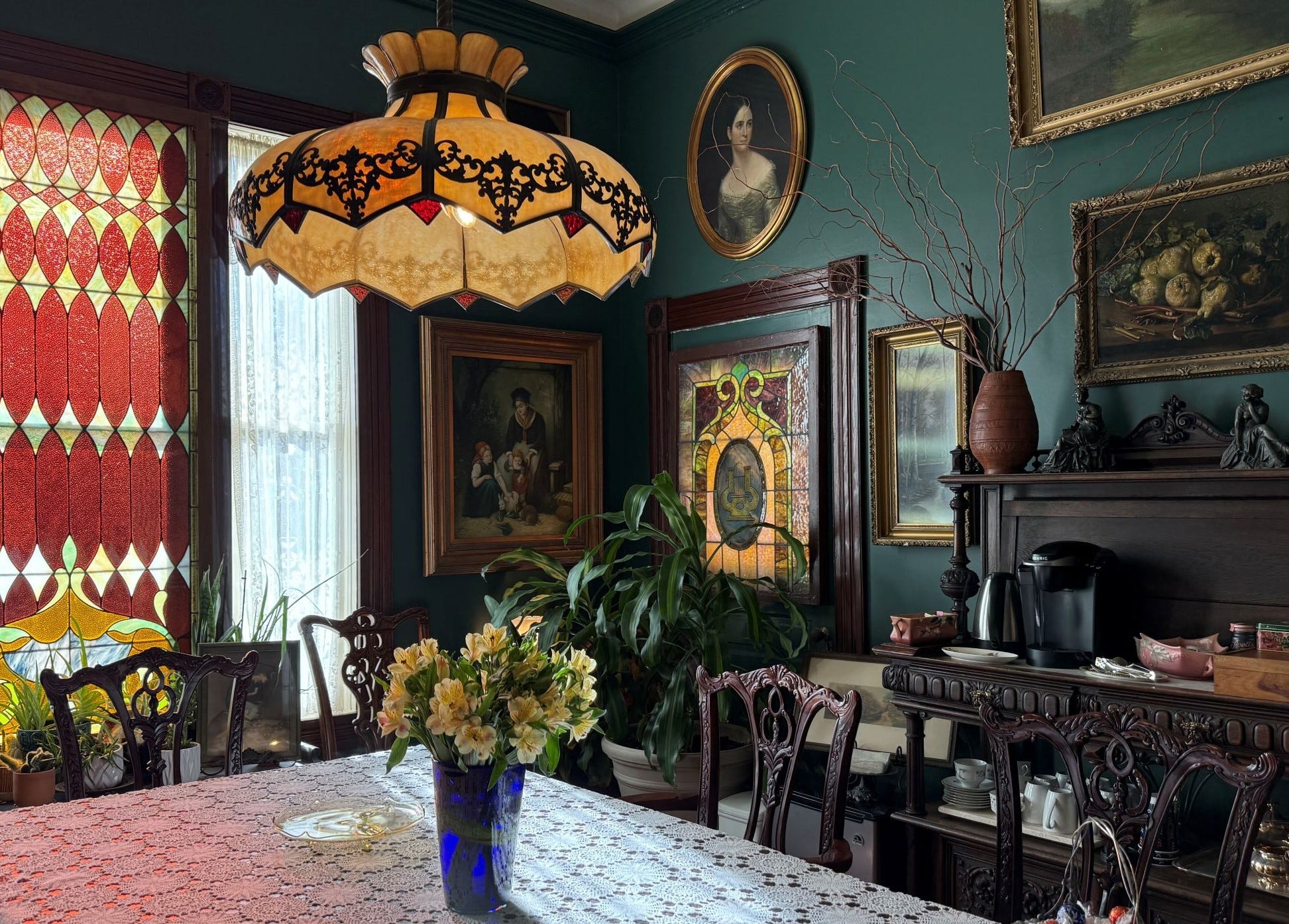
The dining room faces southeast, and in late winter the sunrise finds it early.
It enters through a tripartite window — three tall double-hung sashes, seven feet high, the widest at center flanked by narrower lights on either side. The central pane is stained glass: burgundies, deep yellows, and greens, the warm colors of rooms meant for staying in. The flanking windows are antique wavy glass covered in sheer lace, and what passes through them is neither quite light nor quite pattern but something between — morning refracted softly across the crocheted cloth on the table.
On the southwest wall, a door to the porch carries its own half-light panel of stained glass in greens and yellows, a lyre at center, adding a quiet glow. The room receives light from two sides at once, each with its own character.
Fresh flowers adorn the table, pale yellow — a quieter shade in late winter than in other seasons, as if the color were conserving itself.
A life-size bronze leopard stands amid the plants before the bookcase, exchanging gazes with the portraits that observe from the walls. The deep green of the room, whose darkness the present moment has rediscovered as fashionable, is simply a color serious rooms of this era understood: libraries, dining rooms, places where one stayed long enough to think.
This is where day begins at the Adams Pragge House.
And in late winter, light makes a singular arrival.
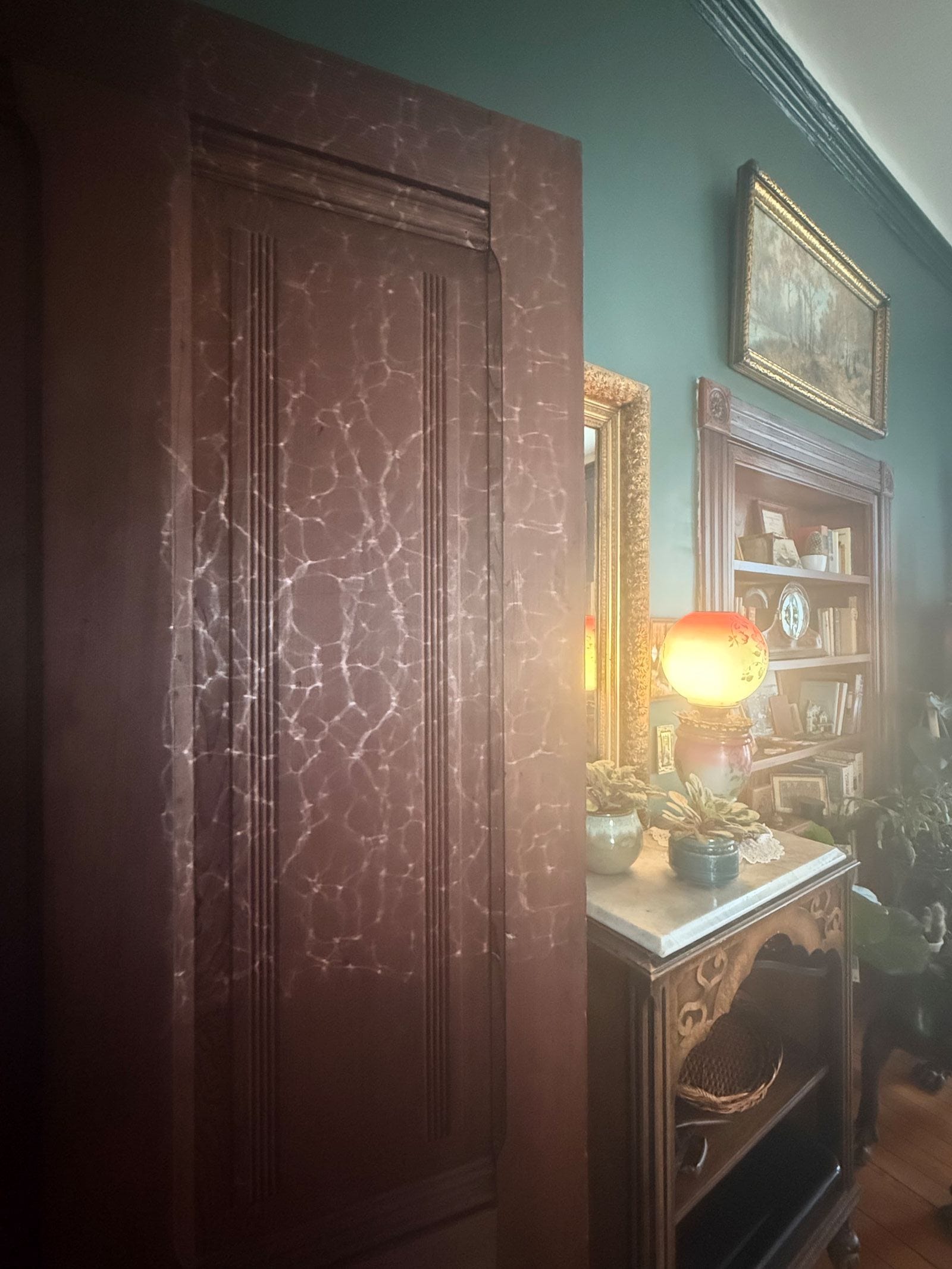
Not the sharp ascent of summer that practically commands the day into action. This light travels inland at a low angle, diffused by marine air that settles against the peninsula overnight. On overcast mornings it can feel less like arrival than retreat — darkness withdrawing stage by stage. On clearer mornings it enters with precision. Even then, something in the atmosphere softens the edge, like an artist’s thumb smudging a charcoal drawing. The shapes cast by the lace appear, dissolve, and return again.
Outside, the house reads differently than in summer.
The brickwork out front carries a darker tone through this season — the color of masonry that has absorbed years of moisture and holds the memory of it even when dry. On the cap of one column, a small colony of succulents has established itself, producing a bright shock of green against the repeating dark columns, like punctuation.
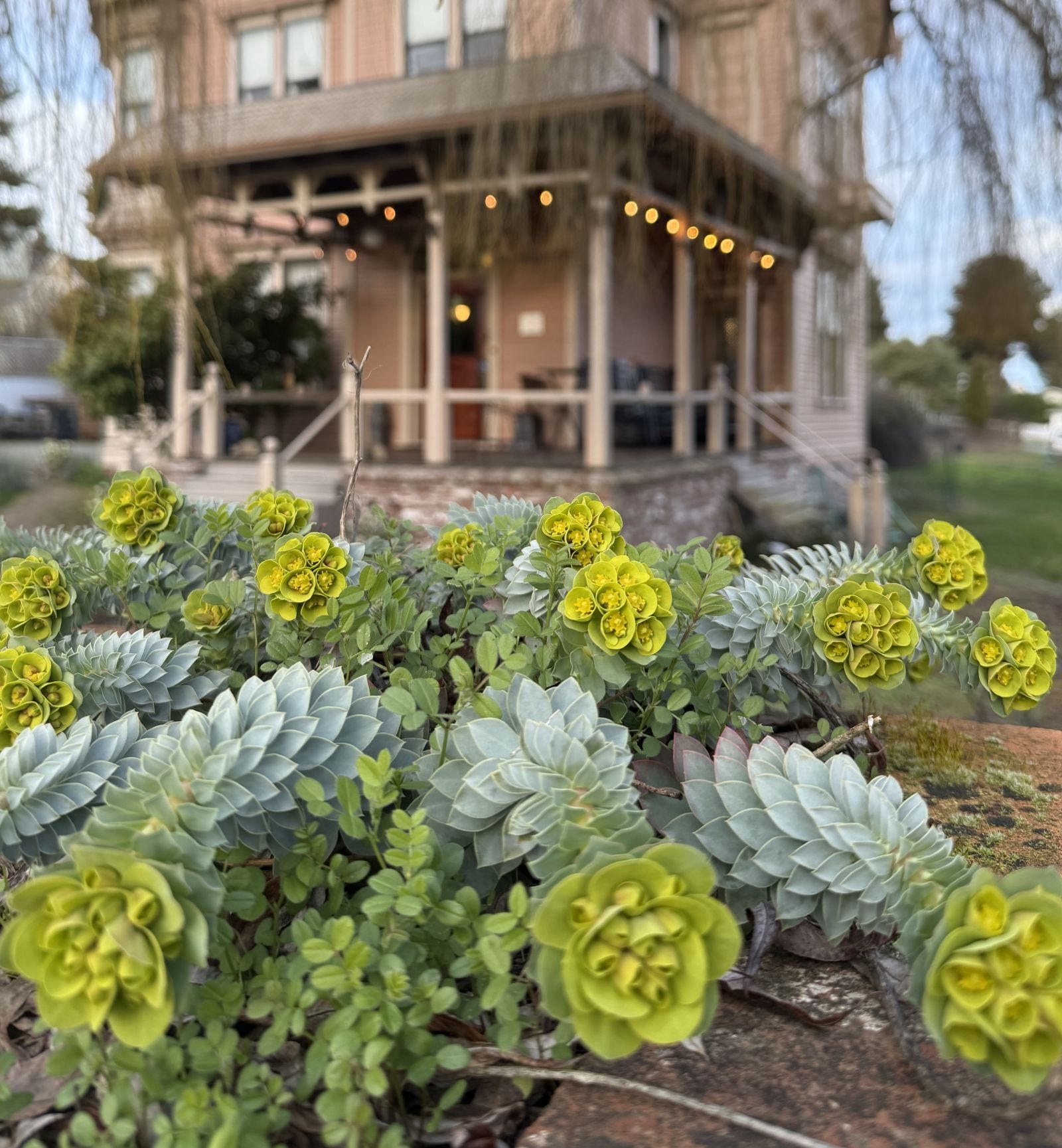
The color of the house complements the winter sky. In winter, the pink undertones recede and a timeless chestnut prevails.
Near the front steps, two Daphne shrubs in full pale pink flower flank the approach to the porch. A third grows beneath the first-floor turret window. They have been blooming since December, their perfume a promise of the coming spring.
Not to be outdone, the rows of lavender and rosemary — not yet cut back for spring — still release fragrance when rain or a passing hand touches them.
And the willow.
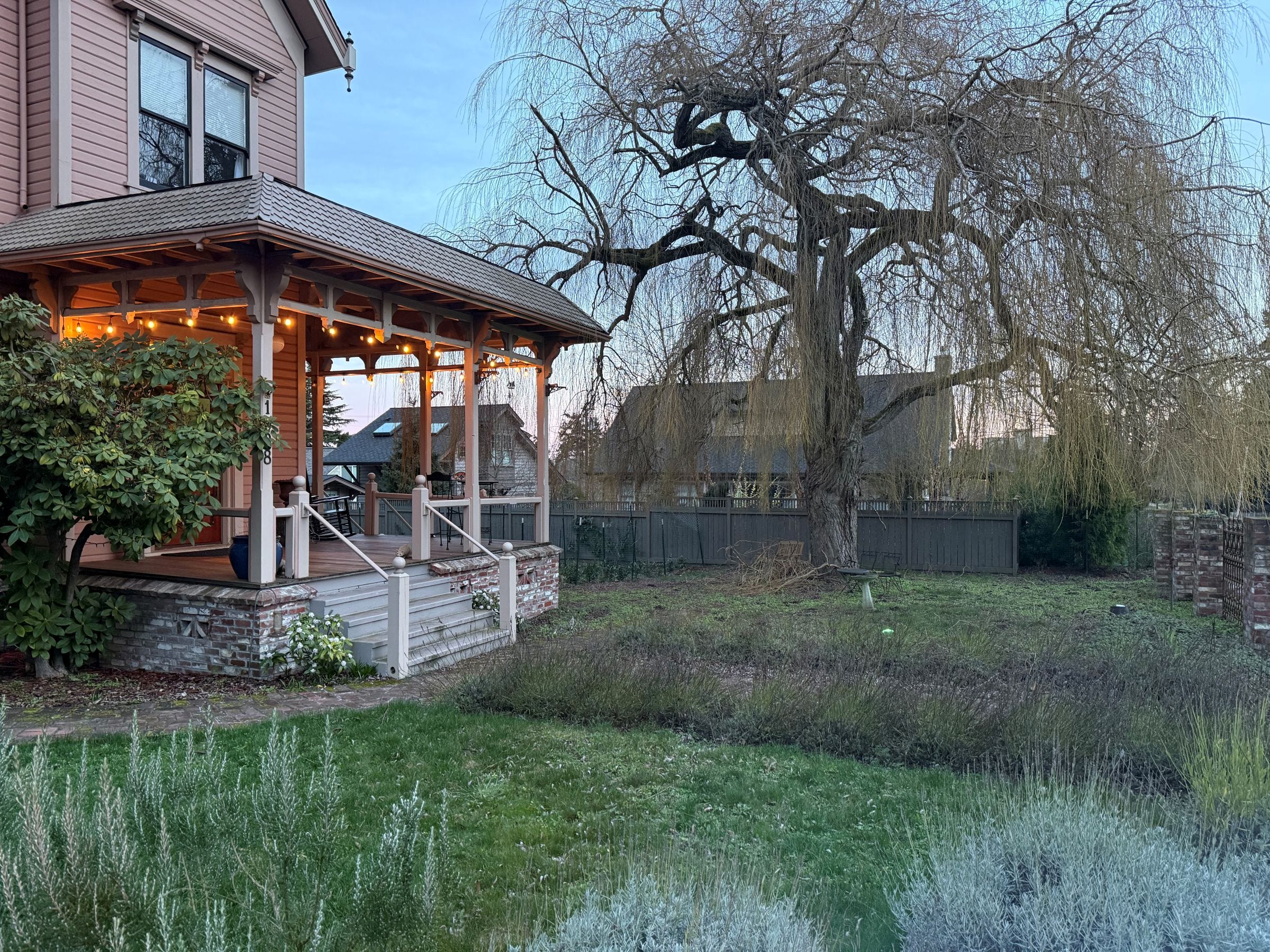
While in summer she is spectacle — long pendulous branchlets sweeping low, animated by transformative green – in late winter she is structure: the trunk’s considered mass, the branching that rises before it falls, the network of limb and lesser limb that makes the summer display possible.
To see this is to understand the architecture that was always there. Summer concealed it; winter reveals it.
Late winter does something similar inside the house, as well.
The rooms change register. Summer light in the turret arrives with a certain insistence — brightness organizing the space around activity and the long momentum of the day. Late winter light enters lower and slower across the angled and curved walls, finding colors summer’s abundance keeps just out of sight: tertiary tones in plaster and painted wood, as if the very surfaces hold the memory of other seasons. The glancing light highlights the patterns carved into the wood furniture.
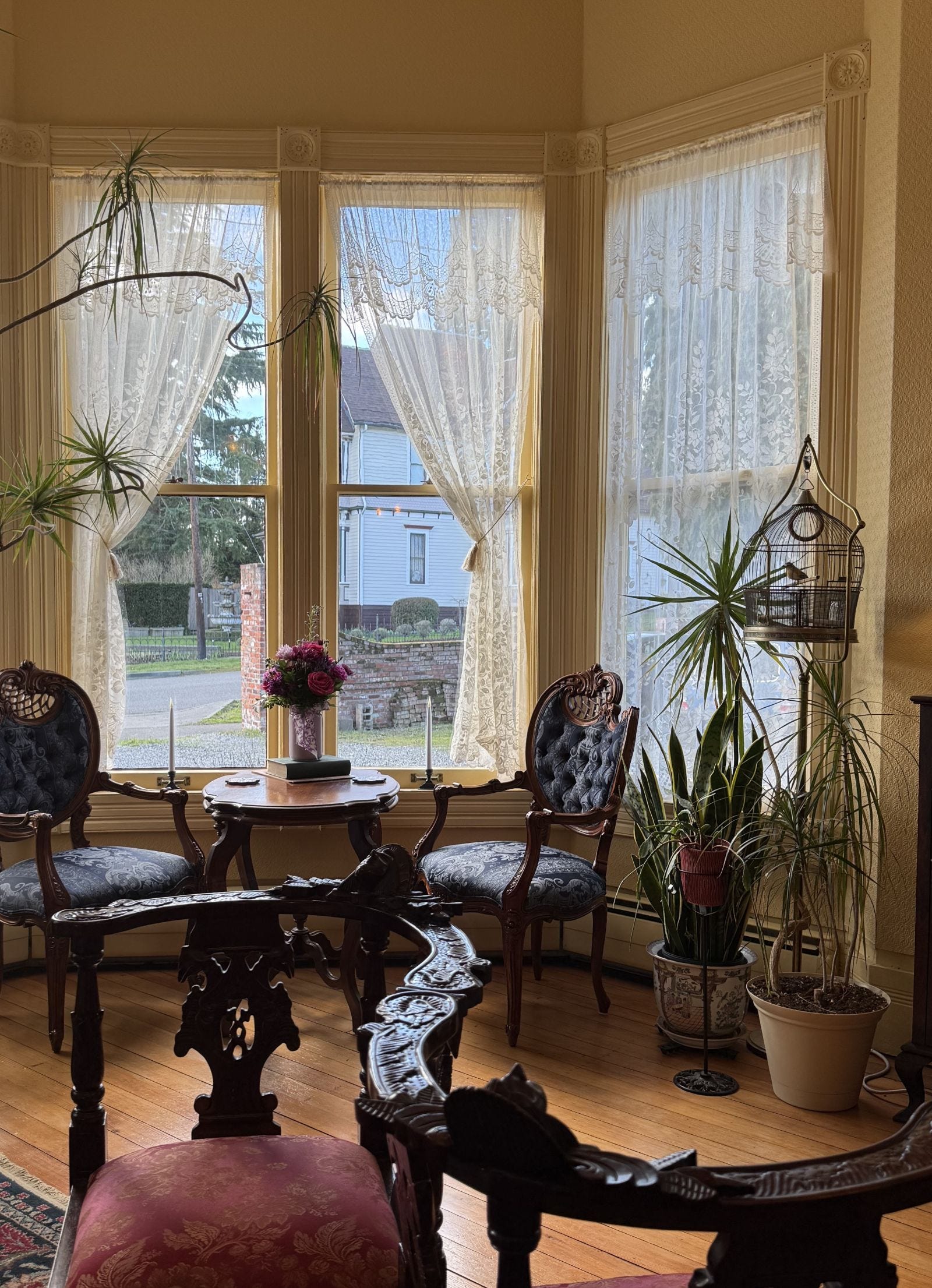
The room does not darken so much as deepen.
What it asks is different.
Sit. Stay.
The pace is deliberate.
Even the heat follows its own late-winter logic. From the basement, the central furnace warms the bones of the entire house each morning. Through the day warmth is conserved. The needs of the house are antithetical to open plans: heat is restricted to the rooms that will be occupied, doors and their transoms closed to prevent its escape. The halls stay cooler. Upper floors benefit from and retain what the lower have released.
The house manages itself with 136-year-old structural efficiency.
Light follows the same east-to-west path as always, but in late winter its movement clarifies purpose. The dining room holds the morning. The turret rooms on the western corner, with their windows that hug the bend, hold the afternoon and then the last of the day.
That the turret faces west merits pause.
The street grid of downtown Port Townsend and the Uptown neighborhood runs largely on the compass diagonals. Most turreted houses in Uptown occupy a north or south corner, and their turrets tend to meet the morning light, presenting their faces toward Admiralty Inlet or Port Townsend Bay.
With its westward orientation at the corner where F becomes Tyler, the Adams Pragge House turret looks instead down the gentle descent of the street into distance. This is not a harbor view but a territorial one: land and sky, and the light that collects above the horizon at the end of the day as the town’s edge gives way to the rest of the Olympic Peninsula beyond.
A west-facing turret extends the usable day.
It gathers what remains of the lingering light when the rest of the house has already let it go.
In winter, when sunset comes early and light becomes practical, the logic of this placement is restored.
From the turret at that last hour, the view is land and distance and the particular quality of late light over the Olympic Peninsula in early March — horizontal, reluctant to leave, without the urgency it carries in other seasons.
Late winter offers clarification.
The garden stripped to its shapes.
The willow to her architecture.
The light reduced to long angles that lengthen shadows even as they clarify form through the marine air.
And the turret of the Adams Pragge House turns, in late winter, toward its other work:
gathering the light that lingers, slowly and without waste, for those of us inside.
Zhenya Lavy writes The Turret Journal from within the Adams Pragge House, an 1889 Victorian in Port Townsend, Washington, where she and her husband serve as its stewards.
The Adams Pragge House is a three-suite bed and breakfast in Port Townsend, Washington. Learn more at adamspraggehouse.com.
→ https://adamspraggehouse.com
Related essays from The Turret Journal:
Beautifully written sharing of the loveliness that is Adam’s Pragge House.
I love the Adams Pragge House!