

The Turret Journal — Essay IV
You do not enter a house like this all at once. You are admitted — and you are admitted in increments.
The porch receives you first — gracious, covered, neither fully outside nor yet inside. A space of inquiry: Is anybody home? May I enter? A space of protected waiting and, for those admitted, the first space of welcome.
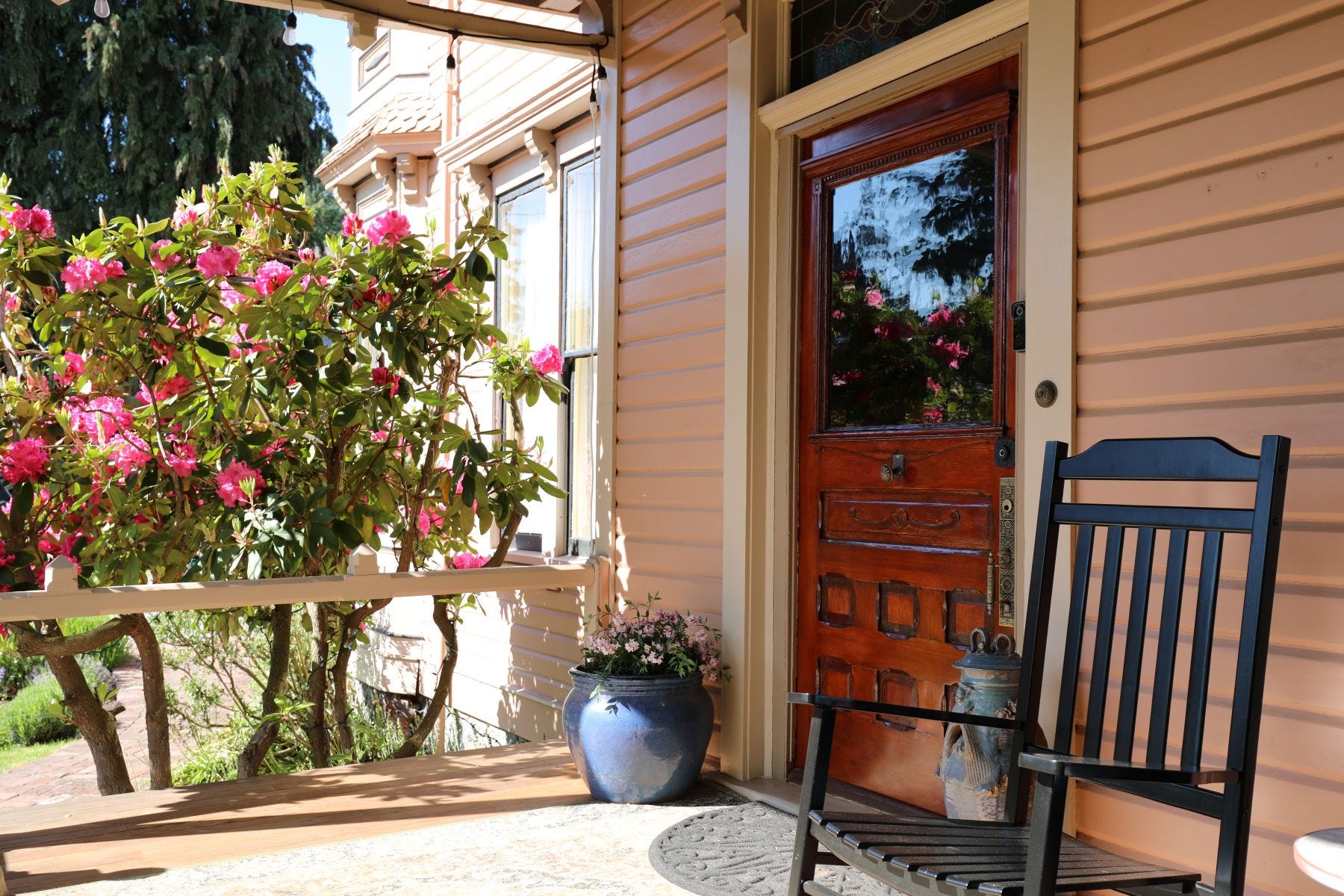
The front door opens into the foyer, where arrival is briefly contained. You are still in a transitional space — not yet a space for living but for the small formalities of arrival: the hall tree receives jackets, hats, umbrellas, canes. The space requires pause, assessment.
There is no single path forward.
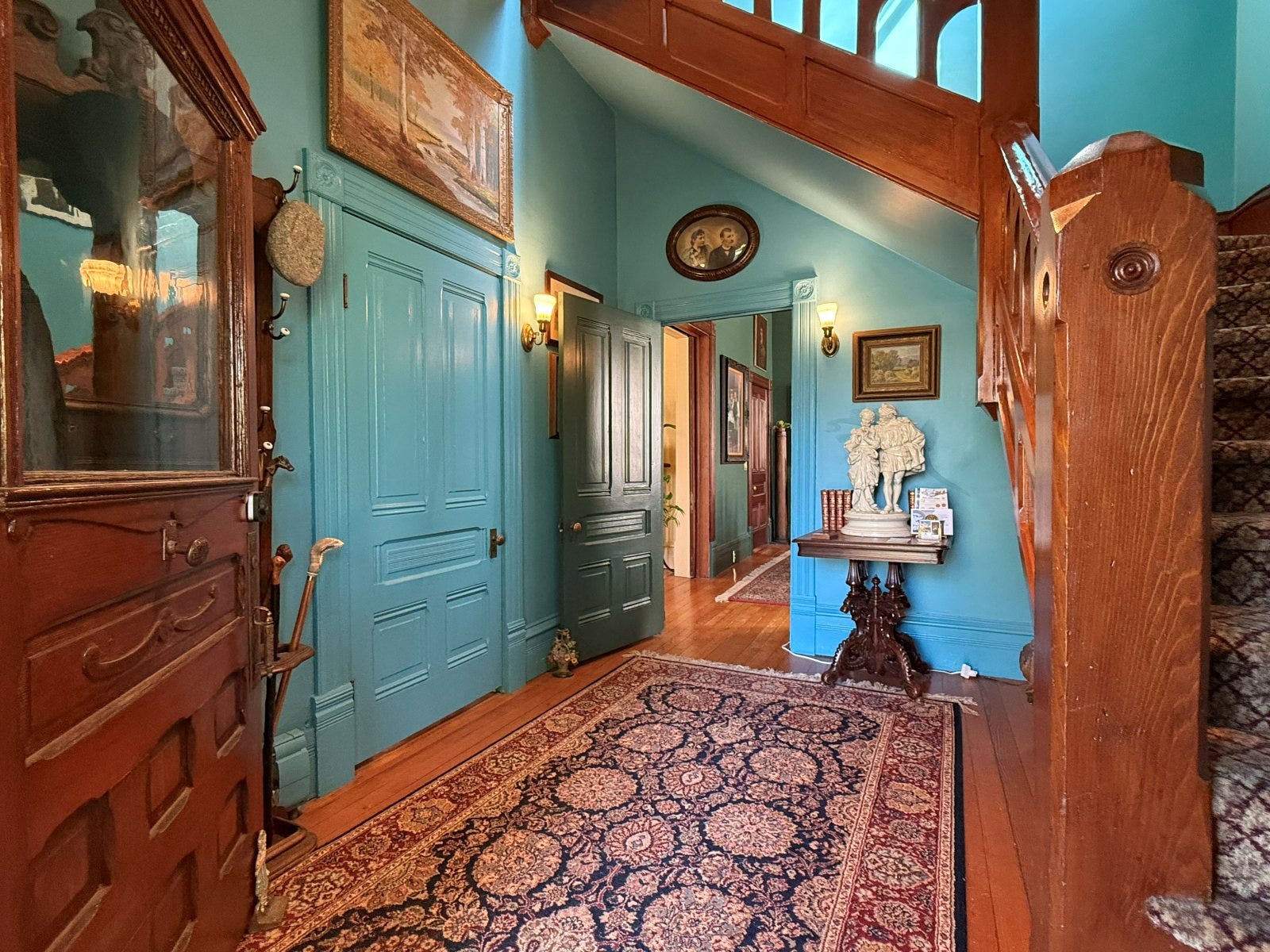
One door leads to the parlor, which can be fully self-contained. Another leads to the dining room, which can also be closed off. A staircase turns upward toward the more private floors.
And there is a second door from the porch that bypasses the foyer altogether, entering directly into the dining room. Like the door at the back of the house, it is tucked away — a passage intended for those who already belong, or who have been invited to behave as though they do.
In a house like this, entry was never meant to be singular or fixed.
This is the first indication: movement here is arranged.
The nineteenth century did not simply build houses; it built boundaries. Privacy — newly understood as something to be achieved rather than assumed — required enforcement. Walls thickened. Rooms separated. Circulation was organized into controllable sequences.
Before the mid-Victorian period, the line between domestic and commercial life had been permeable: workshops adjoined parlors, trade happened in rooms where families ate. The Industrial Revolution reorganized not only labor but space. The home withdrew, closed up, multiplied its walls, and established the interior as a world apart — then structured that world so movement within it would be graduated, managed, and legible.
The house became a system for determining who might go where, and how far.
Beyond the foyer, the first floor has no corridor, no spaces that exist solely for passing. Instead, the rooms lead into one another: parlor to dining room through double pocket doors, and from within the dining room, five thresholds branching outward to porch, foyer, and remaining living spaces.
To pass through is to choose, or to be chosen for, a sequence. You do not stand apart from the rooms and consider them from a distance. There is no neutral ground. You are already within them.
At the back of the first floor, past the drawing room, kitchen, and butler's pantry, the scale shifts. The change is subtle — doors narrow slightly, ceilings drop to ten feet, trim becomes more restrained. This part of the house came later. The original structure, built in 1889, did not extend quite this far. What exists here appears sometime between the Sanborn Fire Insurance Maps of 1891 and 1911. It houses a utility room and a half bath — likely the first fully functional interior bathroom the house ever had.
The bathroom matters.
Port Townsend's first gravity water system — a wood-stave pipeline drawing from Snow Creek — was built between 1904 and 1906 and remained in operation until 1928. The record shows a 1910 permit application by a plumber acting on behalf of Charles Coon, who owned the house at that time, to connect it to the city water supply. Coon, whom I will introduce in depth in a future essay, had served as Port Townsend's mayor during construction of that very system. He had, in some sense, built the pipe that now ran to his door.
Why Coon added the rear addition precisely when he did is not documented, but the timing is suggestive: he was a man in his late sixties, living with a sister in her early seventies, in a house with forty-three stairs between the first floor and the third, newly connected to the water system he had spent years bringing into being.
It is not difficult to imagine that he was also thinking about what the first floor could hold: a bathroom, a room that could serve as a bedroom, a life that might, in time, require less verticality.
Both he and his sister, Camilla Merrick, died in this house — she in 1912, he in 1920. We do not know on which floor.
There is only one pathway to the upper floors: the stairway that asserts itself from the foyer. From anywhere on the first floor, you must wind back to the beginning — to the entry — before you can ascend to the house’s most private spaces.
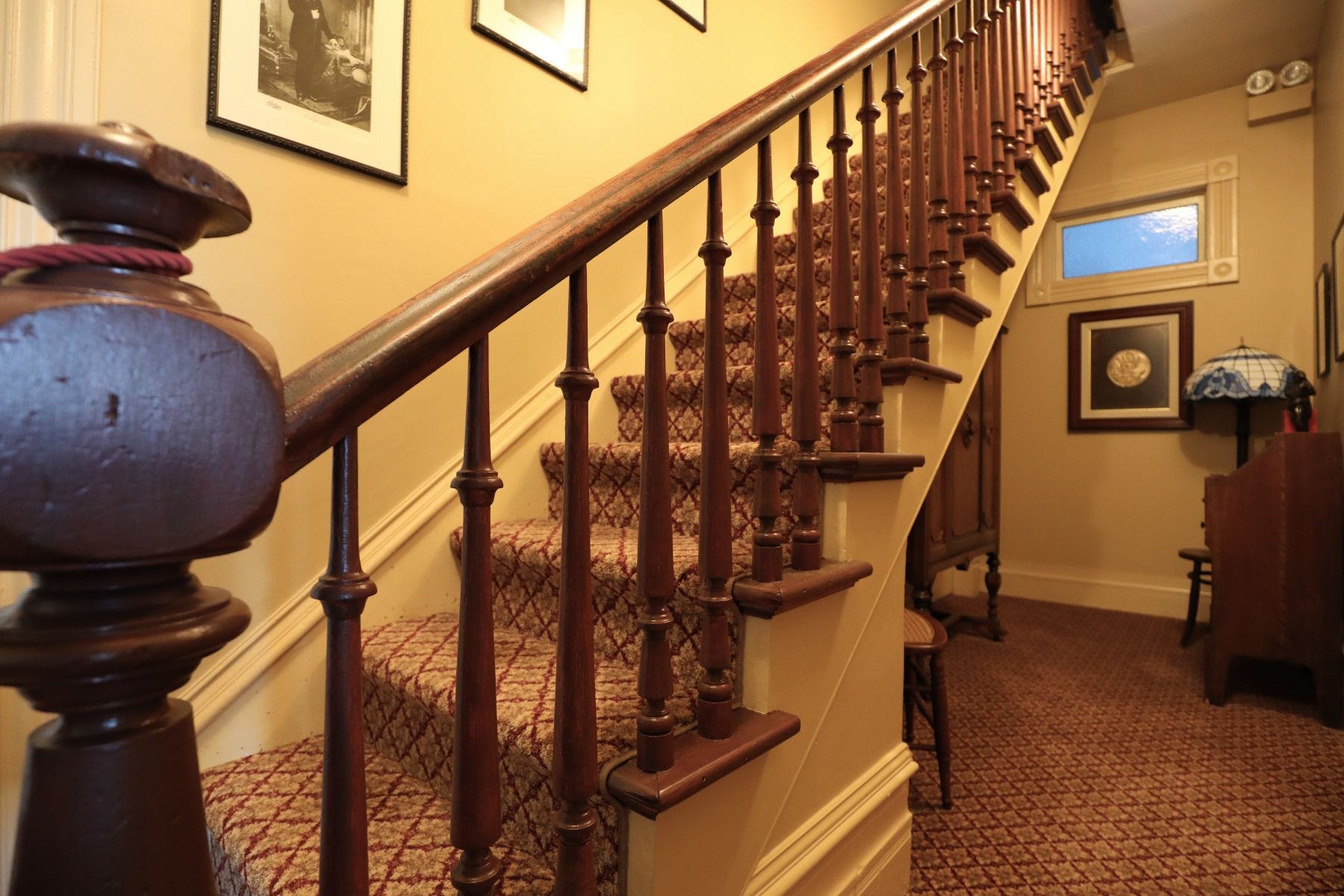
The stair rises in a measured incline. Its character is distinctly Pacific Northwestern, with its solid newel and balustrade suggesting something closer to timber than ornament. It is broad enough to accommodate presence without haste, but it does not offer the glamorous, open curvature of grand eastern houses. It turns once, and then again before arriving at the second floor, breaking the ascent into segments. There is no landing at these turns. Rather, each is accomplished with smaller, wedge-shaped steps that interrupt the body's expectation of continuity and replace it with a greater need for deliberation.
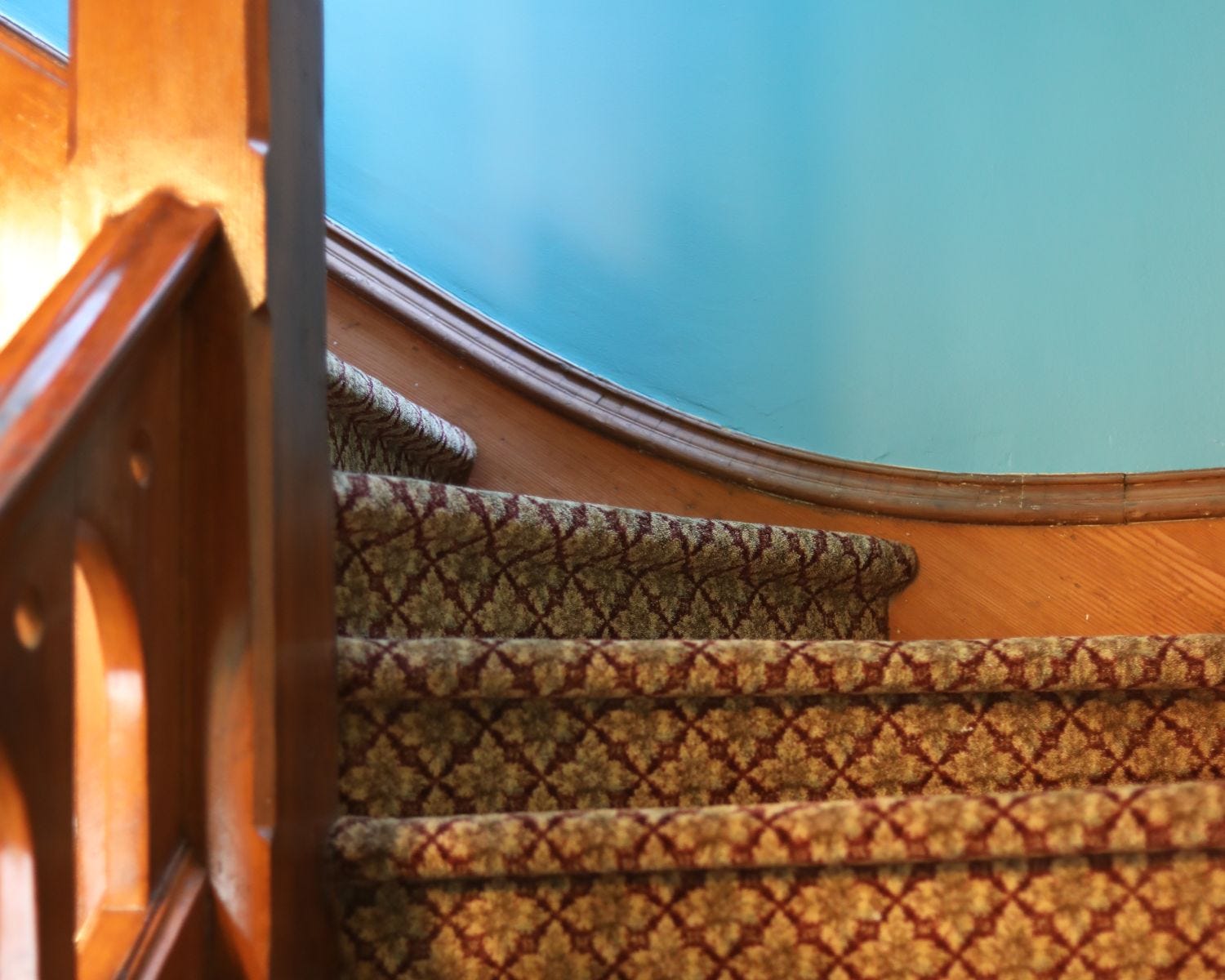
The body begins, here, to plan itself.
I have done this kind of work before — the rehearsal of the body in space, the repetition that teaches the form beyond the mind’s articulation of it. The theater I came from was built on this: movement structured, repeated, refined until the body understood before it could explain.
The house does something similar. Not performance exactly, but not mere transit, either.
The staircase exacts a quality of attention that open floor plans have forgotten how to require.
Forty-three steps between the ground floor and the third. You traverse them less frequently than you would in another house. You begin to count them not as numbers, but as decisions.
You learn what can be carried and what cannot. What is worth the ascent, and what can wait. A round trip from the third floor is an eighty-six-step commitment. Is it really necessary?
You are always calculating, scanning your surroundings for anything you might need on another floor in the next day or so, if not now. Already on the second floor — Have I forgotten something on the first? Is there anything on this floor I should grab or drop off before continuing? Am I carrying everything in a way I can manage when the handrail switches sides between flights?
The second floor receives you differently.
Here, at last, there is a hallway — the corridor that gathers the rooms and holds each at a remove from the others. Doors close. Movement becomes contained. What was fluid below is now ordered and restricted. What was shared becomes private.
The hallway is the architectural invention that made privacy enforceable. It belongs to no room and therefore governs all of them. Movement becomes accountable.
Another stair continues upward.
From the second floor to the third, the stair narrows. The ascent requires greater care—not dramatically, but enough that it cannot be ignored. The basket I can carry widthwise from first to second floors must be shifted to lengthwise from second to third, and I now rely on my hip as much as my arms to hold it aloft.
At the top, the organization of the house shifts again. Six rooms radiate outward from a central landing, their doors opening onto a hub of shared space around the well of the stairway. Each room meets the landing directly.
The linear, directional, mediating order that the second floor hallway enforced has given way on the third to a centrifugal logic. Here, the individual rooms express themselves outward, claiming light, pressing through the primary roofline as gables and cross gables. The resulting roofscape is highly textured, volumetrically complex, a map of adjacency. The centrifugal logic of the third floor carries into the turret room itself: curved interior walls that resist furniture standardization, force intentional use, and gather and rotate light.
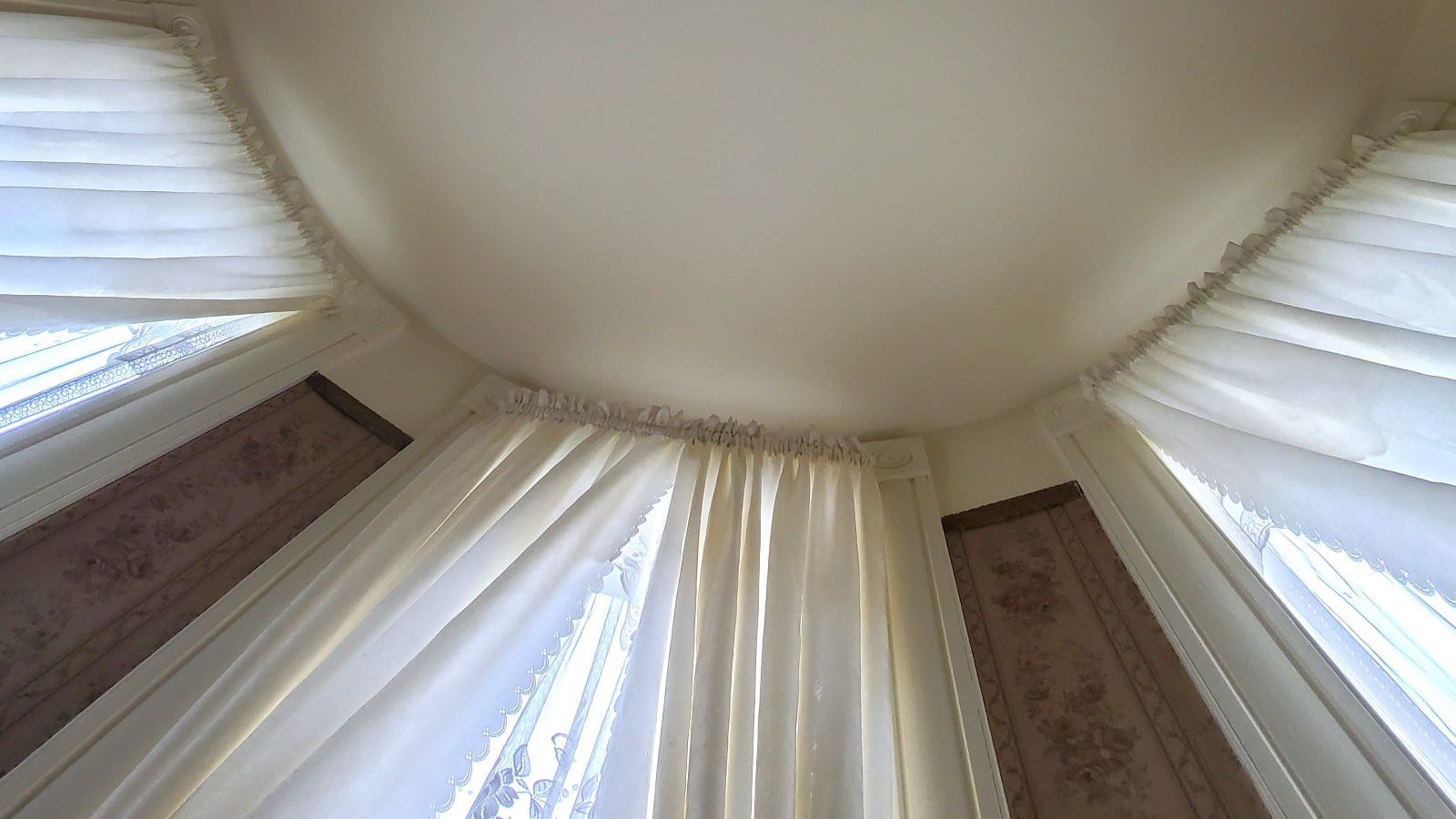
The turret room completes the vertically continuous projecting bay and concludes the corner hierarchy that organizes space across all levels — its conical roof interrupting the gabled system, introducing a cylindrical counterweight to the angular roofline — key to the asymmetry that defines Queen Anne architecture.
The conical roof was built as exterior statement, to be admired from the street, compelling the pedestrian gaze upward like the prayerful gesture of a church spire.
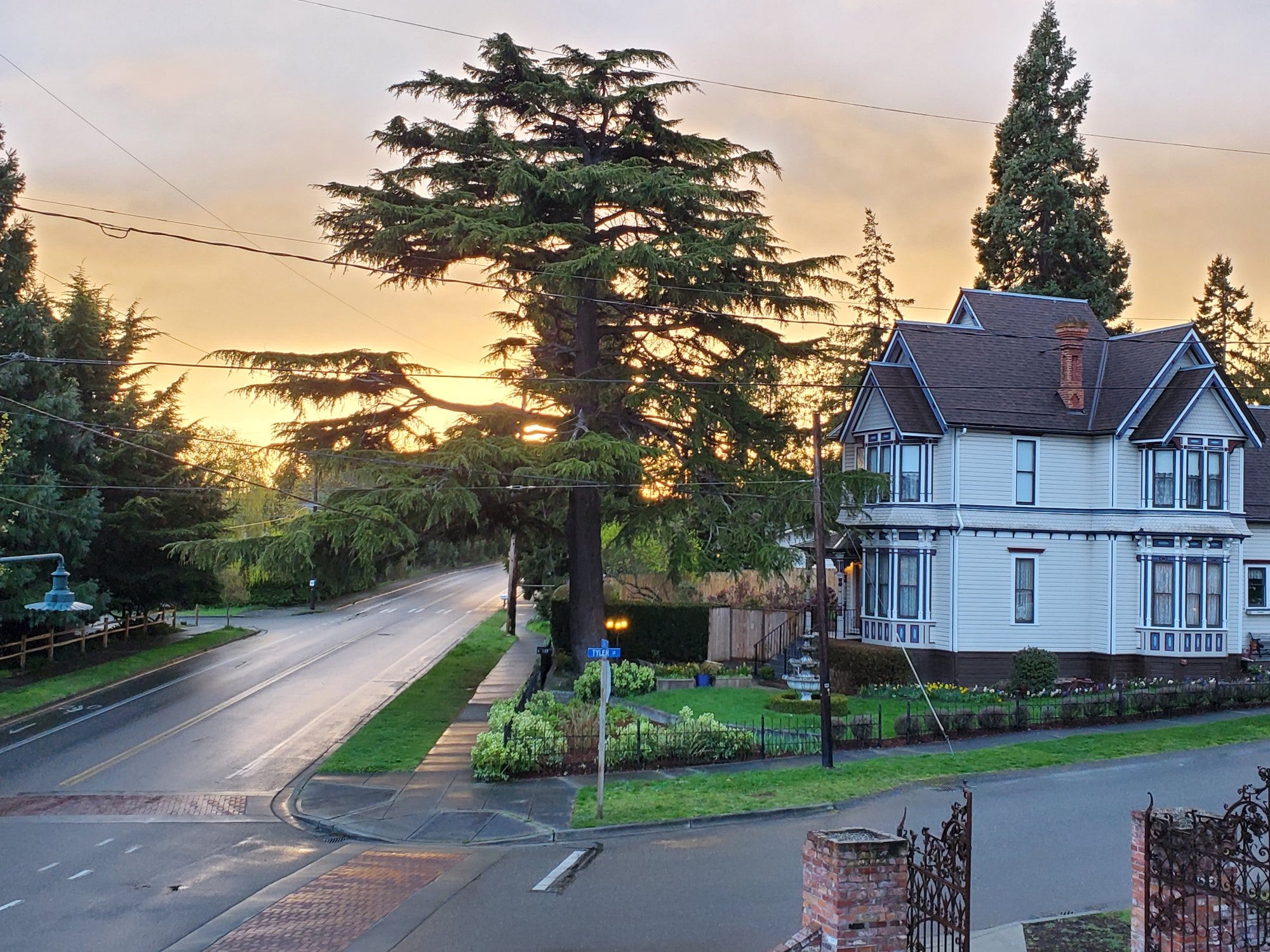
But from inside, in the third floor turret room, the Victorian gaze inverts: the house that was built to display becomes the place from which one watches.
I come here to think, to work, to rest. I come here to photograph the garden, the street, the light as it descends. In this space, I disappear into attention.
Above, the attic withdraws differently still. Its stair is not fixed but pulled down when needed, concealed when not in use. Access here is temporary, contingent. The space itself is extraordinary: massive, old-growth, tightly grained fir beams, the full interior volume of the roof, the access point into the interior of the turret’s cap. We have considered making it a library. The architecture makes such a condition imaginable: a space above the visible house, inhabitable yet removed.
Not all bodies are equally admitted by a house like this.
The stair that organizes movement also limits it. The thresholds that refine experience also exclude. Verticality is both choice and privilege. There are forty-three steps between the ground floor and the third, turns that cannot be taken quickly, widths that cannot accommodate assistance, transitions that assume balance, continuity, and strength.
My mother, who has lived for thirty-three years with the aftermath of stroke and now requires a wheelchair, could never move through this house as I do. There is no sequence by which she could arrive at the rooms above. The choreography — so precise, so legible to the bodies it was built for — fails hers entirely. The house requires physical mobility, and it does not adjust.
This is not an abstract thought for me. It is concrete, and I think about it both in relation to guests and in relation to time. What the house requires of the body now, it will continue to require.
There is only one first-floor space that could function as a bedroom: the former butler’s pantry, now an office but easily repurposed. It adjoins the dining room on one side and the early-twentieth-century half bath on the other. The path from the front door to that room requires no stairs, and the entry steps could be adapted.
Charles Coon may have understood something of this. The addition he likely commissioned, the bathroom he certainly connected — these suggest a man who knew, as we all eventually know, that the vertical logic of a house is a kind of agreement, and that agreements can be renegotiated when the body requires it. They also suggest a life adjusting itself downward, toward what could be reached without ascent.
Now in our later fifties, Joseph and I have begun to consider what renegotiation might look like for us. Our current inclination is to install a small elevator along the back of the house, where it would not be visible from the street — altering the internal logic without changing the exterior presence.
We are not there yet.
The house also has edge conditions.
On the third floor, double doors between the turret room and the adjacent bedroom allow connection to be granted or withheld — the bedroom side locks.
On the first floor, the double pocket doors between the parlor and dining room glide open and closed. They do not lock. Their function is one of modulation and drama, not security.
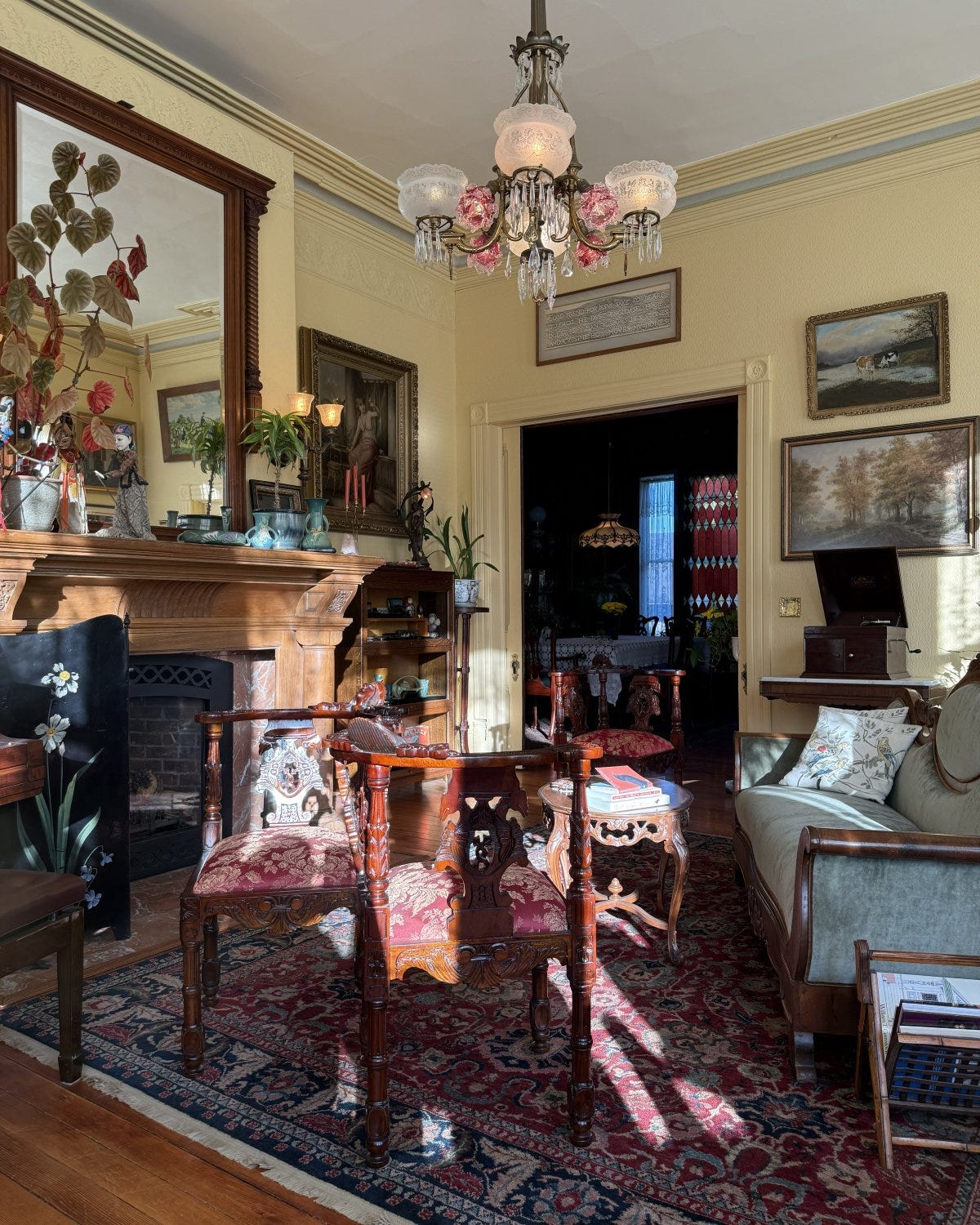
These are the places where the house makes legible that what it has been regulating, all along, is not merely movement but relationship.
To move through a house like this is to encounter a series of permissions: some granted easily, others requiring adjustment, still others withheld unless you know where to look.
The house never had a servant’s stair. But because it now functions both as our home and as a bed and breakfast, we have found our own version of managed movement.
We move with awareness of where guests are and where they are not, shaping and timing our paths so that they may experience the house as if it were theirs — illusion without interruption.
The previous owners, Marshall and Selena Raney, who ran the house as a bed and breakfast for four years in the early 2000s, resolved this by removing themselves entirely during peak summer months, retreating to an Airstream elsewhere on the property.
We believe the home people are invited to experience should be real and lived-in. A house without its inhabitants is not a home, whatever it looks like. We do not offer the performance of habitation; we offer the thing itself.
This requires its own choreography — not concealment, but discretion.
The same rooms have held different patterns of passage over time.
Earlier in its history, when the house operated as a boarding house, the second-floor hallway would have mattered differently, privacy enforced by the corridor between strangers sharing a structure but not a household. There were no private kitchens, no private bathrooms. The kitchen and sanitary arrangements required negotiation: a choreography of the communal.
As a single-family home, when Julia Yesler Intermela held the deed and she and Charles and their children believed they had many more happy years together here to look forward to than they actually did, the rooms organized intimacy: a family, a household, a life lived in the full vertical range of the structure.
After the Intermelas, from 1907 to 1935, Charles Coon, his sister Camilla, and his niece’s family — the Pragges — moved through the house in the overlapping choreography of multi-generational dwelling, with its extensions of care, dependence, and duration.
Each use produces a different map of passage through the same structure.
The architecture does not change. The meaning of movement does.
What appears, at first, as the idiosyncrasy of an old house reveals itself, over time, as something more exact: a structure that directs movement.
You slow where the stair turns.
You plan what to carry and what to leave for later.
You understand that not every path is equivalent: that the back of the house operates under a different register than the front, that the second floor asks something different of the body than the first, that the third floor is the reward of forty-three stairs, the place where the house releases its grip and everything becomes view.
The first floor meanders. The second advances. The third pivots.
The body adjusts to the logic of the space. And in that adjustment something else occurs — not discipline exactly, but a quality of attention that reshapes how you inhabit time. You arrive differently than you would have otherwise. By having moved through the house, you understand something about it that cannot be understood only by looking at it.
The Victorian architects who designed these systems of managed circulation may not have intended attention as their gift. They intended order: the enforcement of privacy, the maintenance of social distinction, the legibility of rank. And yet what survives: what the house still does, a hundred and thirty-five years on, to any body that moves through it with any degree of wakefulness, is invite us to notice. To slow and feel the turn of the stair. To rest at the landing. To understand that a door is a question before it is an opening, and that the answer is not always the same.
Forty-three steps. What you carry. What can wait. How frequently you ascend.
You learn the house by moving through it.
The stair will still turn after I have last set foot on it. The turret will still gather and hold its curved, late-day light. Someone else will count the steps and learn what to carry. They will pivot their day on the third floor — mornings standing in the powder room at the back of the house to watch an April sunrise blossom rose over Admiralty Inlet as a ferry makes its steady journey from Port Townsend toward Whidbey Island, and evenings looking out from the turret across Tyler Street, beyond the seven-gabled Stockand House and its Deodar Cedar, toward the Strait of Juan de Fuca and the westward expanse of the Olympic Peninsula — and feel they have arrived somewhere that required something of them and rewarded their presence.

The Adams Pragge House, built in 1889, stands at 1028 Tyler Street in Port Townsend, Washington. It operates today as a historic bed and breakfast with three guest suites on the second floor. The Lavy family lives on the third floor. It has forty-three interior stairs. This is how we describe the house’s accessibility.
Zhenya Lavy writes The Turret Journal from within the Adams Pragge House, an 1889 Victorian in Port Townsend, Washington, where she and her husband serve as its stewards.
The Adams Pragge House is a three-suite bed and breakfast in Port Townsend, Washington. Learn more at adamspraggehouse.com.
→ https://adamspraggehouse.com
Related Essays from The Turret Journal:
Your words breathe life into the lovely pictures of your home, so much more than merely a beautiful architectural masterpiece.