

The Turret Journal — Essay VI
Port Townsend tourism peaks in July and August — hot summer months when schools are out of session and families are most able to travel, when weather in Washington is expected to hold, and when most people assume the place will be at its best.
But while this may be the most concentrated period of summer vacation, I would suggest that for Port Townsend, the city is actually at its best earlier in the year — and that people traveling during the peak summer months not only must contend with the challenges of the tourism rush but also miss the more revealing season: spring.
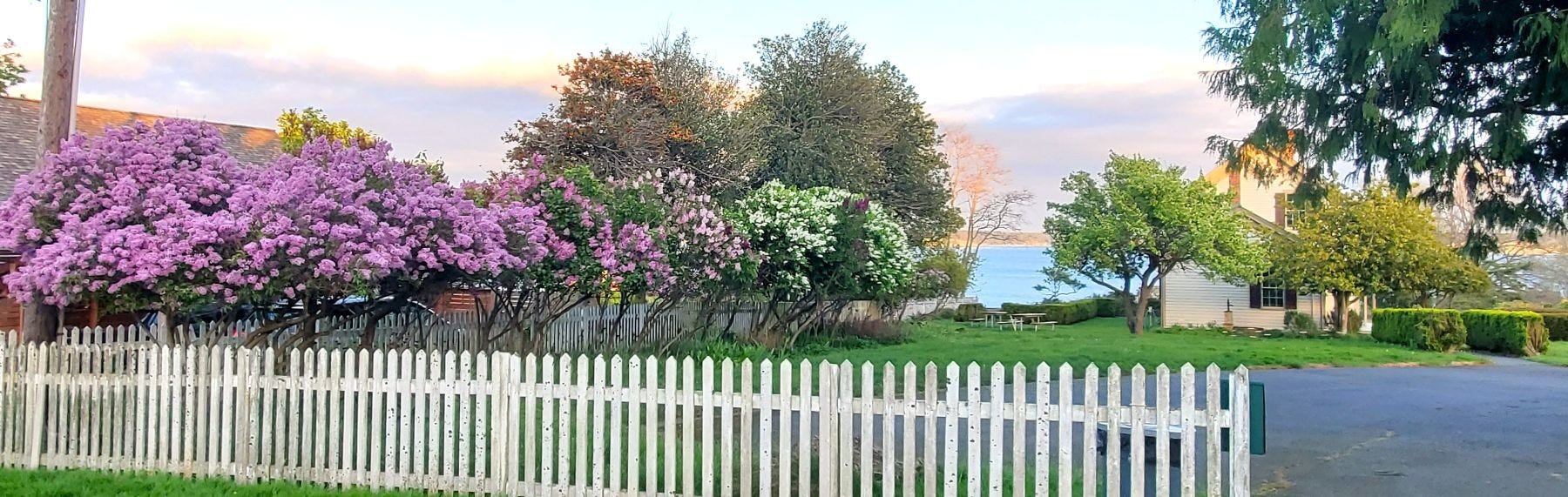
By mid-April, as the famed Saturday Farmer’s Market reopens at Tyler and Lawrence, cherry trees are popping and early rhododendrons just beginning to bloom across Uptown. By this time of year — early May — the ground is mostly dry, and cherry blossom petals are falling as lilacs begin their turn and the rhododendrons light up our landscapes. Entire streets will appear to shift all at once as hedges, yards, and older plantings emerge into bloom in sequence — a dialogue playing out across blocks.
The air carries the scent of blossoms.
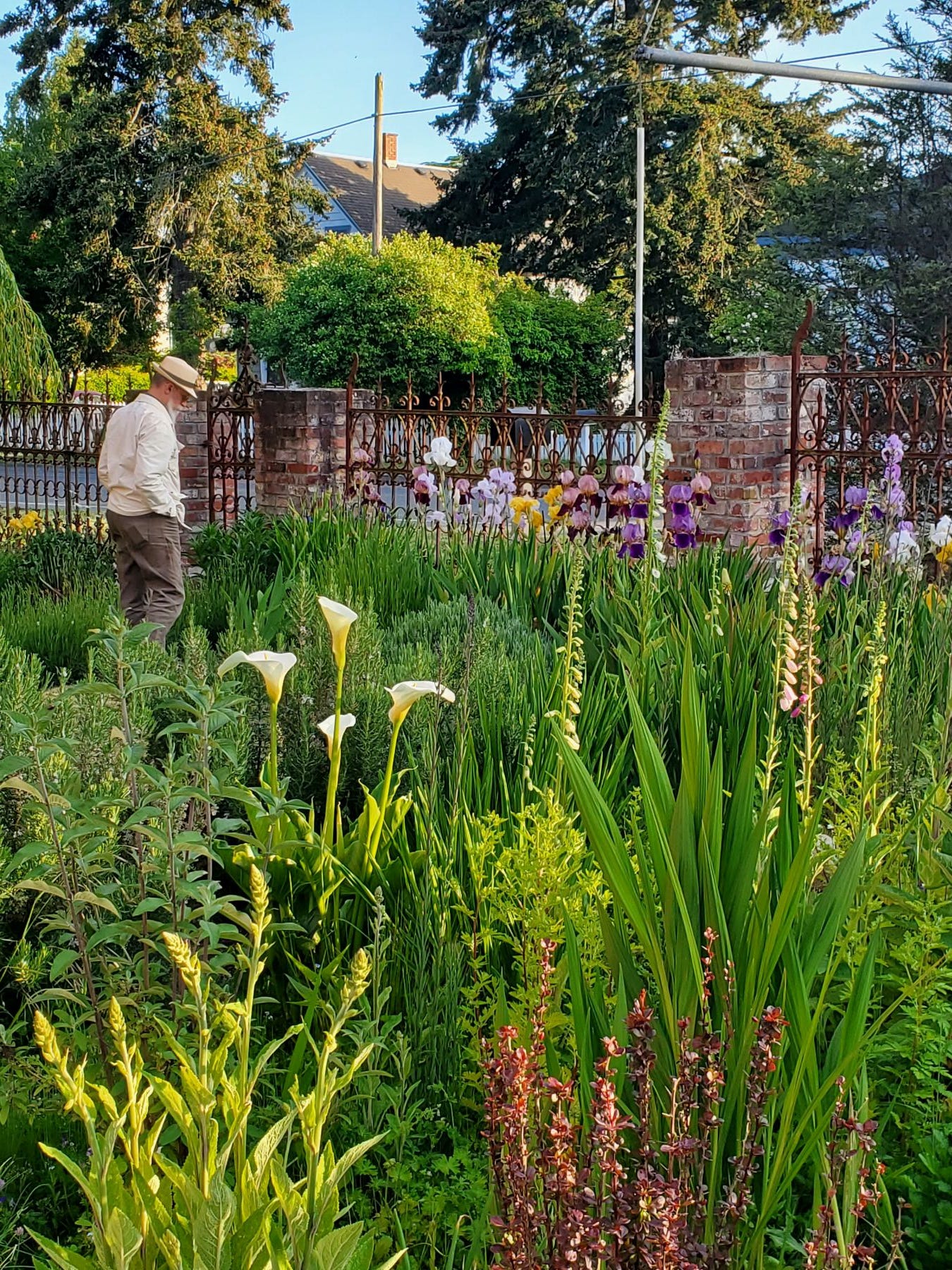
This is, I suspect, the time of year Sunset Magazine had in mind when it called Port Townsend the Paris of the Pacific Northwest.
In spring, Port Townsend is still in the process of arranging itself for visitors. It is active but not yet fully observed.
With each year I live here, I become more curious why visitors wait.
This year, the early months were even warmer than usual — and drier. Sheltered by the Olympic Rain Shadow, Port Townsend typically gets about half the rainfall of Seattle in any given year, and as of this writing we’ve had just 6.86 inches recorded in 2026 — 1.78 inches fewer than average. In fact, April had less than one inch of rain this year. Snow, too, was minimal, with a very light dusting February 18 and a bit of wet snow March 14 — neither of which lingered and nothing that was logged as accumulation. There had been overnight sleet December 27. For the first year since moving here, we captured no pictures of the house with snow.
It would be easy to treat this year’s weather as an anomaly, but it is not unfamiliar.
In late February of 1889, a local paper — The Weekly Argus — noted much the same. Geese had already begun to move. Frogs were active. Blossoms were appearing. The streets, it observed, were dry. The winter just past was described not for its severity, but for its absence: little snow, little sustained cold, and none of the conditions that would ordinarily mark the season.
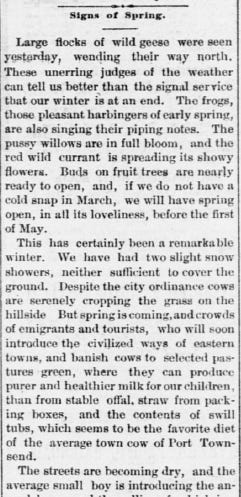
“Signs of spring.
Large flocks of wild geese were seen yesterday, wending their way north. These unerring judges of the weather can tell us better than the signal service that our winter is at an end. The frogs, those pleasant harbingers of early spring, are also singing their piping notes. The pussy willows are in full bloom, and the red wild currant is spreading its showy flowers. Buds on fruit trees are nearly ready to open, and, if we do not have a cold snap in March, we will have spring open, and all its loveliness, before the first of May.
This has certainly been a remarkable winter. We have had two slight snow showers, neither sufficient to cover the ground. Despite their ordinance cows are serenely cropping the grass on the hillside. But spring is coming, and crowds of emigrants and tourists, who will soon introduce the civilized ways of eastern towns, and banish cows to secluded pastures green, where they can produce purer and healthier milk for our children, than from stable offal, straw from packing boxes, and the contents of swill tubs, which seems to be the favorite diet of the average town cow of Port Townsend.
The streets are becoming dry, and the average small boy is introducing the annual hoop, and the rolling of which is a sure sign of spring. Their older brothers are out on bicycles and velocipedes, and their sisters will soon appear with little baskets to gather dainty spring blossoms, or else stroll on the beach to pick up shells and sea moss. In eastern states such recreations do not take place till June, but in this favored region, especially Port Townsend, delightfully weather is so common that no one comments on it, except the newcomers from the land of blizzards, who think this is a near approach to the land of Beulah, the beautiful.”
~The Weekly Argus, Thursday, February 28, 1889
A year earlier, the tone had been more pointed. Responding to claims made elsewhere, the same paper suggested — half in argument, half in humor — that comparisons to milder regions were unnecessary. The weather here, it implied, spoke for itself.
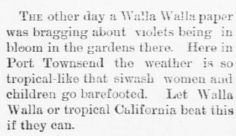
“The other day a Walla Walla paper was bragging about violets being in bloom in the gardens there. Here in Port Townsend the weather is so tropical-like that siwash women and children go barefooted. Let Walla Walla or tropical California beat this if they can.”
~ The Weekly Argus, Thursday, February 2, 1888
The climate the Argus describes was not incidental to Port Townsend’s ambitions during this period. The city had positioned itself as the coming metropolis of the Pacific Northwest — seat of the federal Customs House and official port of entry and customs clearing center for Puget Sound since 1854, presumptive terminus of the transcontinental railroad, a place whose leaders fully expected it to become the region’s dominant commercial center. Local boosters called it “an inevitable New York” of the Pacific Northwest. As of the 1880 census, it was the seventh largest town in the Washington Territory at 917; by the late 1880s, population had surged to more than 4,500 residents — although some records claim there were more like 7,000 to 9,000 people in the area — and the town expected to outshine rivals soon with a population exceeding 20,000. People were building accordingly:
Between the years of Port Townsend’s settlement in 1851 and 1884, the pace of building reflected in WISAARD, Washington’s inventory of documented historic properties — not a record of everything that was built, but it is the most comprehensive assembly of what has been recorded about what was built — appears steady in lower number: one to seven properties constructed per year, with 1875 an outlier at 10.
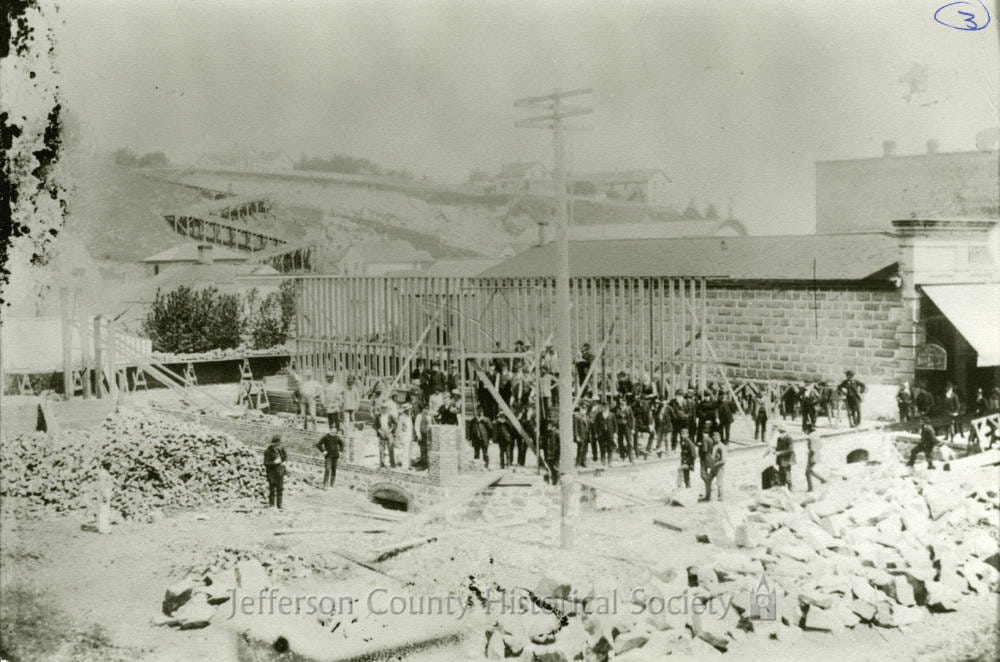
By 1885, we see an inflection point, with 51 properties constructed that year. And from 1887 through 1890 we see a sharp escalation: 20, 43, 58, 104 properties constructed, respectively. 1889 nearly doubles the output of 1887; 1890 nearly doubles 1889. According to historian Peter Simpson, the three years between 1889 and 1891 alone generated 65 percent of the total volume of all the real estate transactions in Jefferson County in the forty years after the town’s founding.
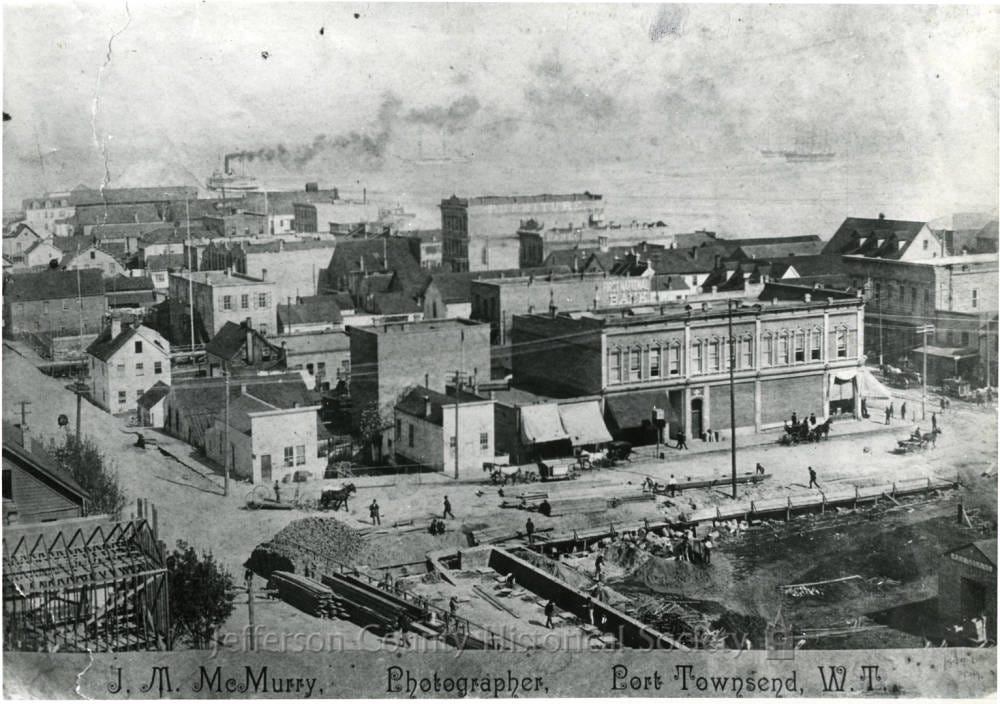
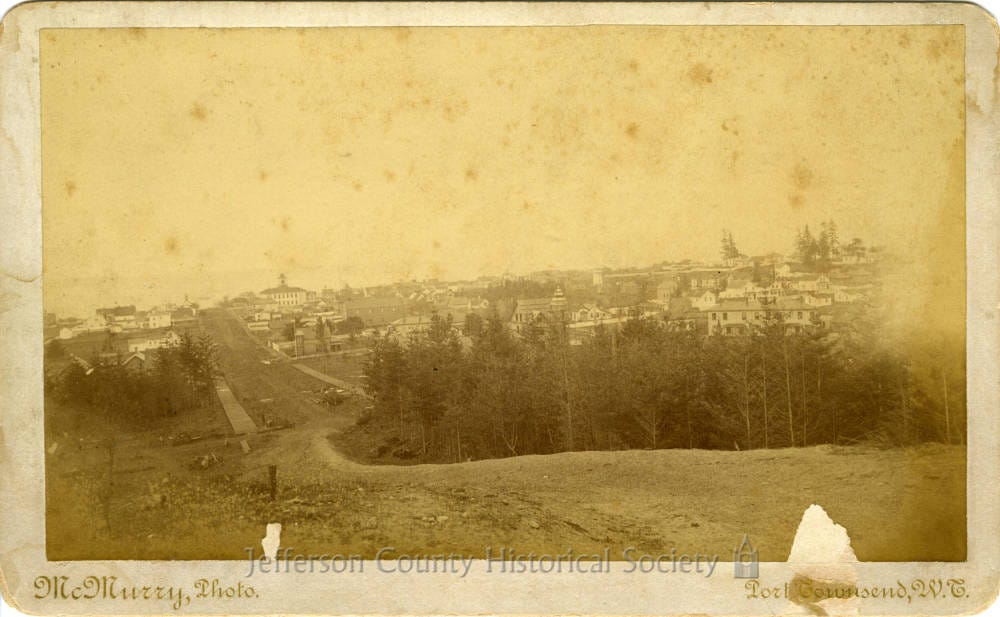
These are the heady years that fueled construction of the massive and architecturally significant Jefferson County Courthouse and the Port Townsend Post Office, Court and Customs House, both of which are listed on the National Register of Historic Places. And Uptown on Tyler Street — one of the most architecturally intact Victorian residential streetscapes in the city — the result can still be observed. Houses follow one another in close succession, not identical, but clearly part of the same interval. Completed in 1889, the house built by Albert C. Adams — now the Adams Pragge House — belongs to this larger act of construction and place-making that unfolded across the town (see the map) within just a few years.
What the numbers reflect in aggregate, the press recorded in real time. On November 25, 1889 — the year the boom crested — the Seattle Post-Intelligencer ran a four-page spread on Port Townsend that devoted considerable space to the peninsula’s climate and had an equally considerable title: “Port Townsend. Facts About Our Thriving Neighbor. Position, Status and Prospects. From a Town to a City in Two Years. Its Enterprising Citizens. How and Why Port Townsend Has Made Such Rapid Progress – Review of the Railroad Situation – Etc., Etc.” The article made the argument that Port Townsend’s meteorological conditions made it a place where outdoor work could proceed with fewer interruptions than elsewhere on the coast. Contractors confirmed it from their own time-books.
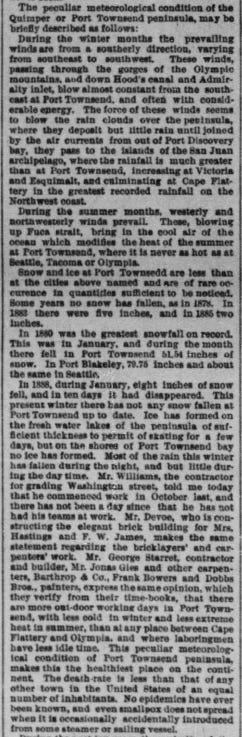
(excerpt)
“Most of the rain this winter has fallen during the night, and but little during the day time. Mr. Williams, the contractor for grading Washington street, told me today that he commenced work in October last, and there has not been a day since that he has not had his teams at work. Mr. Devoe, who is constructing the elegant brick building for Mrs. Hastings and F. W. James, makes the same statement regarding the bricklayers’ and carpenters’ work. Mr. George Starret [sic], contractor and builder, Mr. Jonas Gies and other carpenters, Barthrop & Co., Frank Bowers and Dobbs Bros., painters, express the same opinion, which they verify from work time-books, that there are more out-door working days in Port Townsend, with less cold in winter and less extreme heat in summer, than at any place between California and Olympia, and where laboring men have less idle time. This peculiar meteorological condition of Port Townsend peninsula, makes this the healthiest place on the coast.”
~The Seattle Post-Intelligencer, Monday, November 25, 1889
The building surge was not caused by the city’s climate, per se, but the climate was a significant part of the its marketing to attract residents and — even then — tourists, and the compression of Port Townsend’s building boom into such a narrow span of time certainly benefited from it.
But 1890 is the crest. After that, the numbers fall back: 33 in 1891, 10 in 1892, 1 in 1893, 3 in 1894. The population, too, fell.
The economic bust in Port Townsend in the early 1890s, primarily driven by the failure of the promised Union Pacific/Oregon Improvement Company railroad expansion to arrive, caused the speculative real estate bubble to burst. And the nation’s economic recession in 1893 — the Panic of 1893 — finalized the bust.
The bust did not erase what the boom had built. It stranded it.
By 1896, First National Bank had taken possession of what is now the Adams Pragge House from Albert C. Adams, who had been unable to find a buyer after its completion in 1889. He had been running it as a boarding house; the bank continued to do so while Adams set off to prospect for gold on Mary’s Island in Alaska. The houses he and so many others built stayed. Port Townsend’s accelerated building window left behind an architectural fabric dense enough to outlast the collapse that followed it.
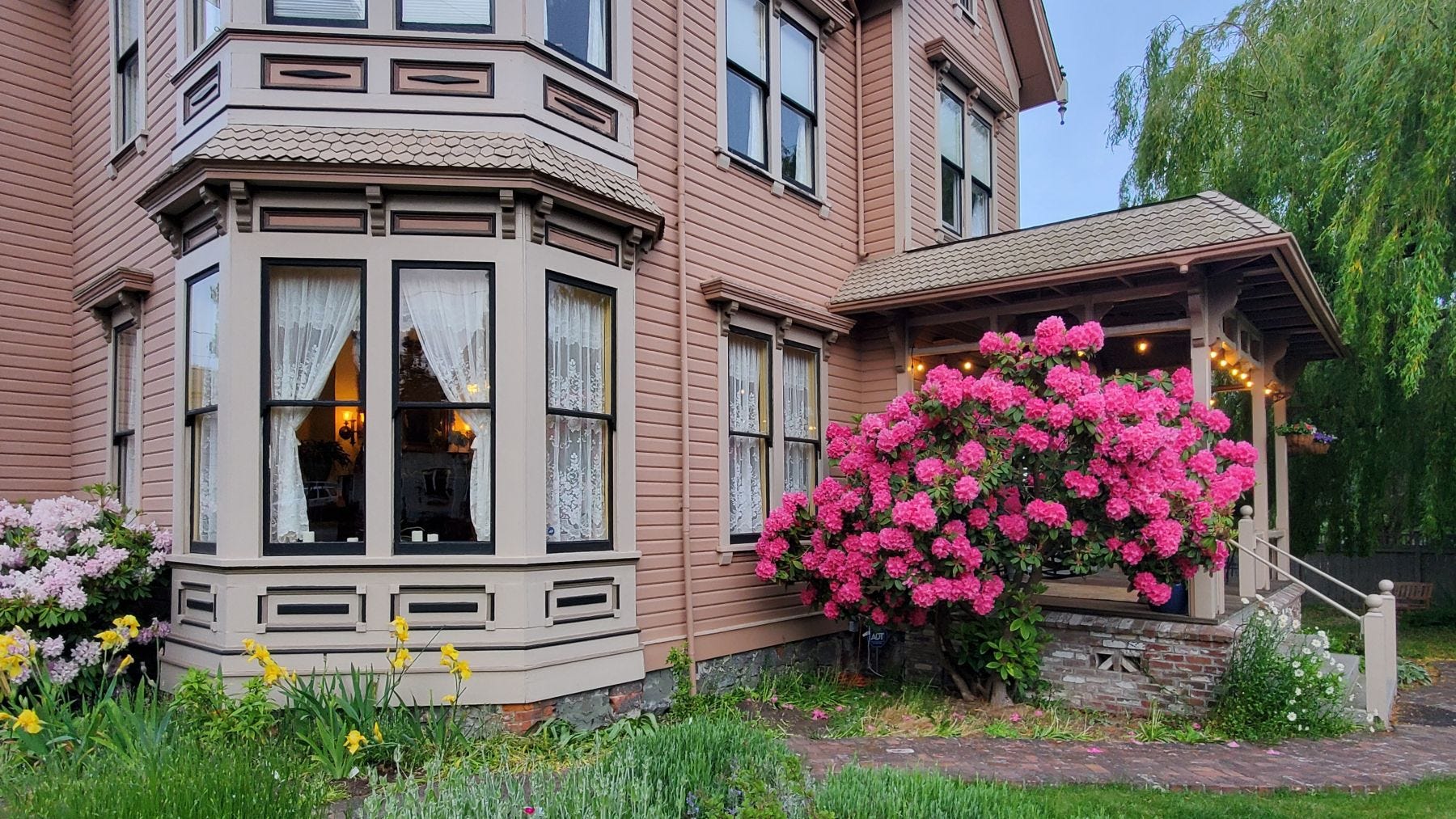
Three rhododendrons grace the property of the Adams Pragge House. Two along the northwest wall start their light pink blooming in late April. The rhododendron at the front of the house — a large, dark pink beauty that defines the facade when in bloom — came to this property by way of the Jefferson County Fair sometime around 1968, won in a raffle by Ron Nowak, his son John recently told us. The Nowaks owned the house from 1962 to 1998 — the longest of any family — and that rhododendron has been blooming here already for nearly sixty years. By the time the Rhododendron Festival opens in mid-May, it is already well into its blooming season.
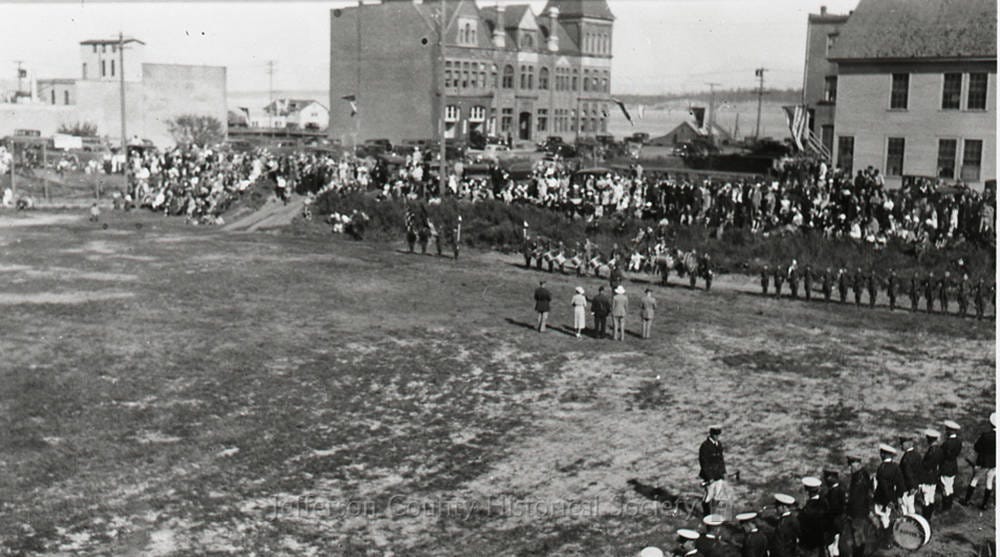
The Festival itself, now in its 91st year, is a massive civic undertaking for a small town. Five days of events: trike races down Water Street, a pet parade, a kiddies parade, bed races with a hair and beard contest for judging, a pancake breakfast, a spaghetti feed, a golf tournament, a Rhody Run, a Chautauqua, and a Grand Parade along Lawrence Street that draws marching bands — high school and college — in numbers you would expect in Seattle, not here. It may call to mind the version of small-town life Walt Disney distilled into a single Main Street, or what Mayberry tried to represent. But here it is not a set or a script. It is a functioning community, in a town with intact historic streets, doing what it has done since 1936, in the same place, at the same point in the year.
The same conditions the Argus observed in February of 1889 — the same conditions that buoyed the building boom.
Summer will come.
The tourists will arrive.
And Port Townsend will arrange itself accordingly, as it always has. But the season when it arranges itself — when the city blooms into flower and festival — is this one.
Zhenya Lavy writes The Turret Journal from within the Adams Pragge House, an 1889 Victorian in Port Townsend, Washington, where she and her husband serve as its stewards.
The Adams Pragge House is a three-suite bed and breakfast in Port Townsend, Washington. Learn more at adamspraggehouse.com.
→ https://adamspraggehouse.com
Related essays from The Turret Journal:
Your documentation of nature and its repeating or not repeating patterns is interesting. I love the photos of the development of the bones of the city. The framework is so interesting to me. The colors of the bushes and trees is swoon worthy!
I could almost smell the lilacs as you led grateful reader back in time, capturing all the excitement of the blooming of Port Townsend.