

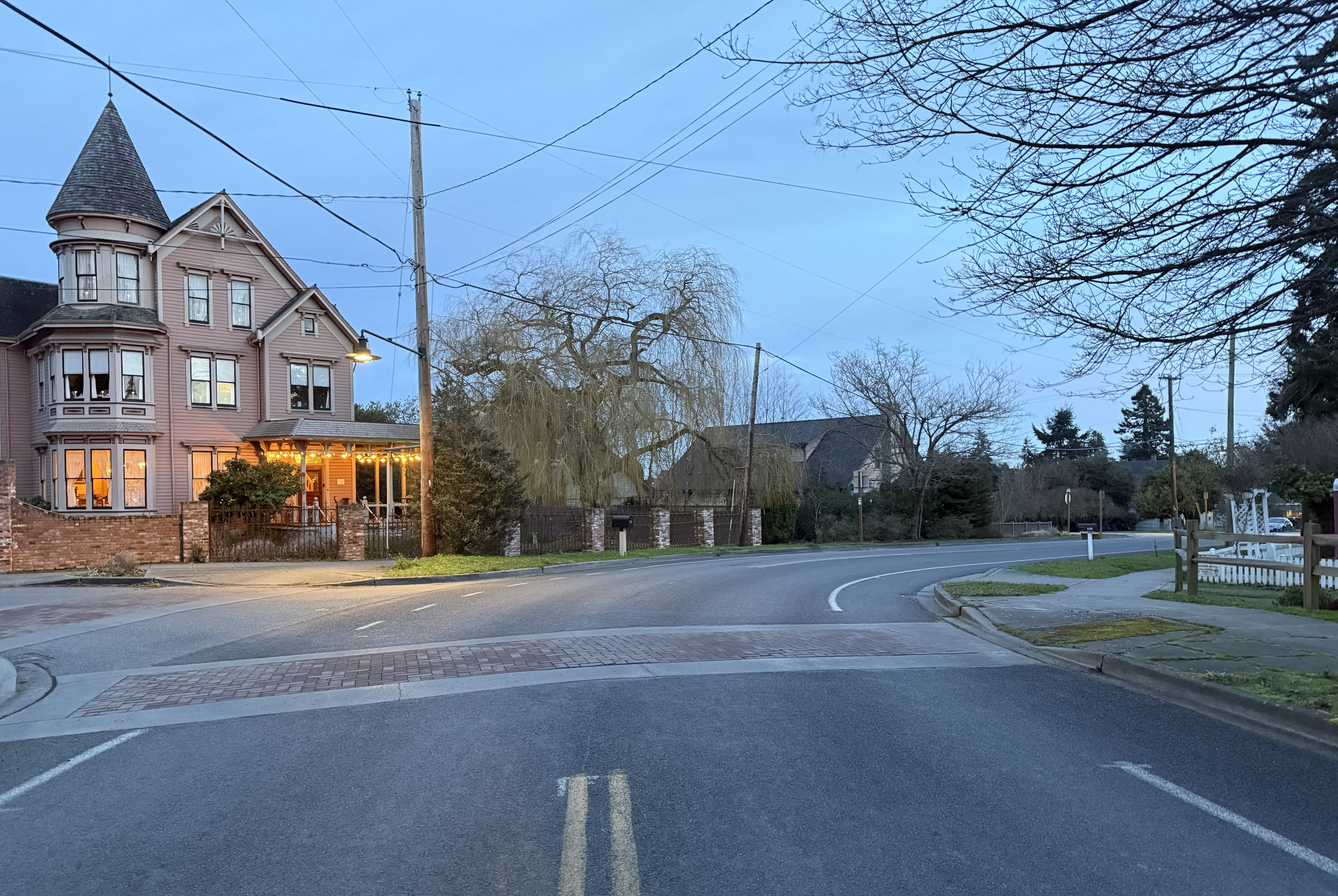
Two routes carry travelers the final leg of the journey along the Quimper Peninsula into Port Townsend, each marked by a moment when the road changes name without announcement.
New visitors arrive along Sims Way, drawn forward by the long approach hugging Port Townsend Bay. The North Cascades rise in the distance beyond Admiralty Inlet, and as the road bends toward downtown, Mount Rainier appears across the water to the right on clear days. The Olympic Mountains, now behind you, complete the horizon. The town reveals itself gradually, then suddenly, as Sims Way becomes Water Street—an architectural time capsule from another era. It is a spectacular entrance, an announcement of arrival.
But there is another way in.
A quieter way, less defined by spectacle. Discovery Road begins beyond the settled edges of town and continues toward it, carrying with it the quiet logic of approach rather than arrival. As Discovery becomes F, the houses grow older, quieter, many set back behind mature gardens and established trees. The street rises. There is no sign, no vista arranged for effect. Only the gradual sense of having passed into the interior life of the town, and of coming upon what was already there.
Then, without ceremony, the house is there.
Today, its full form does not reveal itself immediately. A large limb of a mature Deodar Cedar extends over the street near the bend where F becomes Tyler, obscuring the view until the final approach. Only as you pass in front of the neighboring Stockand House and under the limb of that cedar does the full structure emerge — first rooflines, then upper windows, and finally the turret rising fully into view.
But it was not always so. When the house was built, the approach along F would have unfolded differently: the street rising gradually toward the bend, with the house positioned to meet that ascent — to stand before you at a distance, then nearer, then fully present at the moment when F resolves itself into Tyler. Its placement belongs to that earlier openness, when arrival was measured over distance — like approaching mountains — not in sudden revelation.
Not at the side of the road, but at its turning.
It was an intentional decision, that placement. Made in 1889, during Port Townsend’s years of greatest expectation, when Albert C. Adams built the house at the threshold of Uptown, where the street completes its ascent and changes course in the residential district that embodied the town’s aspirations for permanence and refinement. Adams was a drayman then, accustomed to motion — to departures measured in distance and arrivals measured in presence. The house reflects that understanding. It meets the road. It establishes the neighborhood that follows. It marks the place where Uptown begins.
People notice it differently. Some register only its height, or the curve of the turret. Some notice nothing at all, though later they may recall an awareness of something there. Some pass so frequently in their daily routines that it becomes part of the landscape itself. Others slow — perhaps not quite knowing why and perhaps surprised by the height of the structure suddenly before them — with a fleeting sense of approaching a place with its own interior gravity. Still others pause at the bend and look.
However the house is perceived, Uptown announces itself here.
For more than a century, the house has observed these moments continuously. Morning light emerging from beyond it. Winter rain settling into the grain of the wood and lifting away. Maritime air moving inland from the water below. Sunlight reflected upward from the bay and Admiralty Inlet. The long, slow weathering of years that does not diminish structure but clarifies it.
Inside, the staircase carries you upward into the tower that defines the house from the street. With each ascent, the perspective shifts. The view extends further outward along F, following the same approach that first revealed the house below. Light enters differently at each level, lingering longest in the uppermost room — the turret — where the curved enclosure gathers it more completely. From here, the movement of arrival and departure continues, as it has for generations.
It has taken us time to understand that the house does not exist apart from these arrivals. It was built for them. To stand at that bend where F becomes Tyler as the sign of arrival — a symbol of Uptown — and to welcome those arriving, whether they intend to stop or not.
We are only its current stewards.
The Turret Journal attends to the life of the house as it continues now: to notice what reveals itself slowly, and what remains quietly unchanged at the place where Uptown begins and where what lies ahead becomes visible only by continuing forward.
Zhenya Lavy writes The Turret Journal from within the Adams Pragge House, an 1889 Victorian in Port Townsend, Washington, where she and her husband serve as its stewards.
The Adams Pragge House is a three-suite bed and breakfast in Port Townsend, Washington. Learn more at adamspraggehouse.com.
→ https://adamspraggehouse.com
Related essays from The Turret Journal:
So lovely!
How nice to become reacquainted with your prose, Zhenya. It was like meeting an old friend. Beautiful. Thank you.