

The Turret Journal — Essay IX
Charles E. Coon was one of the best-known men in Washington state: a mayor, lieutenant governor, acting governor, legislator, Civil War veteran, and Acting Secretary of the Treasury of the United States. Yet today, almost no one remembers him. This essay asks how a life of such consequence could fade so completely from community memory.
This essay continues the story begun in “Uncle Charlie” (Essay VIII), which introduced Coon and his connection to the Adams Pragge House. New readers can begin here, though those interested in the full story may wish to read Essay VIII, as well.

Where does water arrive in a house built in 1889?
At the Adams Pragge House, it arrives at the back.
The plumbing rises through the rear of the house to the upstairs bathroom. The later addition, built during Charles Coon’s ownership, extends from the back wall. The windows on that side face northeast across Uptown rooftops, over the bluff at Chetzemoka Park, and out across Admiralty Inlet toward Whidbey Island and the distant Cascades.
This also is the sunrise side of the house, and on the morning this essay is published — the summer solstice — first light began to gather in that direction shortly after 3:30 a.m., with proper sunrise finally arriving at 5:10 a.m.
When Charles Coon bought this house in 1907, city water had been flowing into Port Townsend for barely a year. The system that supplied it — the Olympic Gravity Water System—had been one of the defining projects of his administration as mayor. Water traveled from Snow Creek in the Olympic foothills through roughly twenty miles of pipe before arriving in town.
We only learned that Coon owned the house when we discovered a 1910 permit application connecting it to city water.
That discovery led to another.
Once we started looking, we found Charles Edward Coon’s name seemingly everywhere.
Mayor of Port Townsend. Lieutenant Governor of Washington. Acting Governor of Washington. Acting Secretary of the Treasury of the United States.
Charles Coon left a large paper trail, in newspapers across the country, legislative journals, campaign literature, government records, and obituary notices. And analyzing the record from the vantage point of this house, and the years he spent here at the end of his life, one pattern is unmistakable: everywhere Charles Coon went, he seemed to find himself in positions of responsibility. He became president of organizations. He chaired committees. He managed businesses. He was entrusted with public money, public projects, and public institutions. He was repeatedly placed in charge of things that other people considered important.
He also built things: structure, systems, and in some cases, the very security upon which our country could prosper after the Civil War. But he isn’t memorialized anywhere. He isn’t even remembered.
Why?
Let’s begin at the bottom of the bluff. Downtown Port Townsend. Perhaps behind the counter, in the narrow, deep Bartlett Building storefront at 829 Water Street that extends back to the waterline.
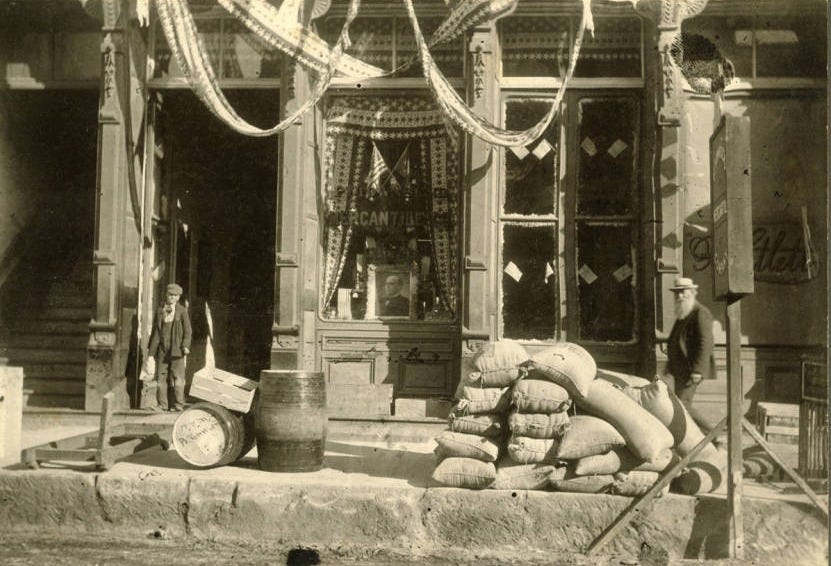
For most of the years he lived in the house at what is now 1028 Tyler Street, Charles “Uncle Charlie” Coon was a grocer. He was president of the Port Townsend Mercantile Company, which the newspapers of the day called the leading business institution of the city, and which advertised itself as “The Sanitary Store” and as “Pure Food Purveyors.” The day-to-day of it was run by Charles A. Pragge — the husband of Coon’s niece, Helen, who shared this house with Coon and who we originally believed had been the house’s owner during this time — but the company was Coon’s, and so was its public character.
There is something the Mercantile Company’s advertisements in the Port Townsend Leader reveal about Coon and his values that the offices, articles, and obituaries do not. From an ad run in December of 1910:
“It’s correct and checks up all right. That is the way we do business — nothing missing, and no shortages.”
This man who had moved the debt of the United States through the banking houses of London advertised that, at his store, your change would be right. The smallness… the attention to detail… were the point.
In these years he also, repeatedly, served as president of the Washington State Grocers’ Association — by 1908 serving his fourth term — and a fixture at the grocers’ picnics and conventions up and down the Sound. This man kept the books, and he kept them clean, and he wanted the town to count on it.
Now let’s climb the bluff, because the next thing he built changed the city.
When Coon was mayor — and he was mayor of Port Townsend across the first decade of the century, and would be again a few years before the end of his life — Port Townsend did not own its water. The city bought its water from a private concern, the Spring Valley Water Company, which drew from a well near the pond at F Street and San Juan Avenue. By the turn of the century, the well could not keep pace with a city that still believed it was about to become great. In 1904, under one of Coon’s mayoral administrations, the city bought out the Spring Valley Water Company and built something new: a diversion on Snow Creek, through a wood-stave pipeline running some twenty miles down out of the foothills of the Olympics, carrying water to the town by gravity alone. Mayor Coon had traveled to Olympia with the city attorney and a representative of the quartermaster’s department at Fort Worden to appear before the state board of land commissioners and secure the financing for the project. He succeeded. The water system came into service in 1906 and had cost, by the reckoning of his later campaign literature, a quarter of a million dollars. One newspaper called it “the pride of every citizen.” When he died, his obituaries singled out this achievement above everything else he had done in the town:
“The Olympic Gravity Water System was built by the city, Mr. Coon being one of the foremost promoters of this worthy enterprise, whose wonderful success has justified the predictions.”
Coon helped take the town’s water out of private hands and make it a public thing — a system the city owned, that ran downhill into every house whether or not the household could have financed a well.
Water security can change the fortunes of a place.
In 1916, at the age of seventy-four, Coon ran for mayor again. His campaign filing statement said he was “bound to no party or faction,” having “relied solely upon my reputation for twenty years’ service to the citizens of Port Townsend.” He won, again, and took office in January 1917 for what his own inaugural address called the duties of mayor “for the fifth time.”
That March, a small notice from the Leader in the middle of a column about other things, revealed that
“The supply line of the Olympic Gravity Water System was recently broken and has been satisfactorily repaired by Superintendent Groves without difficulty, although the water is now coming to town with considerable pressure.”
The man who built the system, a decade on and in his seventies, was the mayor under whom its infrastructure started to show some age and its broken pipe got mended.
In another notice from the same period, we learn that the same mayor, in the same winter, was fielding this:
“A great many complaints have reached Mayor Coon of dogs howling at night, and in one case a sick lady has been very seriously disturbed.”
The dog tax was due. The dog catcher, the notice warned, would shortly be at work. And Charles Edward Coon — the man who had once signed, by one account, an average of four hundred United States Treasury warrants a day, representing nearly seven million dollars — was now seeing to it that a sick woman could sleep.
The water that comes to this house today is not Coon’s water. The system he championed served the town for twenty-two years — 1906 until 1928 — and then, eight years after his death, it was replaced. By then the paper mill and its much-needed jobs and industry had come, and the city had grown, and even Snow Creek could not supply the demand. So the city repeated Coon’s strategy but on a bigger scale, going after the Big and Little Quilcene rivers, and building a new diversion and a new wood stave pipeline now nearly thirty miles long. Over the following decades the wood stave would be replaced by welded steel. And so the water in my tap today descends from a different river, through a different pipe. What Coon actually built — the most concrete, most lasting-seeming thing of his career — was torn out and rebuilt past him within a decade of his death. The principle survived. The public ownership of Port Townsend’s water survived. The Olympic Gravity Water System name survived. But like so many things of the early Pacific Northwest hewn of the wood we had in such abundance, the works did not.
Step back once more, and the scale jumps.
The water and the dogs and the grocery were the work of a mayor. But in the very years he was doing all of these things, Charles Edward Coon was also the second-highest officer of the State of Washington.
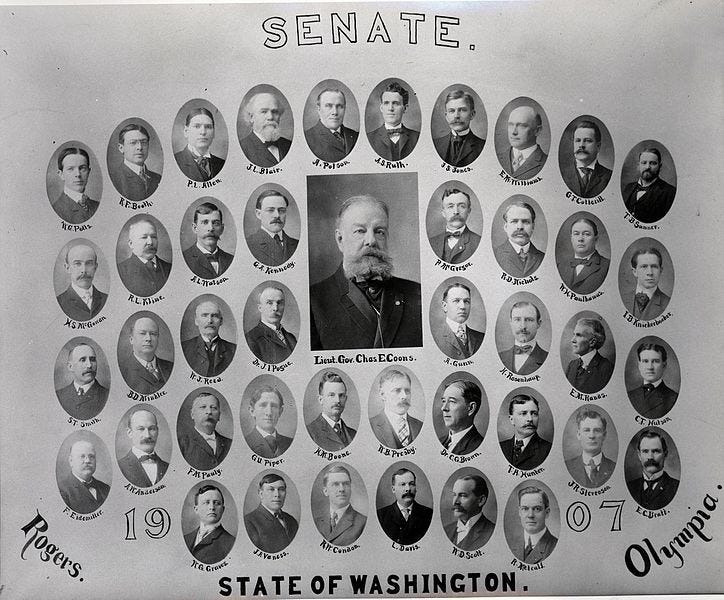
He had been elected Lieutenant Governor in 1904 — the same year he travelled to Olympia to secure the funding for the water system. The Lieutenant Governorship made him the presiding officer of the State Senate, and whenever Governor Mead left the state, Coon was its acting executive.
A 1905 Seattle Star headline reads, “Charles Coon is governor of the state of Washington today.”
He held that power more than once, and headlines declaring the back-and-forth transitions of power from the Governor to Coon have a strange, almost pedestrian flatness to them compared to the long road to power transitions we experience today. In 1905, Governor Mead had gone to an out-of-state board meeting, and in his absence the small-city grocer became Washington’s chief executive. It happened again, and again when Governor Mead travelled to Washington, D.C., to see the President; the duties passing each time to Coon.
In May of 1908, while serving as Acting Governor, Coon came home to Port Townsend while in his official capacity as the acting head of the state, and the town turned out to welcome him. The man who built the water supply and the man who governed the state were, at that time, demonstrably the same man.
And he slept in this house.
The Senate, twice and unanimously, commended him as a presiding officer “of marked ability and fair and impartial manner.”
In 1908 Coon ran for a second term as Lieutenant Governor.
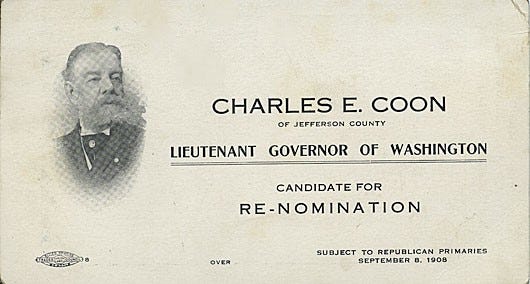
He lost the Republican nomination to a man named M.E. Hay. He did not believe the loss was clean, and he was right. Hay had won by paying newspapers for advertising, which was forbidden by the primary law. Coon said so, formally, to the State Senate, in a written protest in his own voice that survives in the Senate Journal of January 1909:
“I do therefore protest to your honorable body that said M.E. Hay is not eligible to said office ... and that I do continue to hold said office by reason thereof, and I do declare that I am ready and willing to perform the functions of said office.”
He took it to the Supreme Court, which dismissed him. In 1912 he ran for the office again, and he lost again. In 1914 — Hay by now having risen to the governorship — a Seattle paper laid the whole thing bare in an editorial that admitted what the courts had not been willing to act on: that the judges “had to admit in their decision that Hay OPENLY VIOLATED THE LAW IN SECURING HIS ELECTION,” but had let him keep the office because, they said, “THE PENALTY WAS TOO SEVERE.”
He was cheated out of the office, and he could not get it back, and the institution he had served so scrupulously declined to protect him from a man who had not served it scrupulously at all.
This didn’t stop Coon.
A Seattle paper, watching him surface yet again after another defeat, made a comparison that eventually became a touchstone:
“It has been very generally conceded that a cat has nine lives, and from the number of times Charles E. Coon bobs up after he has been put to sleep, the Coon, from a life standpoint, should be classed along with the cat.”
Coon took the joke and made it his own. A decade later, at seventy-six, having won a seat in the State House of Representatives, he gave an interview a Tacoma reporter headlined with his own words: “More Fights, More Cats, Says Veteran.” He served that 1919 session as one of Jefferson County’s two members, was placed on the Appropriations Committee — “one of the most sought-after committees in both houses,” the Leader noted with local pride — and was caricatured on the front pages of the Tacoma papers by two cartoonists in three days — both of them labeling the old man at his desk the same way: “Uncle Charley Coon of Port Townsend.”
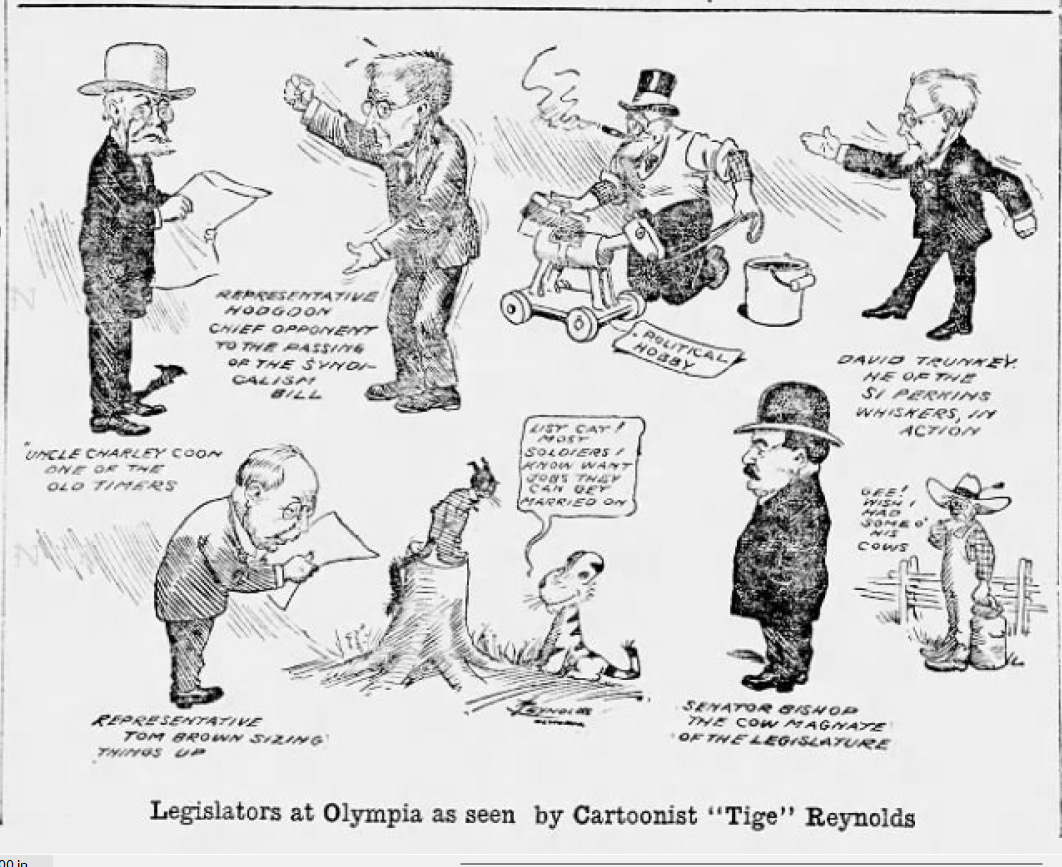
He was, the papers agreed, the oldest of the old-timers, a man who had attended his first political convention at eighteen, in the Lincoln year.
He died the next winter, a sitting legislator.
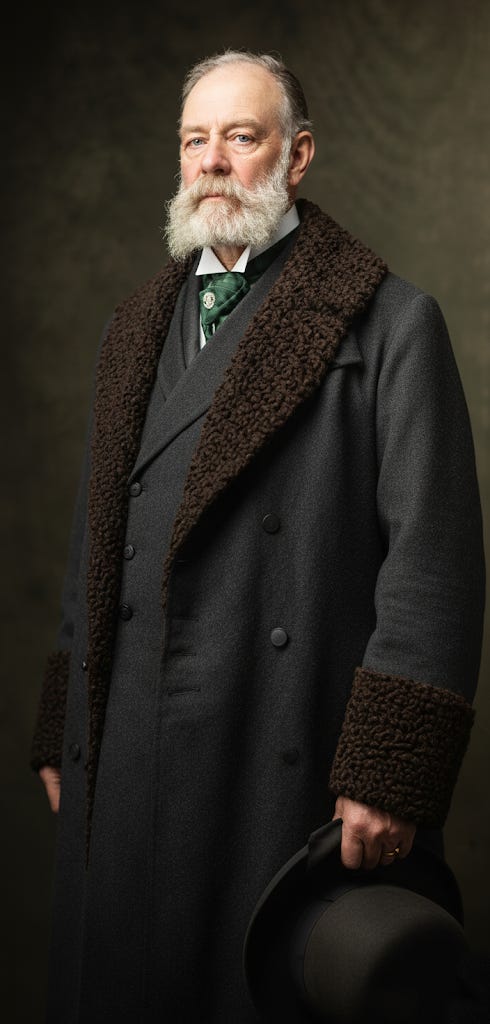
And now we step back a final time, to the outermost ring, the one that ought to have made Charles Edward Coon impossible to forget but did not.
Before the grocery, before the water, before the state, there was the Treasury. Coon went into the Treasury Department in Washington, D.C., as a young man after the Civil War and rose inside it across more than twenty years, from bookkeeper to a position from which, by the campaign accounts of his later life, “more than one billion dollars passed through Mr. Coon’s hands.” The most consequential of that work was done in London. At the request of the Secretary of the Treasury, he crossed the Atlantic after the Civil War to refund the national debt — to convert the government’s high-interest bonds to lower ones. And on one such mission, during the Garfield administration, he “succeeded in refunding seventy-five million dollars at a great saving in interest,” and “Congress promptly recognized Mr. Coon’s services in this connection.”
A daily account from his Washington years gives the texture of it: he “signed an average of four hundred treasury warrants every day, representing nearly seven million dollars.”
In April of 1884 President Arthur named him Assistant Secretary of the Treasury, and the Senate confirmed him at once. When the Secretary fell ill that summer, Coon became the Acting Secretary of the Treasury of the United States. The machinery of federal finance moved under Coon’s signature. He was forty-two years old. His rulings in that office, one paper wrote, were “of such marked good sense as to attract the attention of the country, and inspire many strong appeals for his promotion to the Secretaryship.” From London, Sir Nathaniel Rothschild — a major political and philanthropic figure, and close friend of the future King Edward VII, he also would be the first Jewish person to be elevated to the British House of Lords as a peer — cabled the American government about Coon’s confirmation directly:
“Congratulate you and American Government on its excellent choice.”
But Coon did not keep the office long. When the administration changed in 1885 and a Democrat came into the Treasury, Coon — a Republican of, as one paper put it, “a very decided kind” — was asked to resign, and did, in a letter reprinted across the country that asserted, without bitterness, a “service of nearly twenty years in the Treasury, without the intervention or solicitation of a single politician.” He offered to go the moment he was asked, and he went. Years afterward a Washington paper still called him “one of the best financiers that ever occupied the office.”
Charles Edward Coon refinanced the debt of a nation. The bonds he converted matured and were paid and vanished into the ordinary functioning of the nation he served. The most consequential thing he ever did is also the most completely invisible.
The world does not build statues to the smooth functioning of a Loan Division.
Following his departure from the Treasury, he traveled twice to Europe on private financial business. He cruised the New England coast aboard the yacht of General William Tecumseh Sherman — the most famous living American soldier — and their excursion made the papers. In 1888, the Republicans of the Tenth New York congressional district nominated him to run against General Dan Sickles — a Civil War officer who had lost his leg at Gettysburg and gone on to serve as Minister to Spain — in a district that favored the Democratic name. Coon lost the race. He ran one thousand votes ahead of the Harrison presidential electors, outperforming the top of the Republican ticket in his own district, and losing to the larger name anyway.
He became briefly vice president and treasurer of a company promoting Elisha Gray’s telautograph, a device that transmitted handwriting over telegraph wire, whose backers called it “The Telephone’s Rival.” The company failed to become what its backers imagined.
Then, in 1895, he traveled west to visit his niece, Helen. She had married Charles Pragge and was, at the time, living in Tacoma. Coon liked what he found in the Pacific Northwest, and in 1897, he moved to Port Townsend. His niece and her family, as well as his sister Camilla, all would follow him there and would live with him in this house.
One thread that runs under all of it, from the first record to the last, is also visible in the oldest record.
The earliest document we have of Charles Coon, from March 1867, has nothing to do with finance or government. It records that the young men of Washington, D.C., had organized themselves into an association of baseball players — the sport then barely out of its cradle, not yet professional, still a thing gentlemen did in clubs — and that they had elected, as the president of the Empire Club, one Charles E. Coon.
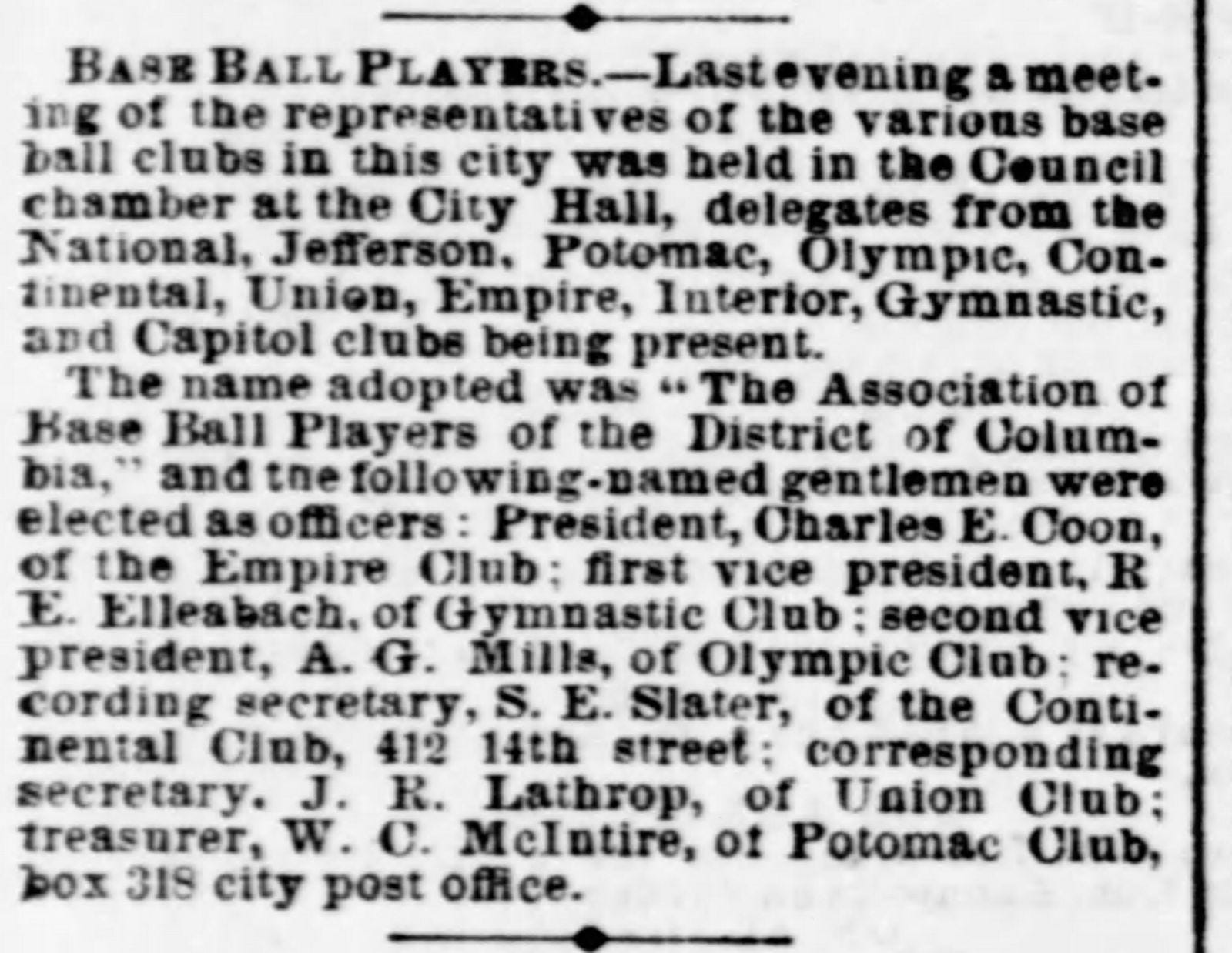
He would later, in an 1892 article in the Washington Evening Star reminiscing about baseball’s “olden times,” be remembered as a “brilliant player.” In November of 1870, he was elected an Alternate Delegate to the National Base Ball Convention.
In 1869, he was a founding charter member of the Masons’ Pentalpha Lodge No. 23, alongside future president James A. Garfield. In November of 1872, he was elected M. E. high priest of the Masons’ Lafayette Chapter, No. 5.
From an early age, Charles Coon seemed to almost naturally find himself entrusted with leadership.
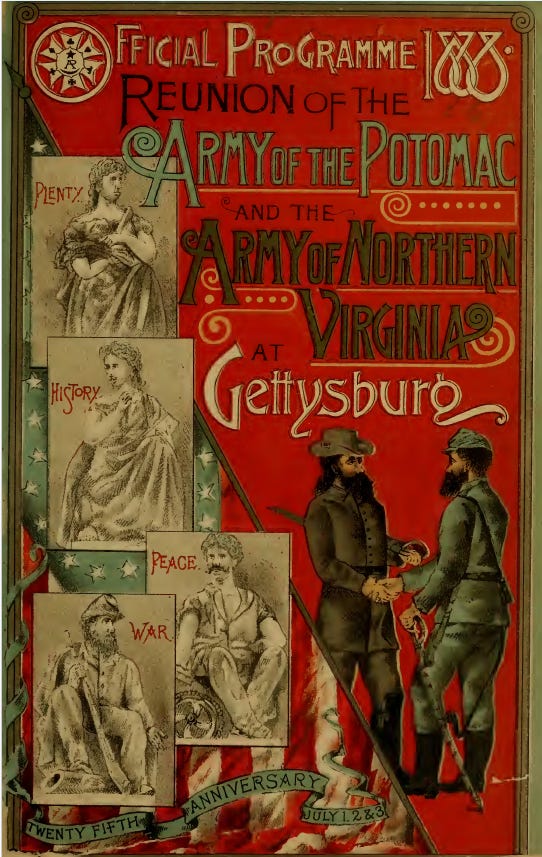
A deeper layer beneath even that was the Civil War. Coon had enlisted as a boy and served in the 23rd New York Volunteers as part of the First Corps in the Army of the Potomac. He was appointed 3rd Corporal April 27th,1861 — a little more than a month after his 19th birthday. His regiment saw considerable action. He fought at the second Battle of Bull Run, Fredericksburg, and Antietam. He was pulled from combat and promoted to deputy Army provost marshal for an area encompassing the southern part of New York State and was discharged for disability January 20th, 1863. He carried that soldier in him the rest of his life: a leader in the Grand Army of the Republic, the presiding officer of its local post. He was vice president of the Society of the First Corps for the 1888 reunion in New York of the Army of the Potomac and the Army of Northern Virginia at Gettysburg. He marched with the veterans into his old age.
He died in Port Townsend in this house on January 8, 1920 — in his sleep, having suffered a paralytic stroke five days earlier. He was surrounded by his niece and her family.
The military command at Fort Worden — the army post guarding the mouth of this harbor less than a mile north of this house — ordered out its band and a detail of soldiers to carry him to the cemetery “as a mark of respect to the memory of a man who had served his country well, both as a soldier and as a high official under the government.”
According to the Leader, the Masonic Temple was filled to overflowing. Every prominent man in this part of the state attended his funeral. Then soldiers from Fort Worden carried the old soldier up to Laurel Grove Cemetery and put him in the ground. The loop that opened on a battlefield in 1861 closed on a hillside above Port Townsend fifty-nine years later, when men in uniform like he had worn, laid him to rest.
Coon’s life and public service deserve a book.
For today, let us simply return to where we started:
It’s May of 1908. He is the acting Governor of the State of Washington, and he has come home for the week. Port Townsend had turned out to welcome him. It is morning. He stands in a room at the back of the house, preparing for his day. Perhaps up before any others, observing the early light of dawn that I, too, watch and document in photos every morning a century later. He is, in that single moment and all at once, the grocer who keeps the change right, the mayor who built the water and minds the dogs, the presiding officer the Senate twice celebrated for his fairness, the acting Governor of the state, the man who once acted as Secretary of the Treasury of the United States, the young man who participated in the dawn of America’s pastime, and the boy who went to the war. It is all true at the same time, in the same man, in the third-floor room at the back of this house, where the water he championed and secured as a public good for his city flowed.
Port Townsend’s water runs from another river now. The bonds dissolved into the solvency of the country. The offices passed to other men. His Mercantile is gone. The name on his gravestone is not a title but an endearment. The city’s connection to the man who had done so much grew thinner with each generation.
The house where he lived stood at the intersection of streets named for a former president and for a man who had at one time been a political colleague — neither of whom ever set foot in or had anything to do with Port Townsend — and that remains true today.
Coon’s name appears nowhere.
But then, he did not spend his life building things to bear his name. He built things to serve the community.
A man who had held the whole scale of American public life — who had governed a state and steadied the Treasury — spent the last decades of that life making sure a small harbor town of six thousand had clean water, honest weights, and a quiet night’s sleep. He brought his largest capacities to the smallest stage and gave them undiminished.
The morning light broke softly this Summer Solstice, filtered through the maritime atmosphere, a blanket beyond which the Cascades hid, a massive presence, invisible but assured, in the distance.

*Sources for this essay include the Port Townsend Leader archives; the Journal of the Senate, State of Washington (1909); the Seattle Star, the Seattle Republican, the Tacoma Daily Ledger and News Tribune, the Spokane Spokesman-Review and Daily Chronicle, the New York Times and New York Sun, the Washington Post, the Washington. D.C. Evening Star, and the Buffalo Morning Express, accessed through Chronicling America (Library of Congress) and the Washington State Digital Archives; the records and history of the Olympic Gravity Water System published by the City of Port Townsend, Department of Public Works; and the collections of the Jefferson County Historical Society. Also Camp Fires of the Twenty-Third: Sketches of the Camp Life, Marches, and Battles of the Twenty-Third Regiment, N.Y.V., During the Term of Two Years in Service of the United States (New York: Davies & Kent, 1863).
Special thanks to Joseph Lavy, whose years of archival research into the history of the Adams Pragge House and its residents made this essay possible.
Zhenya Lavy writes The Turret Journal from within the Adams Pragge House, an 1889 Victorian in Port Townsend, Washington, where she and her husband serve as its stewards.
The Adams Pragge House is a three-suite bed and breakfast in Port Townsend, Washington. Learn more at adamspraggehouse.com.
→ https://adamspraggehouse.com
Related essays from The Turret Journal:
Uncle Charlie may have had to wait 106 years for a proper eulogy, but you have honored his memory beautifully. His spirit sighs proudly.