

The Turret Journal — Essay X
Charles E. Coon was one of the most visible public men in Washington: a Civil War veteran, federal Treasury official, Port Townsend mayor, lieutenant governor, acting governor, and state legislator. Yet the most private parts of his life survived only as silence, kinship, innuendo, denial, and one gravestone reading “Uncle Charlie.” This essay considers what can be preserved, what can be weaponized, and what must be left sacred.
This final essay in the sequence follows “Uncle Charlie” and “The Measure of a Man,” which introduced Coon’s public life, his connection to the Adams Pragge House, and the problem of community memory. New readers can begin here, though those interested in the full story may wish to read Essays VIII and IX as well.
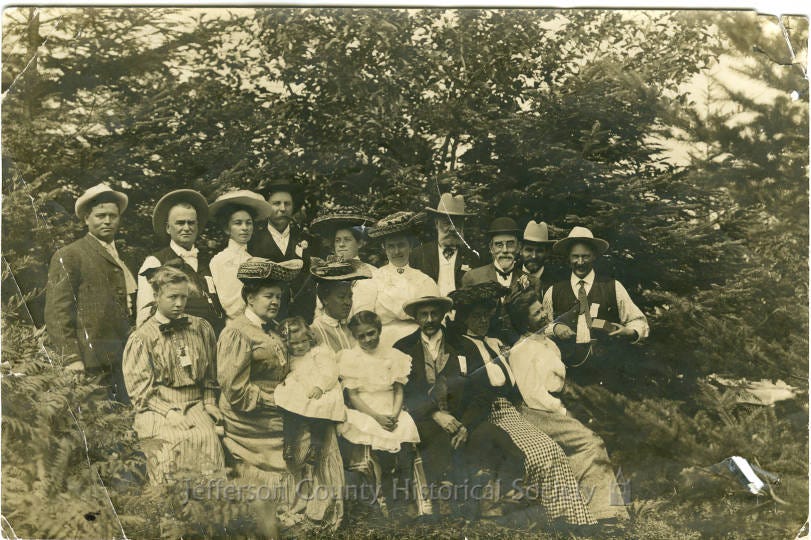
After Charles Edward Coon’s death, his estate was counted, and on September 3, 1920, in the Superior Court of Washington for Jefferson County, the decree of distribution was entered in probate case number 770. The court had received the final report of Helen Louise Pragge, executrix of Coon’s estate and also his niece. It found the proceedings correct and regular: the estate had been appraised; claims, taxes, inheritance tax, costs, and charges had been paid; and a true inventory of the property had been filed.
The record could account for many things.
It could account for the house at 1028 Tyler Street, other lots in Port Townsend, cemetery property at Laurel Grove, and land in Irondale. It could account for shares in the Port Townsend Mercantile Company, the Washington Coast Utilities, the Seminole Land & Investment Company, the Olympic Fair Association, and the Olympic Canning Company. It could account for war savings stamps, one hundred fifty dollars to a surviving sister, three hundred dollars to Allan Trumbull for his work as attorney and three hundred dollars to Helen Louise Pragge for her service as executrix. It could account for the fact that Helen Louise Pragge was the sole residuary legatee — receiving what was not otherwise gifted or owed.
His property could be inventoried.
His life could not.
Charles Coon had spent much of his life visible in records: muster rolls, payrolls, Treasury documents, newspapers, legislative journals, election returns, city minutes, federal directories, tax notices, deeds, party reports, campaign columns. His work was noteworthy, as a Civil War veteran, Treasury official, Assistant Secretary of the Treasury, acting head of the department, a congressional candidate in New York, mayor in Port Townsend, lieutenant governor of Washington — for part of that period, mayor and lieutenant governor at the same time — and finally, in old age, as a state legislator.
The public man left traces in abundance.
The private man did not.
That difference is our subject.
At the time of the 1910 census, Charles Coon owned and was living in the house at 1028 Tyler Street. At that time, the street name was still Maple. The census records Coon not as husband, father, or head of a conjugal household, but as uncle within the Pragge family. His niece, Helen Louise Pragge, and her husband, Charles A. Pragge, were the center of the domestic structure, which included their daughter — also named Helen but called “Nellie” — as well as Helen Louise’s mother, Camilla Merrick, who was Coon’s sister. Coon had helped raise his sister’s children after their father died, and his place in this household was kinship.
Kinship was a category the early twentieth century understood. A man might be unmarried and still housed. He might have no wife and no children yet not be alone. He might enter old age not in an institution or rented room, but among family, meals, callers, errands, illnesses, habits, and objects.
In that sense, Coon’s life at Tyler Street was not marginal. It was an intimate form of belonging. Domestic. It had address, relationship, continuity, and eventually inheritance.
Coon, the Pragges, and other members of the family network are buried together at Laurel Grove Cemetery, in a family plot that Coon provided when his sister, Camilla, became the first member of the household to be interred there in 1912. And when it was Coon’s turn to make his final rest there, the man who had held offices, crossed the continent, worked at the center of federal power, and moved through public life with unusual confidence received a modest gravestone. Its inscription forewent the ceremonial, titular weight of “Charles Edward Coon” to read, simply, “Uncle Charlie.”
Whatever affections, obligations, irritations, dependencies, jokes, routines, and acts of care had accumulated in their daily life within the house, the law ultimately could keep only the parts with specific names. Coon: deceased, resident of Port Townsend, testate.
The public record kept his titles, votes, and achievements.
The family ground kept the kinship.
Each preserves evidence of his life while stripping it of atmosphere.
Coon was not a man who passed invisibly through his era. The papers — which, for a time, could not get enough of him — made that plain. They remarked upon his height, his long legs, his beard, his manners, his bearing. In 1904, during his campaign for lieutenant governor, one paper said he had a commanding presence and was the kind of man who “would be picked out from a crowd of a thousand.”
It is a theatrical image: Coon in a crowd, marked out by height, age, whiskers, carriage, reputation. A man made for public rooms — seen immediately.
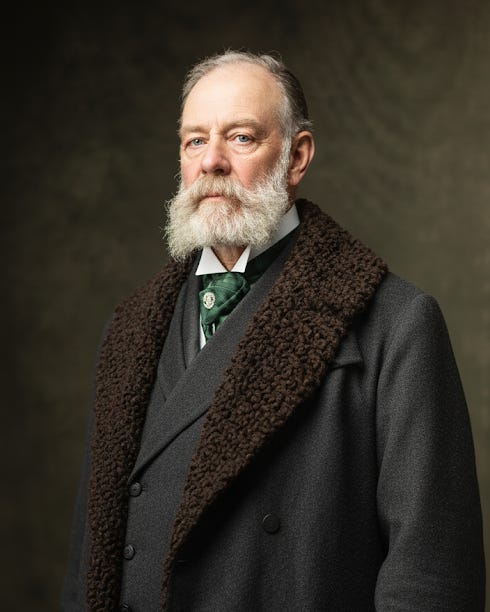
The papers could see — and help us see — his body. They could see his offices. They could see his ability to speak, preside, campaign, manage, and endure. They could see the “flowing whiskers” that made him a conspicuous mark in a parade. They could see the old soldier, the public servant, the bachelor, the candidate, the mayor.
But visibility is not the same as legibility.
These were surfaces a nineteenth- and early twentieth-century public culture knew how to understand.
Something more of Coon is made legible through the American flag.
He had gone to war as a young man and come home a veteran. The emblem he had served under during the Civil War stayed, for the rest of his life, one of the plainest signs of what he thought public life was for. His reverence for the flag extended into his household and his business. The record shows that in June 1912, the Port Townsend Mercantile Company gave out 1,584 small American flags — eleven gross — to its customers for Flag Day. Five years later, on April 18, 1917 — twelve days after the United States entered what was then still called the European war, not yet World War I — Mayor Coon went before Port Townsend’s city council and asked the city to fly the flag.
He spoke of duty and pleasure in the same breath:
“At a time when our country is engaged in a struggle for the maintenance of the just rights as a free and independent people, it would appear to be the duty as well as the pleasure of every citizen to show his fealty to his country, to which he is indebted for the preservation of the rights of a free man. One of the means by which he can do this is to display the glorious flag of his country, a flag which has always been the symbol of freedom and the rights of man.”
Although other cities were requiring the display by ordinance, under penalty, he chose not to recommend compulsion. He only noted that few citizens had yet put out their colors and allowed his suggestion to stand.
On Flag Day that same year, June 14, the Elks gave the city a flagpole, raised midway up the Taylor Street stairs above the Haller Fountain. With the Sixth Artillery band playing and the parade forming behind him, Coon accepted the flagpole on behalf of the city. The gift, he said, would see “this glorious flag fly from it every day.”
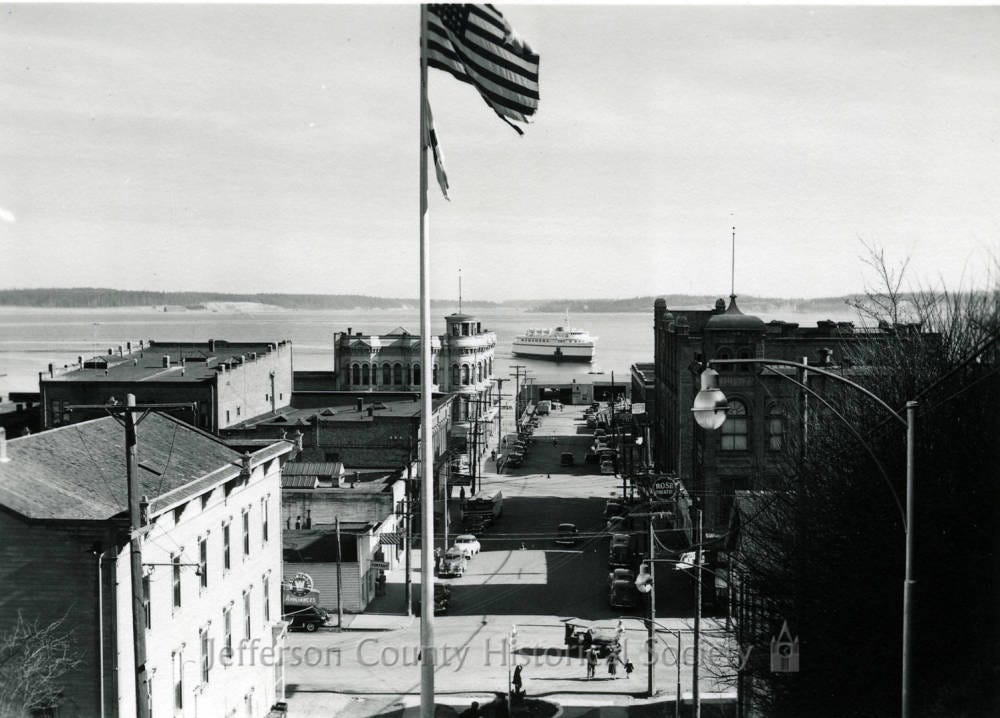
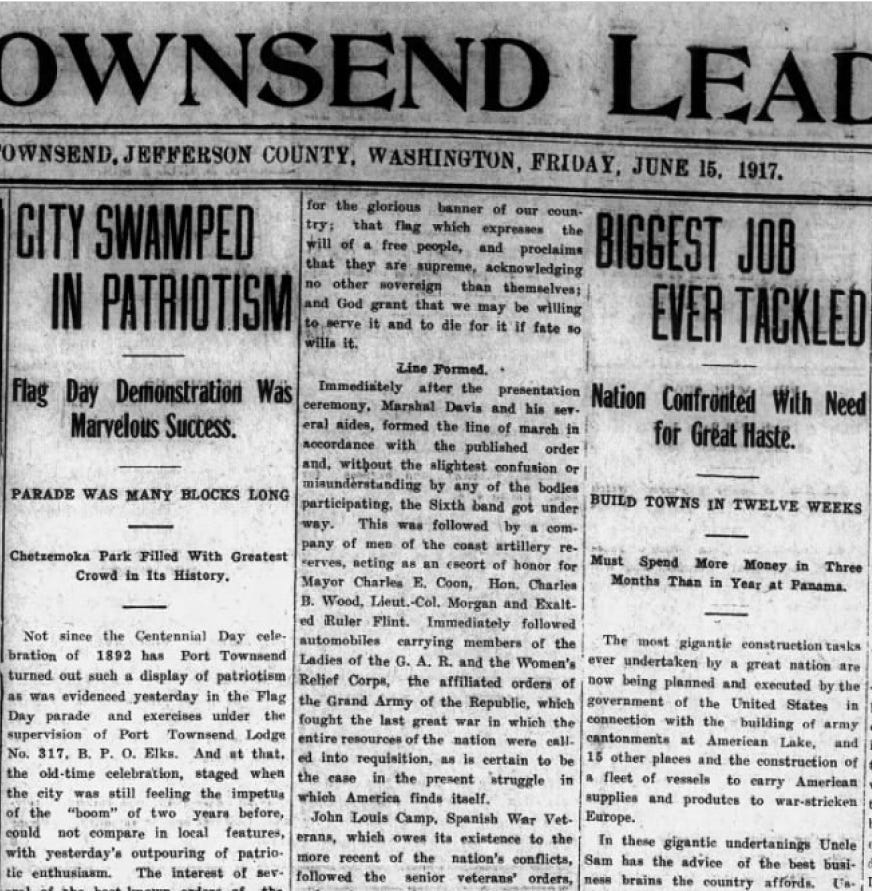
The next day’s Port Townsend Leader front page declared, “CITY SWAMPED IN PATRIOTISM — Flag Day Demonstration Was Marvelous Success; Parade Was Many Blocks Long” and described the attendees as the “greatest crowd of patriots in city history.”
Weeks before Flag Day, on May 3, the Leader reported among its front-page news that “Mayor Charles E. Coon is meeting with hard luck in his efforts to keep the Old Glory flying” at his home. Whether a result of foul luck or foul play, the man who asked the whole city to raise the flag was finding it difficult to keep his own aloft at home.
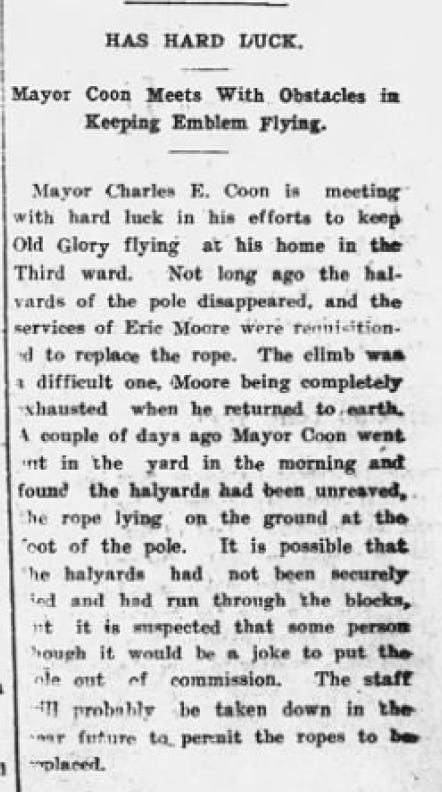
It is the kind of detail the record rarely preserves. A public devotion and a private difficulty, the same season, the same man, a handful of blocks apart — walkable in less than 10 minutes. A flag at the stairs would be raised for the whole town. The flag at the house would not hold.
The story his world knew how to hear circulated in the language of freedom, duty, citizenship, service, nation, sacrifice, public belonging.
Even so, the more telling human narrative — and the pathos — is in the gap.
At times, the record around Coon convulses.
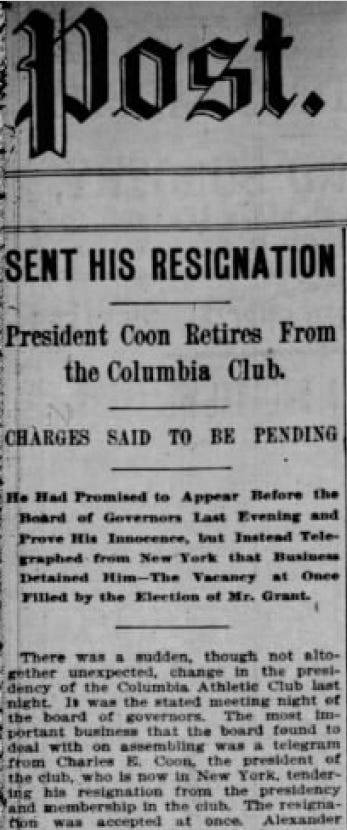
On April 12, 1894, while he was president of the Columbia Athletic Club in Washington, D.C., a front-page Washington Post report declared: President Coon retired from the club. Charges were said to be pending.
He had promised to appear before the board of governors and prove his innocence. Instead, he had sent word from New York that business detained him.
The article is built around innuendo.
“Rumors in regard to President Coon’s conduct as a member of the club had been circulated,” the Post reported. Coon had indignantly denied the truth of the charges. He had said he would appear and convince the board of their falsity. Then he left the city. The club secretary acknowledged rumors, regretted the timing of the resignation, and said there had been no charges filed. Had charges been preferred, he added, they likely would not have been given out. That was not common club practice.
It’s a recognizable pattern: rumor, conduct, denial, absence, resignation, no charges, no publication, no naming.
The article closes with biography: Coon’s previous high government positions, current roles, and continuing political ambitions — concluding, “He is well known in New York club life. He is unmarried.”
In some circumstances, that sentence would not mean much. But in this placement, it becomes part of a mechanism. The article cannot — or will not — say what the charges were. The club will not give them out. Coon denies them. The only printable facts offered to readers describing him amid scandal are position, ambition, club life, bachelorhood.
Later that month, on April 21, the Evening Star reported that Coon also had to resign his post as confidential clerk to the quartermaster general of the Army — and that it was “not altogether voluntary.”
A life can become legible through omission.
Ten years later, in 1904, the same pattern returned in Washington State — this time not in a club but in a campaign — and from within his own party. Coon was the Republican nominee for lieutenant governor.
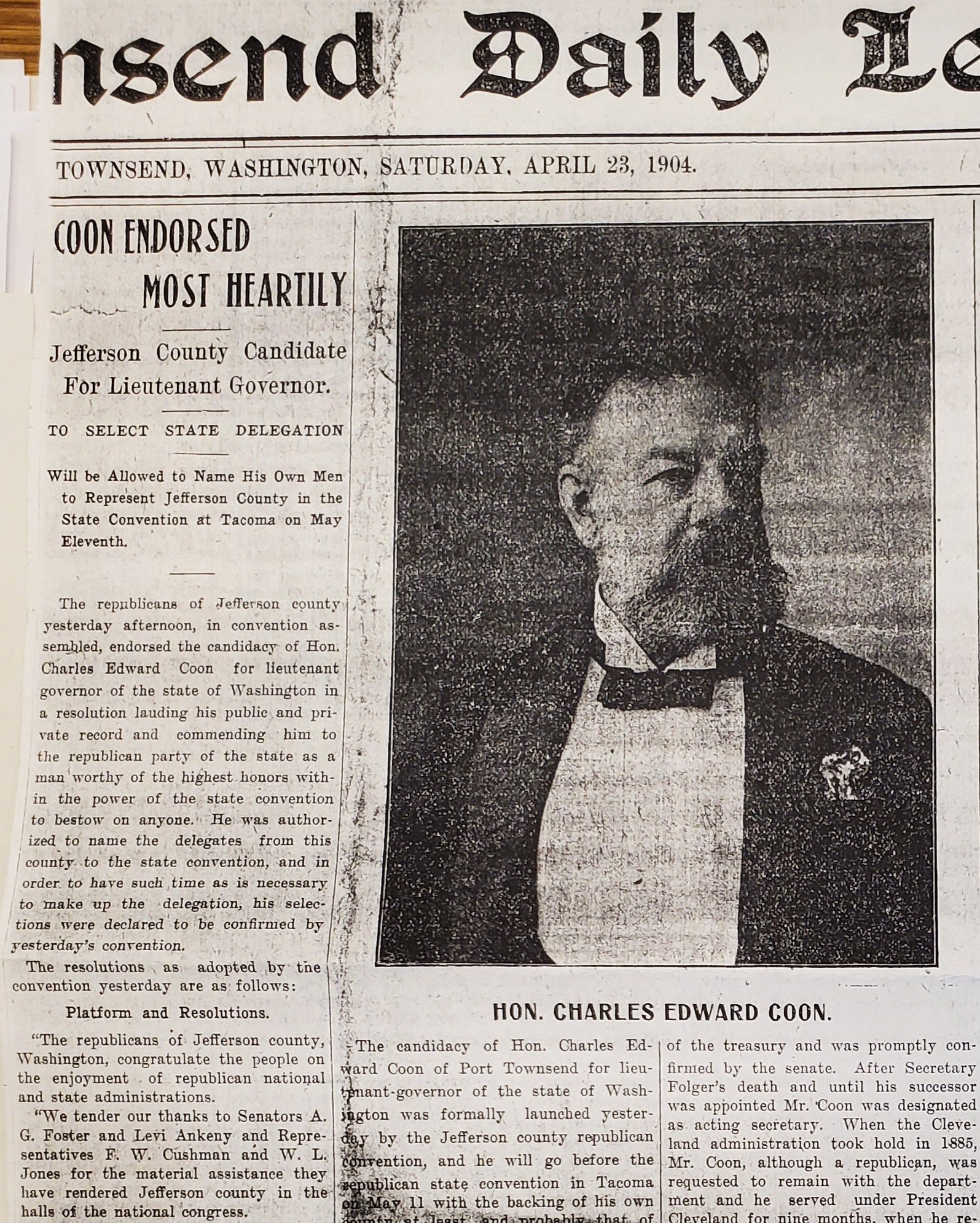
The “war on Coon” was launched shortly after the convention by men who wanted Coon off the ticket so they could install an Eastern Washington man. Eastern railway managers had needed Coon to carry the northwest counties in a recent election, but they had no more use for him. Even papers hostile to Coon seemed uneasy with the charge, which was so ugly that it was printed mostly through denial.
A defense of him in the July 14, 1904, Anacortes American named the smear by condemning it: “the false statement that Charles E. Coon is the Oscar Wilde of Washington Republicanism.”
The comparison was potent. In 1904, Oscar Wilde’s trials were only nine years in the past, and his name had become a public shorthand that could do the work a respectable paper preferred not to do in direct language. To call a man the Oscar Wilde of anything was not merely to call him artistic, theatrical, foreign, or decadent. In a political campaign, especially, it was to place him under a specific sexual suspicion while preserving just enough indirection for the paper to pretend it had not printed what it had printed.
That shorthand hadn’t existed at the time of Coon’s Columbia Club resignation, but in 1904 it made a category of being visible — and poisonous.
On June 13, the Evening Statesman of Walla Walla had called the story “probably a base slander,” a factional scheme to force Coon from the ticket. The paper defended him by recounting public evidence: his office, his service, his age, his bearing. It insisted that even the Democrats of the state had no sympathy with the calumnies circulated against him by his own political associates. In other words, even those across the political aisle could recognize the tactic and were repulsed by it.
For those who sought to defeat Coon from within his own party, the allegation was expedient because it did not need to be proven. It needed only to attach itself to him long enough to make him vulnerable.
Two weeks later, on June 28, the same paper gave the most explicit account yet — and, in the same breath, professed its disbelief:
“It is not easy to believe that a man of such fine bearing and aristocratic appearance would stoop to the hideous vices with which he is charged. While Mr. Coon is a chronic officeholder who has had a long pull at the public teat, the fairminded people of the state will be slow to believe that he is not a gentleman in private life.”
But in doubting the charge, the article also spelled it out. The “scandal,” it reported, had “reached a climax”: an “unsavory lot of stories reflecting upon Coon’s private character” had been circulating for more than a month. Senator A. S. Ruth of Thurston County was named in many of them as one of the men who had “narrowly escaped Coon’s seductive wiles” on a boat trip from Seattle to Port Townsend. And Republican leaders charged that Coon had been expelled from a fashionable club in Washington, D.C., because of his “degenerate habits.”
And there it is.
The record finally says what it means, but only by borrowing language of disgust. “Seductive wiles.” “Degenerate habits.” “Hideous vices.” “Private character.” “Scandalous.” “Unprintable.” Words that don’t reveal anything about Coon’s interior life but do reveal the terms under which such an interior life could be dragged into public view.
The 1904 story also tied the campaign attack to the 1894 club episode. Contemporaries saw the connection. Whether they knew more than they printed, whether they repeated what they had heard, whether the old club scandal had become a convenient weapon in a new political fight — the archive does not settle the question. Instead, it gives us the pattern, the recurrence, the political usefulness of the insinuation.
The Spokane Spokesman-Review gives us a brief glimpse of the impact on Coon:
“Coon is prostrated at his home in Port Townsend by the attack which has been made upon him. His friends say he is overwhelmed by the attack, and is suffering extremely from the sensational nature of the charges which have been made against him.”
When it came, Coon’s rejoinder was brief. The Spokesman-Review introduced it as his first public statement on the “scandalous and unprintable charges” concerning his private character.
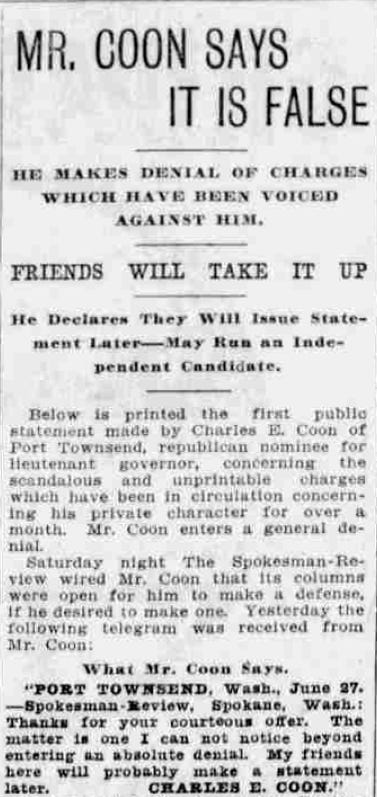
His telegram read:
“Thanks for your courteous offer. The matter is one I can not notice beyond entering an absolute denial. My friends here will probably make a statement later.”
What a remarkable sentence: “The matter is one I can not notice.”
Not “will not” — “can not.”
It may have been the only survivable response. To answer the charge in detail would have required repeating it. To repeat it would have given it form. To give it form would have invited the public to imagine the very thing he needed kept from the center of the campaign.
So he denied it and refused it.
We should take that refusal seriously. Coon said the charge was false. His allies said the charge was false. The papers defending him called it slander and calumny. Nothing in the record gives us the right to judge him on the terms of his enemies.
But the attack itself is evidence: not necessarily evidence of what it claimed, but evidence of a world that knew how to hint, shame, threaten, and expel. It knew how to make an unmarried man’s private unknowability useful.
He did survive it.
He stayed on the ticket. He continued in public life. He later served as lieutenant governor. He kept appearing in newspapers, meetings, elections, ceremonies, and legislative chambers. A Seattle paper would eventually joke that Coon had nine lives.
Public men can be killed politically many times.
Coon returned by refusing the terms of the attack.
But survival has costs that escape the record.
What did he burn, keep, say, deny, confess, protect, ignore? What letters did he not write? What letters did others destroy? What did Helen know? What did Charles Pragge know? What did the household know without saying? What did Port Townsend know, or think it knew, or agree not to know? What did Coon know about himself in the language available to him? What words would he have rejected? What words would have wounded him? What words might have relieved him? Which parts of his life belonged to desire, which to loneliness, which to habit, which to grief, which to affection, which to mere public cruelty?
While the archive cannot answer, that unanswered part is not empty. It is the fact.
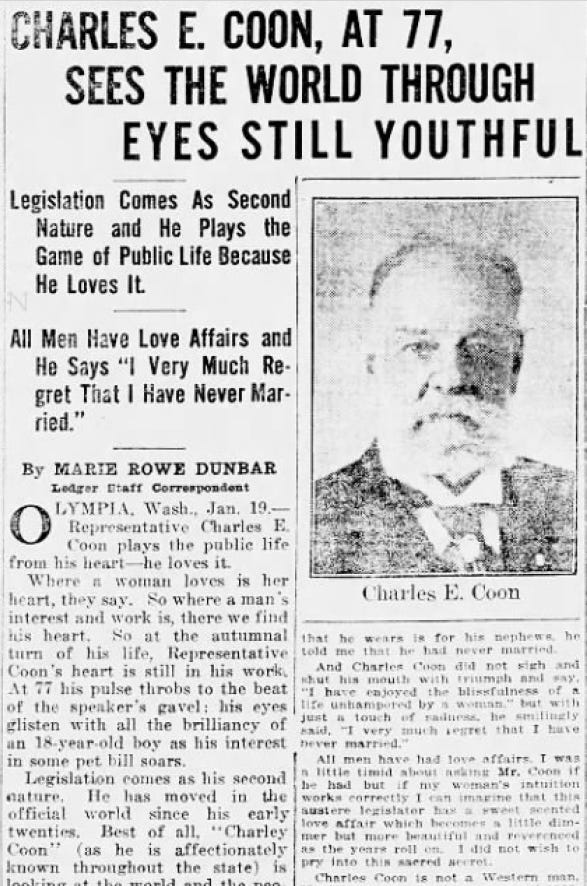
In 1919, the year before Coon died, Marie Rowe Dunbar wrote a feature about him for the Tacoma Daily Ledger. He was seventy-seven. The headline presented him as youthful still, a man whose eyes had not dimmed with years of public service. He loved the game of public life. Legislation came as second nature. His heart, the article said, was still in his work.
Then, before it had even gotten past the subhead, the article turned toward marriage: “All Men Have Love Affairs and He Says ‘I Very Much Regret That I Have Never Married.’”
Later in the article Dunbar wrote that Coon did not answer the question with a bachelor’s boast. He did not claim to have enjoyed a life unhampered by a woman. Instead, “with a touch of sadness,” he smiled and said, “I very much regret that I have never married.”
His sentence can bear more than one reading. It might be convention. Performance. Sadness. Protection. It might be true in the simplest sense. It might also be true in a more complicated one. Regret can attach itself to things never desired, things forbidden, things lost, things impossible, and things chosen too long ago to un-choose.
Dunbar sensed something beyond the sentence. “All men have had love affairs,” she wrote. She imagined, by what she called a woman’s intuition, that the old legislator had a love affair somewhere in the past, grown dimmer and more beautiful with years. Then she stopped:
“I did not wish to touch this sacred secret.”
It is one of the most humane sentences in the entire record about Coon.
After decades of newspapers circling Coon’s private life as scandal, gossip, charge, and weapon, here was a reporter choosing not to intrude. She did not solve him. She did not expose him. She did not demand that the old man hand over his interior life for public use. She marked the existence of a secret and left it sacred.
Coon was born in 1842. He came of age before the modern categories of language available to us now had settled into their present meanings. There were no neutral identity terms for what his enemies insinuated.
The words available to them were accusations, diagnoses, insults, moral verdicts, and threats.
The words available to his defenders were often silence, denial, character testimony, office, bearing, and respectability.
The words available to the household and the cemetery were kinship words: uncle, niece, sister, family.
The words available to the court were probate terms.
Each vocabulary kept something and lost something else.
The political vocabulary gave us scandal and denial.
The newspaper vocabulary gave us bachelorhood, appearance, rumor, and regret.
The legal vocabulary gave us deceased, resident, testate, and property.
The family and community vocabulary gave us Uncle Charlie.
None gives us the whole man.
Upon his death, the public notices returned to the one personal fact they all knew how to print:
“He was unmarried.”
The sentence had followed him for at least twenty-six years. In 1894, it sat at the end of a scandal story that would not name its charge. In 1919, it became the center of an interview in which he voiced regret. In 1920, it closed the life as if it were one of the necessary details, like age, offices, and burial.
“He was unmarried.”
True.
Insufficient.
There are many ways not to marry. There are many ways to love. There are many ways to build a household. There are many ways to become legible to one’s family and illegible to history.
Charles Coon’s public career can be revealed. His private life cannot. That difference was made by law, language, danger, decorum, family discretion, newspaper practice, political cruelty, and perhaps by Coon’s own discipline. He had lived long enough in the public eye to know what not to answer. He had lived through at least two eruptions in which unnamed charges against him were made to do public work. He had learned that some matters could not be noticed beyond denial.
And so, the record leaves us with a man who was simultaneously conspicuous and unreadable.
It leaves us with a mayor whose beard and height drew newspaper comment, a federal officer whose career encompassed both Washingtons, a politician who kept coming back, an old legislator whose heart was still in public work. It leaves us with an uncle in the Pragge household, a niece to whom he had bequeathed nearly everything, and a grave among family. It leaves us with “I very much regret that I have never married.”
It also leaves us with “I did not wish to touch this sacred secret.”
That may be as close as a record can come to mercy.
The harder work is to hold the evidence without making it say what it cannot: to notice the violence of the accusation without accepting its authority; to see in the household not absence but one of the many forms a life could take; to let the sacred secret stay sacred.
At 1028 Tyler Street, the house still holds the primary shape of Coon’s family life: people crossing thresholds, sitting at tables, climbing stairs, entering rooms, keeping papers, moving furniture, opening doors to callers, and making a life around the ordinary fact of one another.
Coon’s place in the house was not the grand public center he had occupied elsewhere. It was more intimate and, for that reason, less recoverable. But we know that home, for him, was refuge — and that he fought to keep the symbol of freedom flying in the front yard of the house at 1028 Tyler Street.
The record could make him an official. It could make him a candidate. It could make him a scandal. It could make him an uncle. It could make him a man who left an estate.
The court made its inventory. It named the lots, the shares, the stamps, the fees, the legatee, the executrix, the property to be distributed, and the trust to be discharged.
But it could not make an inventory of whom Charles Coon loved, what he feared, what he denied, what he protected, what the household knew, what the newspapers suspected, or what words he would have accepted for himself.
His estate could be settled; his life could not.
The rest is not ours to seize but to recognize as missing.

This essay draws on Jefferson County probate records for Charles E. Coon’s estate, including the September 3, 1920 decree of distribution in Superior Court probate case no. 770; United States census records; cemetery and family-plot evidence at Laurel Grove Cemetery; historic photographs from the Jefferson County Historical Society; and contemporary photographs and site observations at 1028 Tyler Street and the Taylor Street stairs above the Haller Fountain.
Newspaper sources include the Port Townsend Leader’s coverage of the Port Townsend Mercantile Company’s Flag Day distribution in June 1912; Mayor Coon’s April 1917 request that the city fly the American flag; the May 3, 1917 notice on his difficulties keeping “Old Glory” flying at home; and the June 15, 1917 coverage of the city’s Flag Day celebration and Taylor Street flagpole dedication.
The 1894 Columbia Athletic Club episode is drawn from the Washington Post, April 12, 1894, “Sent His Resignation,” and the Evening Star, April 21, 1894, on Coon’s resignation as confidential clerk to the quartermaster general of the Army.
The 1904 lieutenant governor campaign material is drawn from the Evening Statesman of Walla Walla, June 13 and June 28, 1904; the Spokane Spokesman-Review, June 28, 1904, “Mr. Coon Says It Is False”; and the Anacortes American, July 14, 1904. These accounts are treated here not as proof of the allegations they circulated or denied, but as evidence of the language, tactics, and public pressures surrounding Coon’s private life.
The 1919 interview and “sacred secret” passage are drawn from Marie Rowe Dunbar’s feature, “Charles E. Coon, at 77, Sees the World Through Eyes Still Youthful,” published in the Tacoma Daily Ledger on January 19, 1919.
Much of the archival and newspaper research behind this essay, and behind the larger Uncle Charlie sequence, was located by Joseph Lavy. Any errors of interpretation are mine.
Zhenya Lavy writes The Turret Journal from within the Adams Pragge House, an 1889 Victorian in Port Townsend, Washington, where she and her husband serve as stewards.
The Adams Pragge House is a three-suite bed and breakfast in Port Townsend, Washington. Learn more at adamspraggehouse.com.
→ https://adamspraggehouse.com
Related essays from The Turret Journal:
The Measure of a Man: Charles E. Coon and the Problem of Community Memory
Two Letters By Her Name: Julia Yesler Benson Intermela and the Adams Pragge House
Thanks for reading The Turret Journal