

The Turret Journal — Essay VII
A house does not survive more than 135 years by accident. What remains is not permanence, but continuity carried imperfectly forward.
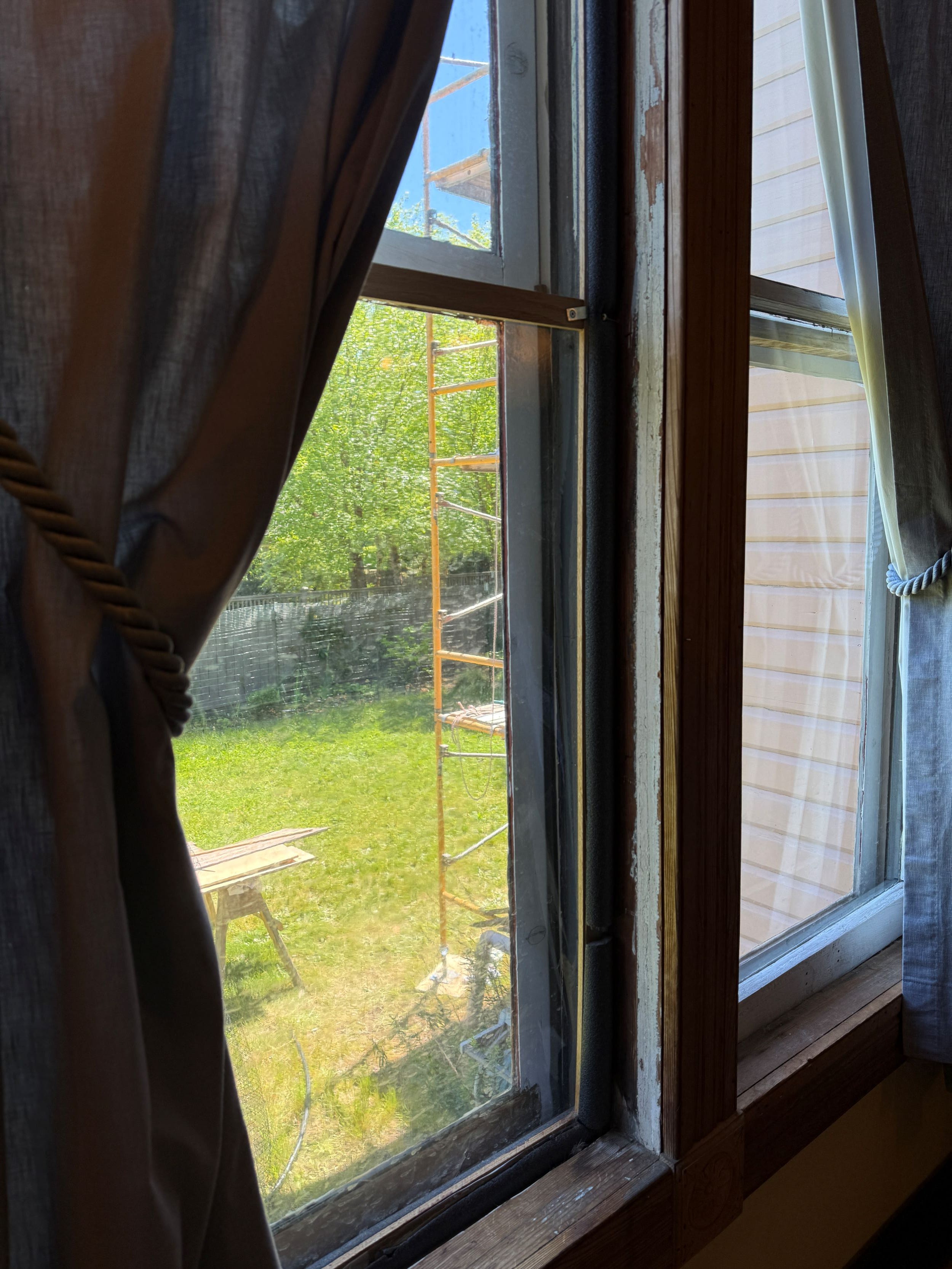
When we first toured the Albert C. Adams house at 1028 Tyler Street, it appeared to be in great shape from the outside. Inside told a different story.
The city had shut off the water. The buried propane tank at the rear of the property needed to be replaced. The house was still full — over-full, in fact: not staged for sale, not neutralized for future buyers, but deeply inhabited by the accumulated material of other lives and obligations still in motion. Statues stood in corners. Massive Tiffany floor lamps. Clocks. Barometers. Furniture from estates and embassies. Tools everywhere. Tables loaded with drawers of hardware, bins of parts. The parents of the previous owner, Marshall Raney, had been high-end antiques dealers, and after their deaths, much of what had passed through their lives passed, temporarily or otherwise, into this house as well.
Our earnest money paid to restore the water service and replace the propane tank before we arrived. A week or two after we moved in, Marshall had his brother install a new kitchen faucet that he’d already purchased.
He was holding a garage sale in the driveway and still had belongings on two floors of the house when we arrived with our moving van. For several weeks after closing, he remained in the process of moving out. Not lingering. Working. Undertaking the physical relocation — largely alone, in his sixties — of an enormous quantity of furniture, tools, antiques, architectural fragments, statuary, and equipment, which first had to have made their way across three floors, basement, and attic, into the garage to be organized and packed. Truckloads. Multiple protected storage units to coordinate. Decisions to make about objects accumulated across decades by himself, his parents, and even deceased friends.
The house was in active transition.
Today’s media and social spaces present a romanticized version of old-house life. Entire worlds exist online devoted to restoration and renovation: hidden fireplaces rediscovered behind drywall, original trim emerging beneath paint, dramatic before-and-after transformations presented in clean visual sequence. Even deterioration becomes aestheticized. And whether through excitement or exhaustion, the structure always appears to move steadily toward revelation.
We arrived carrying some version of that ideal with us. Having previously restored a 1917 Craftsman foursquare in Akron’s Goodyear Heights neighborhood, we understood that projects expand, budgets fail, and walls conceal surprises. But memory edits difficulty. And over time, what remains are the memories of meaningful discoveries, the accomplishment of stripped woodwork, the satisfaction of completion. The labor itself softens around the edges.
We learned, instead, that the house would tell us what needed doing — and that what it asked for would not always be what we expected.
In the earliest days, before our dozen moving pods had even arrived, some undone things seemed surprisingly simple. We found the missing globe for one of the foyer sconces sitting on the top shelf of a kitchen cabinet. It only needed cleaned and reattached. A half-painted piece of trim was solved by Joseph within minutes using a bucket of paint from the basement. There were small things everywhere that appeared, at least initially, to require almost no effort to complete.
I remember wondering why they had not already been done.
Not smugly, exactly. We knew enough to know there were things we did not yet understand. But there was still a kind of confidence in those early weeks — the confidence of people who had not yet encountered the scale of what remained invisible.
Because alongside those small repairs came the slow realization that, more than a house, we had inherited an accumulation of systems, adaptations, compromises, and unfinished decisions extending across generations. Pipes crossed the basement ceiling in dense and unlabeled paths, disappearing upward through three floors. Walls concealed altered uses and patched surfaces. The entire structure bore the narrative of changes in convenience and technology across more than 130 years.
One of the first major problems we tackled announced itself through water.
The house has a hydronic heating system, designed and installed by former owner and local plumber Ron Nowak in the 1960s. It was the house’s first centralized heating, and the fuel-oil furnace still powers the system sixty years later. But during a winter cold snap sometime before we purchased the house, a pipe had burst somewhere inside the walls while Marshall was away and had not been repaired. He had warned us about the leak: When the furnace was turned on and pressure returned to the system, water would rain down through the top of the doorway between the kitchen and what we now call the drawing room.
The visible leak, however, was not necessarily the source.
Marshall had theories about how we might find it. While we had hoped to work together to do so, we weren’t able to collaborate on this project before Marshall completed his move. And as our first summer turned toward fall, Joseph and I found ourselves puzzling over how to handle it. We had some tradespeople in to look at it — including Ron’s successor, Scott, who arrived in the original Nowak Plumbing truck — but none thought it was a job for them to take on, so we were on our own.
We started with the obvious: opening the wall above the doorway. Instead of finding the source of the problem, we found the beginning of another realization: every opening into an old house creates additional obligations. Walls are not abstract barriers. Once opened, they must later be repaired. In some cases that means plaster must be matched. The surfaces must be restored. Paint reconsidered. Rooms reassembled.
And immediately the scale of risk changes.
If we guessed wrong, we might end up opening walls across multiple floors, including in finished guest suites above the kitchen. Suddenly even locating a leak became a question of strategy, restraint, and acceptable damage.
What followed was less renovation than investigation. Listening. Studying. Trying to understand how water might have traveled internally through the structure to arrive at the top of that doorway. Joseph spent weeks tracing possibilities mentally before finally deciding to open a small section of ceiling in a remote kitchen corner on an exterior wall.
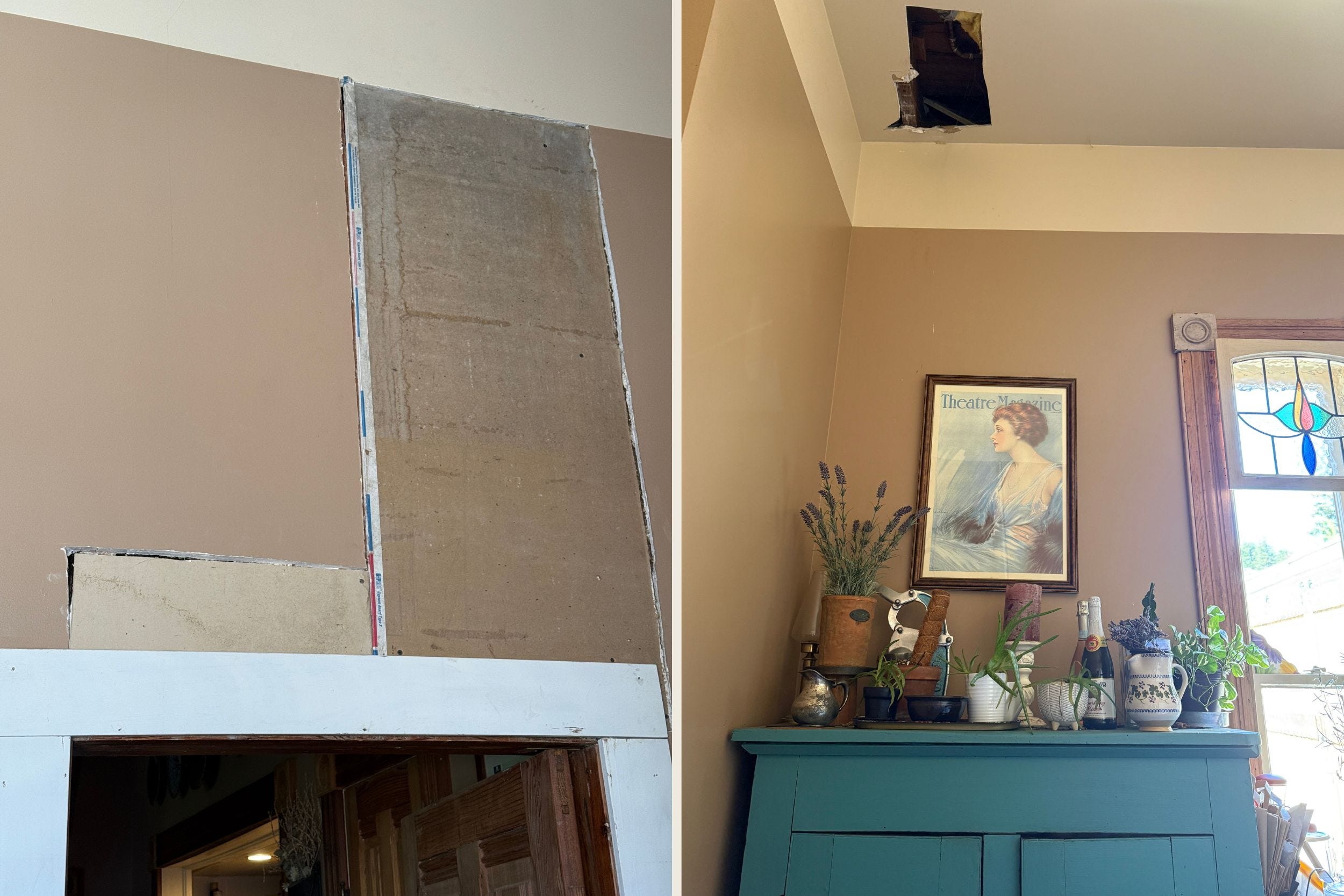
The opening was scarcely larger than a foot square.
Very fortunately, the leak was there.
A neighbor offered to solder the pipe. On October 11, 2022, we took our first delivery of fuel oil and started using the furnace.
But a slow leak at the site of the repair revealed itself almost immediately. We waited to repair the wall and ceiling, and for the next year we kept a bowl under the leak, emptying it every few days.
A year later, on October 10, 2023, Joseph texted me that Scott had agreed to fix the leak for good and would arrive in two days.
And today, nearly three years later, the leak is fixed — but the openings in the wall and ceiling remain unrepaired.
Not forgotten.
Simply overtaken by other priorities.
The house was beginning to alter our understanding of what unfinishedness meant.
At first, we still imagined stewardship primarily in terms of accomplishment. We began to understand it more often as negotiation.
The house has repeatedly changed our understanding of scale. Some projects we feared became unexpectedly manageable once the structure revealed another path of access or another layer of logic. Others expanded almost immediately beyond what we imagined possible.
For our first three years here, I worked in what had once been the butler’s pantry behind the dining room. We’d converted the space into my office because I no longer wanted to spend my workdays isolated away from the life of the family as I had during the pandemic in the daylight basement of our previous house. The old butler’s pantry has two seven-foot windows facing the morning light.
At first I arranged my desk to face those windows. As I learned how overwhelming the sun reflecting off the bay can be on this weather side of the house, I turned the desk to face an adjacent wall.
Ironically, the very same day Joseph had texted to say the final pipe repair was scheduled, at 5:25 p.m., I texted back: It’s raining in the office.
Not heavily. Not dramatically.
But enough.
The rain was blowing in sideways through the weather-side windows and reaching me where I sat several feet inside the room.
So before one water problem was fully fixed, with the end finally in sight, we had another — and instead of heat, windows became a priority.
We already knew the windows in the butler’s pantry were problematic. Marshall had pointed them out when we purchased the house. One didn’t even have sashes in it, just a storm window.
The day it rained inside, we discovered that the lower rail on the storm had deteriorated so badly it had fallen off. There wasn’t an easy option for repair. There was simply open space between the glass and the sill, between me and the elements. At first I stuffed towels into the gap. Later, I cut down a blue pool noodle and wedged it along the opening to block the draft.
For more than a year, this was genuinely our solution.
The pool noodle periodically fell out. The side exposed to the weather slowly bleached in the sun. I suspect the neighbors wondered what exactly we were doing. I joked about my pool noodle with colleagues.
But we knew it needed proper correction. Somewhat sheepishly, we contacted Rain Shadow Woodworks, whose reputation in town for historic window repair is unparalleled.
On an early fall day in 2023, Rain Shadow’s owner and master craftsman Seb Eggert walked through the house with us, examining not only the weather side but all 53 of our windows, assessing various conditions. He placed us on Rain Shadow’s schedule for restoration work, and at the time, I think we imagined this meant the problem would be resolved for winter.
As I write this in May 2026, two and a half years later since Seb’s first inspection, their crew is finally here installing 17 rebuilt sashes.
In the intervening years, my silly blue pool noodle gave way to other temporary strategies for keeping bugs out in the summer and heat in during the winter. We experimented with window insulation film, though the ornate profile of the wood trim made modern sealing systems difficult to apply cleanly. Joseph eventually transferred functioning sash components from another part of the house in order to improve one side of the set. He also built custom inserts using a heavy, transparent plastic sheet and insulating foam around a thin, 29” x 84” wooden frame.
The work became iterative.
Adaptive.
Seasonal.
Prolonged negotiation with imperfect conditions.
Our new focus on windows also has revealed new layers.
For example, the turret windows on the third floor are not glass at all. They are plastic. Beautifully done, convincing enough that we lived here a year before realizing it, but nevertheless plastic replacements for the original glass that were installed sometime during or after World War II.
At first this discovery felt disappointing, as though some authenticity had been lost. But the longer we live here, the less stable the idea of authenticity itself becomes.
Curved glass suitable for turret windows is still manufactured, but it commands a premium price easily 30 to 50 percent over flat glass. Under what circumstances had our turret windows needed replaced? Could previous stewards realistically have sourced or afforded such replacements given their own prioritization of projects? What matters more: continuity of material or continuity of form? If the choice decades ago was between improvised replacement or losing the windows altogether, does the substitution become failure — or survival?
The house resists clean answers.
Original or early wavy glass remains throughout much of the structure. Many windows have flat glass dating from after 1940. In other locations, windows have changed function entirely. What once was an exterior window now looks out to the utility room of the addition. And one of the original windows in the Victoria Suite had been converted to a door sometime many decades ago based on photo evidence, likely during one of the house’s periods as a boarding house. As part of our current window project, we asked Rain Shadow to restore that door to window form again. Although the sash pulleys had partially disintegrated from prolonged weather exposure, the original hardware still survived inside the opened cavity. As of last week, it’s possible to glimpse the evening sunset from that room again — and the new light completely changes the character of the suite.
Even the rooms themselves contain layered evidence of earlier lives.
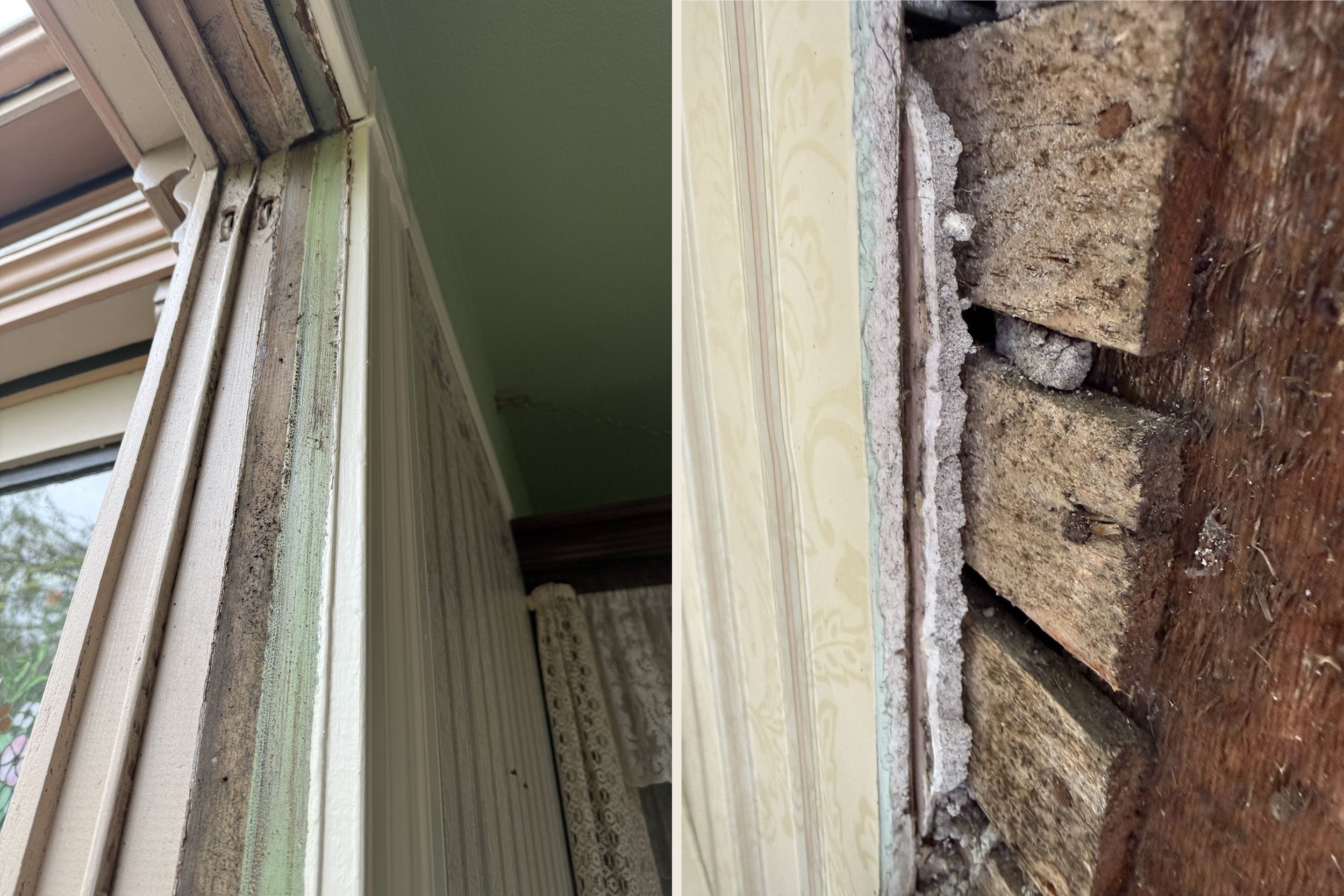
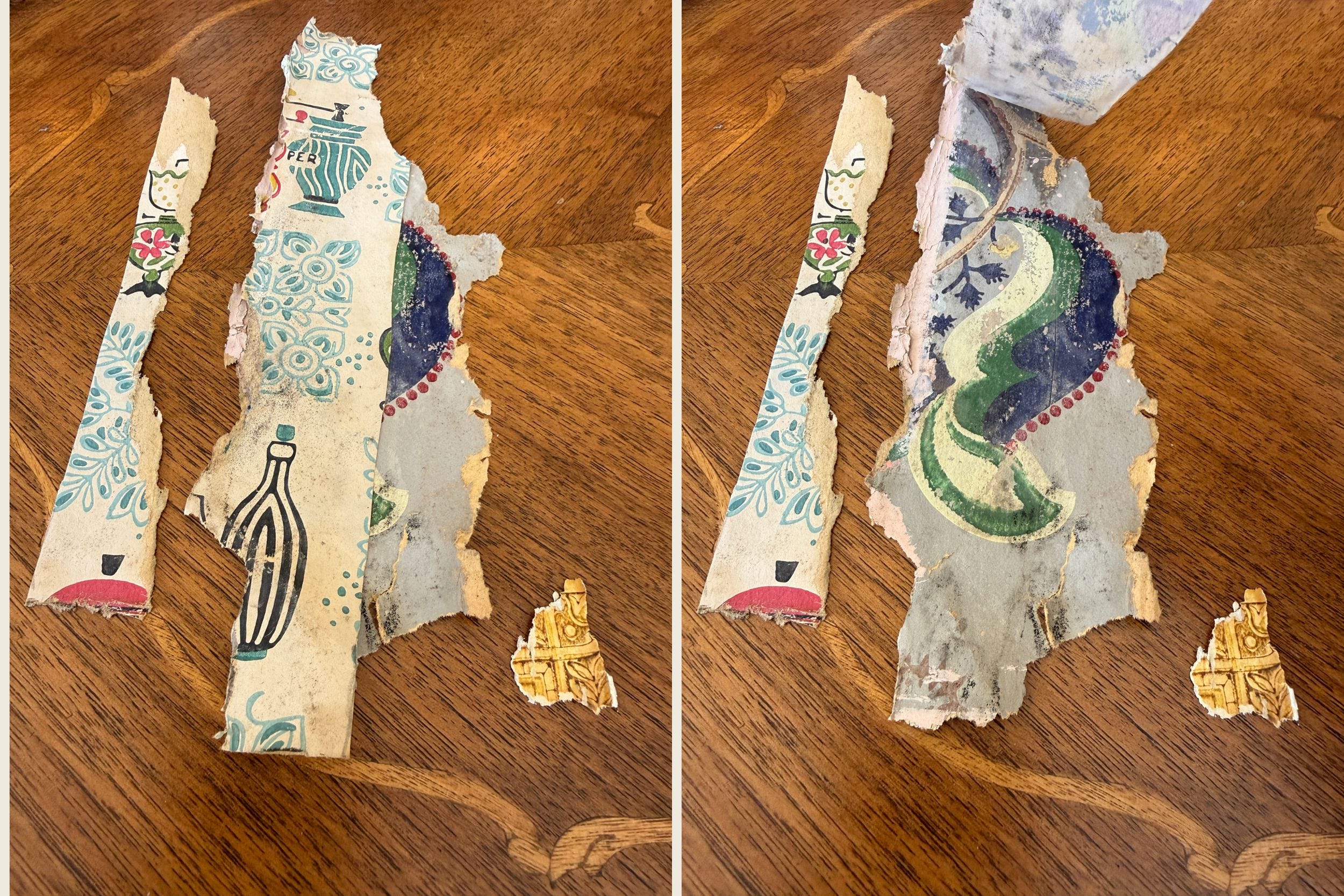
While Rain Shadow had the framing open for work on the Victoria windows, we could see layers of historic exterior paint colors. We also observed that the original plaster and lath still survives beneath a thin layer of plywood installed long ago to stabilize or conceal failing plaster before wallpaper was added above it. Joseph was even able to retrieve fragments of earlier wallpaper from within the wall cavities. The top layer appears to date from the 1940s or 1950s: little pepper grinders and bottles in blue and green on white, suggesting that at one time this second-floor space contained a kitchenette if not a full kitchen — likely during the house’s boarding-house years. The bottom layer appears to be hand printed in the kind of pattern chosen for a bedroom or private sitting room. Another early scrap, pulled from what is now an en suite bathroom, reads entirely differently: a gold ground, subdued and close.
The walls reveal succession.
And increasingly, that feels true of the house as a whole.
Every layer reveals adaptation to changing forms of living: Heating systems added in the 1960s. Propane conversions. Capped stove pipe holes and clipped telephone and coaxial cables. Storm windows. Reconfigured rooms. Covered plaster. Reused hardware. Temporary repairs that lasted decades. Interventions that once appeared contemporary and permanent, then slowly became historical themselves.
We recognize, through this house, how even our own supposedly “timeless” decisions for our first house would be considered dated now. The wallpaper we had carefully selected had felt restrained, classic, and entirely appropriate to that 1917 structure. But looking at it now in photographs, it is unmistakably of its own 1990s era. Not wrong, necessarily. Simply visible historically in ways we couldn’t perceive at the time.
Perhaps every generation experiences at least part of its own taste as neutral. Then time passes, and what seemed invisible becomes the most visible thing in the room.
The fantasy that restoration returns a house to some singular authentic state becomes increasingly difficult to maintain. Every restoration is itself historically situated — shaped by the materials available, the technologies affordable, the aesthetics current, the labor possible, the economic pressures present, and the assumptions invisible to the people making decisions at that moment.
A completed renovation is not timeless.
It is another layer future stewards will eventually inherit.
That realization has changed how we think not only about our own work here, but about the work of those who came before us.
When we first arrived, certain absences frustrated me. Decorative sconces had been removed. The parlor mantle was gone. Various projects remained visibly incomplete. At first it was difficult not to experience these as losses due to someone else’s decisions.
But eventually we acquired our own unfinished projects.
Our own temporary fixes.
Our own evidence of compromise.
What is now the Olympia Suite bathroom was in disarray when our offer on the house was accepted. In order to satisfy the appraisal required for closing, we worked collaboratively and quickly to bring the room into functional operation. Joseph’s mother purchased the vanity. Our realtor and her handyman traveled from Seattle with plumbing fixtures and completed installations. A clawfoot tub sat inverted in the middle of the room with a red-painted exterior that Joseph later repainted white. Marshall had installed a heated tile floor but not connected it to power, and the controller itself had disappeared somewhere within his own drift of parts and projects throughout the house.
Nearly two years later, he found the controller and brought it to us.
Even now, after we attempted to install the controller, the heated floor isn’t functioning and will require electricians for further investigation.
The bathroom became operational long before it became complete.
And perhaps that distinction matters more than we initially understood.
We opened the Adams Pragge House to guests while still actively learning how to live within it ourselves. Historic houses do not cease evolving simply because they become operational. The house had to begin sustaining itself. Suites and public spaces could be elegant and welcoming while systems, walls, and future projects continued unfolding behind them.
Guests encounter atmosphere, comfort, hospitality, light, architecture, breakfast tables, flowers, conversation, the continuity of the house as lived experience. They do not encounter the electrical panel hidden on the third floor that eventually allowed us to bring electricity into two rooms that previously had none. They do not see the plaster blowout still waiting around outlets installed three years earlier after electricians navigated the complexities of the roofline to make those rooms inhabitable for our adult daughter and future workspaces. They don’t see the patched but unfinished drywall above the kitchen door.
Nor should they.
Even the smaller restorations here have begun to feel less like acts of recovery than acts of participation.
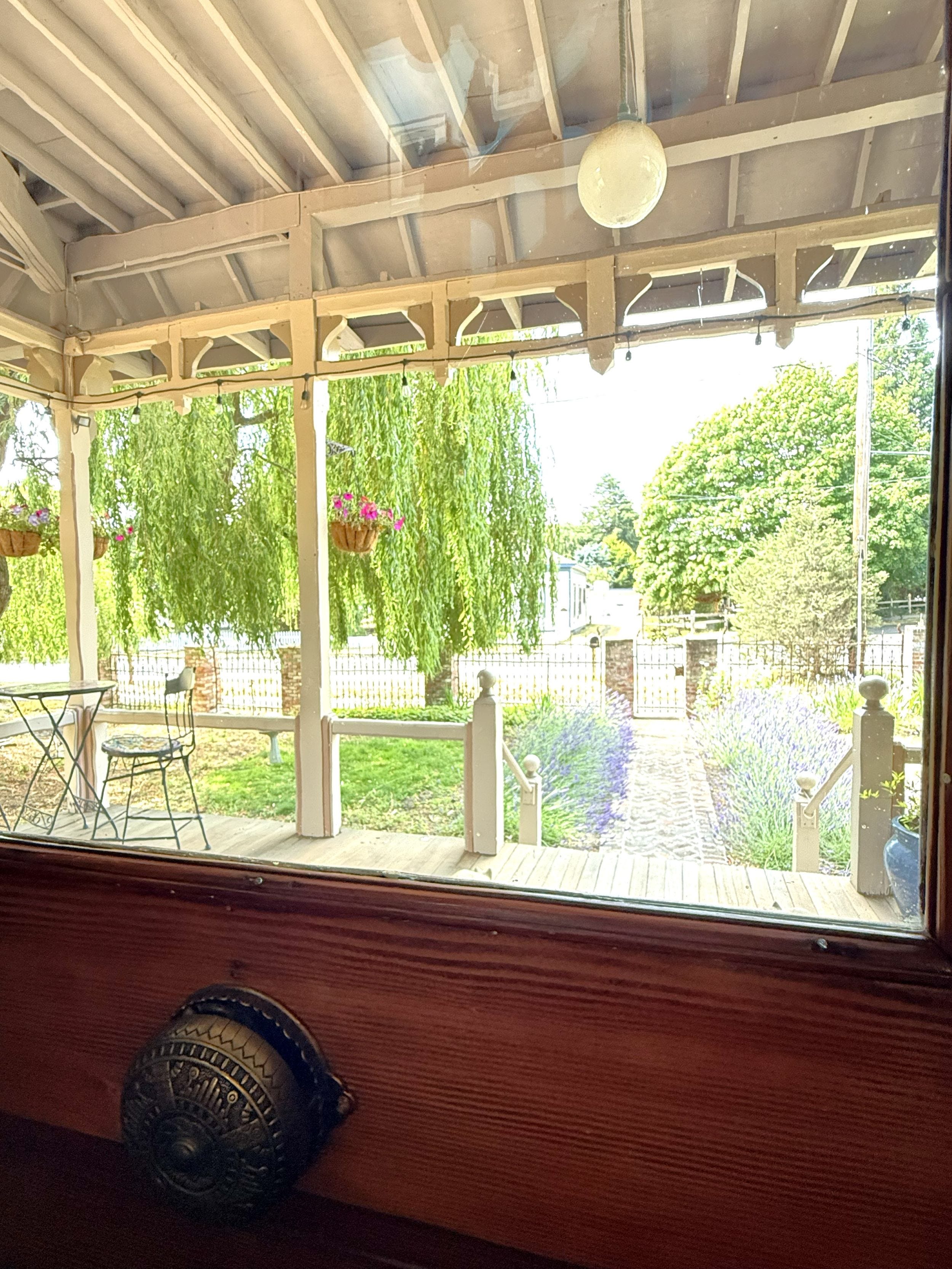
An antique bell on the front door, long nonfunctional, rings again because Joseph became fascinated enough to reverse-engineer the mechanism from surviving fragments and examples of similar bells. Its sound is unexpectedly grand — the kind of resonant ringing intended for formal arrivals at the front entrance of a very large house.
Nothing required him to make that repair. Another, functional and more modern doorbell had long since been installed.
Repairs like that matter because they continue the layered life of the house rather than reducing it toward utility alone.
That reduction happens gradually. Rarely through catastrophe. More often through convenience or comfort. A detail may be omitted because reproducing it is expensive. A repair simplified because labor is scarce. A replacement chosen because it is easier to source. Over time, enough small simplifications accumulate that the structure survives while much of its originality and particularity disappears.
I think about contemporary real-estate culture and how it may accelerate this further. Increasingly, houses are staged not as records of lived continuity, but as speculative projections for future buyers. Evidence of prior inhabitation is minimized. Rooms are neutralized. Surfaces simplified. Histories softened into marketability.
But old houses are not naturally neutral.
They are accumulations.
The house at 1028 Tyler Street did not greet us as a clean slate awaiting our imagination. It arrived crowded with evidence of prior stewardship, prior labor, prior attachment, prior incompletion. It still does.
Even now, the current window restoration has been revealing additional work beyond the original project scope: vulnerable exterior boards likely to fail in future storms, old vent patches requiring proper repair, missing metal flashing that perhaps always should have existed based on surviving evidence elsewhere on the house. Every intervention reveals adjacent needs.
The work expands contiguously.
One exterior wall painted this year. Another the next. Seventeen windows restored as resources allowed. A repair delayed until access aligns with another project.
Because houses like this exceed any single, final moment of completion.
This spring, we discovered that the current owners of our old Akron house have enclosed the front porch where we once spent so many mornings sitting together, eating strawberries and improvising absurd haiku. We had worked so carefully to honor what we understood to be the spirit and architecture of that house, but its life continued beyond us. Other owners arrived with other needs, other preferences, other interpretations of livability and beauty.
Perhaps that, too, is part of stewardship.
Not permanence.
Participation.
The longer we live here at the Adams Pragge House, the less convincing the idea of a “finished” house becomes.
There are still walls unopened. Systems only partially understood. Projects deferred until time and resources allow them to be done properly. Repairs that may never happen exactly as we currently imagine them. Layers still waiting beneath other layers.
The house remains in motion.
And perhaps that is what stewardship finally is: not completing a structure, not returning it to an impossible original condition, but participating for a time in its ongoing continuity — measured at human scale — before handing its unfinishedness forward again.
Zhenya Lavy writes The Turret Journal from within the Adams Pragge House, an 1889 Victorian in Port Townsend, Washington, where she and her husband serve as its stewards.
The Adams Pragge House is a three-suite bed and breakfast in Port Townsend, Washington. Learn more at adamspraggehouse.com.
Related essays from The Turret Journal:
Seems like your Adams Pragge House is a living breathing entity. Quirks and corners hidden until you find them. Beauty at every turn. When seeing the view off the front porch; who cares that there is unfinished plaster. Beautiful wander through your explorations and uplifting to a person who has lived in many works in progress homes. Thank you for sharing this story.